The Framework Gordon Left Behind: Sir Arthur Gordon in Fiji, 1875-1880
Sir Arthur Gordon and the framework he left behind. Read the FPR Portrait.


FPR Portrait returns to the primary sources: the letters, the records, the documents to look at Fiji's historical figures.
Sir Arthur Hamilton Gordon, First Governor of Fiji, 1 September 1875 – January 1880
On a Wednesday in September 1875, Sir Arthur Gordon read the Royal Charter of the Colony of Fiji, took the oath of office, and delivered "a little speech" from the front steps of Government House in Nasova. The steps were covered with matting and, unusually, a Serbian carpet. A large crowd gathered in the square below, while a ship in the harbour was decorated with flags. That morning, Fiji officially became a British colony, and Gordon was appointed its first Governor.
Before arriving in Fiji, Gordon had governed New Brunswick, Trinidad, and Mauritius, and was recognised by British Liberals as a conscientious colonial administrator. As the son of a former British Prime Minister, he maintained close contact with William Gladstone. Gordon’s experiences in Fiji left a lasting impact. Gladstone had served as Chancellor of the Exchequer under Gordon's father, the 4th Earl of Aberdeen, who was Prime Minister from 1852 to 1855.
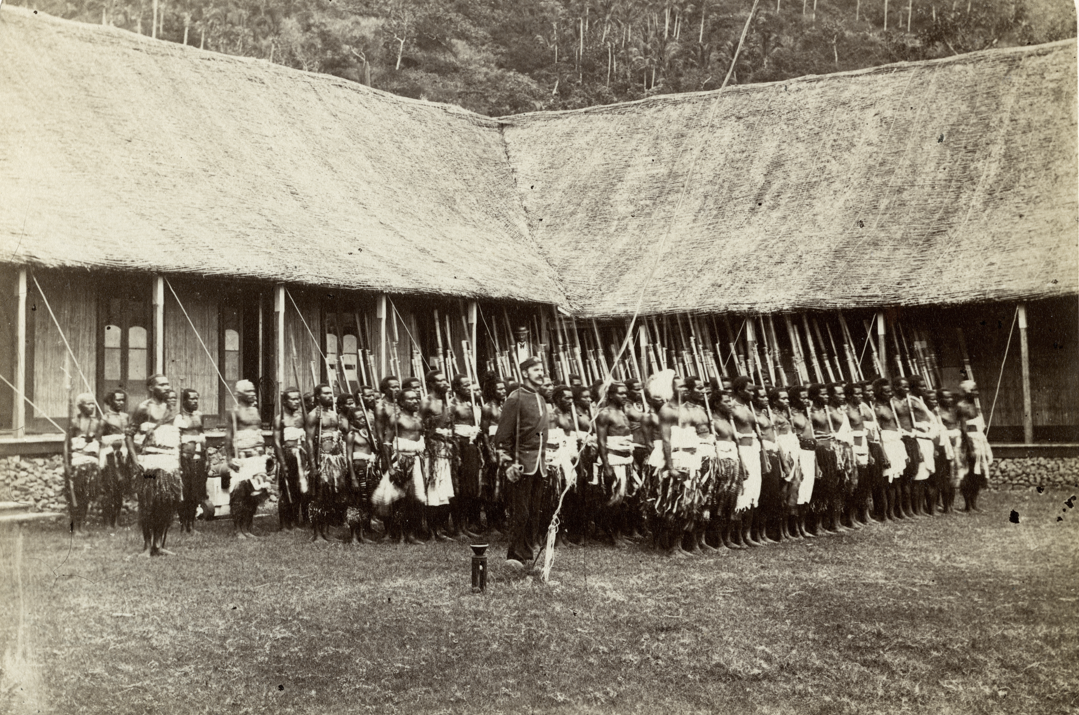
On his first afternoon, he convened the Legislative Council and enacted four Ordinances. The third Ordinance halted all ongoing land claims in the Colony’s courts, while the fourth established a Commission to resolve disputes between Europeans and iTaukei. Within hours, Gordon suspended all land cases and began forming the Lands Commission, preferring that ordinary courts not handle land issues.
Six months earlier, a measles epidemic introduced by a British warship had spread throughout the islands. In his words, "Pestilence, heedlessly admitted, had swept away one-third of the entire native population." The impact was uneven, with coastal villages emptied and some inland communities suffering even greater losses. The Cakobau government struggled to respond, and during the crisis, the Colony transitioned from provisional administration to Gordon’s Royal Charter. He assumed leadership of a nation in mourning.
He also encountered an environment that concerned him. Between Cession and his arrival, white settlers told the iTaukei that annexation to Great Britain had abolished their laws and customs, ended their rules of succession and property transmission, made many of their traditions illegal, transferred their lands to the Crown, and would require them to work on white men's plantations. The iTaukei were further told that "all distinctions of rank among them were at an end," which Gordon noted, in its suddenness, was more perplexing than pleasing to the people generally, and which naturally caused irritation and distrust among the higher Chiefs."
In the interior, many believed the measles outbreak was caused by deliberate poisoning. Gordon acknowledged in a dispatch that this belief was "encouraged, I am ashamed to say, by some of our own countrymen," and considered it the main cause of the highland uprising the following year. Meanwhile, on the plantations, indentured labourers whose contracts had ended but who could not return home were living in what he described as "extreme misery."
Gordon arrived in Fiji with a distinct political background. As a mid-Victorian Liberal from an aristocratic Whig family, his views were shaped by his role as private secretary to his father, the 4th Earl of Aberdeen, during the Peelite-Liberal government of 1852–1855. He embraced the humanitarian aspects of Gladstonian liberalism and the Burkean doctrine of trusteeship. Gordon believed the colonial state should protect iTaukei society from direct involvement in the money economy, settler land acquisition, and common-law property transactions. He also maintained that the state should hold iTaukei interests in trust, with European-trained administrators making decisions until iTaukei society reached a level of development he considered comparable to modern Europe, within the stadial model of social progress he had absorbed from his education. The first belief produced the land protection framework the TLTB still administers. The second resulted in the ongoing exclusion of iTaukei landowners from ordinary legal remedies.
His clearest early articulation of the philosophy came in a dispatch to the Earl of Carnarvon, Secretary of State for the Colonies, dated 30 October 1875. It opens: "One of the most important questions which I have had to consider since my arrival here, is the degree and measure in which native laws and customs should be preserved in force, and how far English law should be at once generally introduced."
He determined that, while state law would apply in principle, the law of the vanua would prevail in practice. His predecessor, Sir Hercules Robinson, had instructed Stipendiary Magistrates to avoid involvement in native cases except for serious crimes, a position Gordon endorsed. Although this appeared to respect iTaukei custom, it effectively left some laws outside state control while preserving the state's authority to intervene as needed. This approach later influenced the Constitution, which recognises iTaukei land ownership but delegates decisions about that land to ordinary laws. Gordon set this precedent from the outset.
First, Gordon shifted land matters from judicial to administrative processes. Unlike the adversarial, evidence-based, and appealable judicial process, administrative decisions rely on the discretion of executive-appointed officials. Since then, land issues in Fiji have rarely returned to ordinary courts. The iTaukei Land Trust Board, foreshore decisions, and mining consents are all managed administratively. The Native Lands Commission he established confirmed that specialised state bodies, rather than the common law that applies to other property, would govern iTaukei land.
Second, the state, rather than the vanua, determined what constituted iTaukei land. The Commission investigated, recorded, and registered land, producing the Native Lands Register, which formalised mataqali boundaries. This process transferred boundaries from vanua knowledge to a state-maintained register, which remains the foundation for all current iTaukei land records.
Third, by excluding land matters from ordinary courts because of perceived incompatibility between iTaukei custom and English law, Gordon set a precedent in which "protection" of iTaukei interests also meant exclusion from standard legal remedies. iTaukei landowners have not had the same direct access to courts for land disputes as other Fijian citizens have for their property. Both the protection and exclusion were intentional, originating from the decision on 1 September 1875.
Two years later, in a memorandum regarding a land claim by the Wesleyan Mission, Gordon was asked to determine ownership of foreshores and reefs. The missionaries had purchased "the reefs between high and low-water mark from the natives" and argued that Fijian deeds referring to the sea as a boundary meant the sea at low water or the outer edge of the reef. Gordon rejected this, stating that accepting the claim would be "to yield up nearly the whole of the foreshore and reefs of Fiji to private hands." He clarified: "Her Majesty's Government consider the foreshores of Fiji generally to be the property of the Crown." In July 1878, when the Wesleyans raised the issue again through Colonial Secretary John Bates Thurston, Gordon's response was summarised by Thurston: no claim "could possibly be entertained to reefs over which, for twelve or sixteen hours in every twenty-four, the sea, common right of way to all men, held undisputed sway." This principle became the foundation for current law. Today, Cap 132, the Crown (State) Lands Act, enshrines this concept.
In May 2026, the iTaukei Land Trust Board asked the Fiji Law Reform Commission to restore foreshore and inland waterbed ownership to iTaukei landowners, reversing Gordon’s 1877 and 1878 position. Gordon’s statement regarding the tide was a legal, not merely geographic, assertion. Before his argument, Fiji’s reefs had customary owners, but they lost that status when his legal view prevailed.
By the last years of his governorship, Gordon had formalised a tiered political system across the whole colony. The lower tiers rested on pre-existing vanua institutions, which Gordon codified into named administrative units. The village was the base unit, with a local chief "practically hereditary, but nominally appointed by the District Council." Several villages made up a Buli district, where the Buli convened monthly meetings of town chiefs in the Bose ni Tikina, or district council. The Buli districts were grouped under twelve Roko Tui, each of whom gathered the Bulis of their province in the Bose vaka Yasana, the provincial council. At the highest level, Gordon introduced "a meeting annually of the Roko Tuis with myself, thus completing the chain from the village to the Governor. This Bose vaka Turaga, or Great Council".
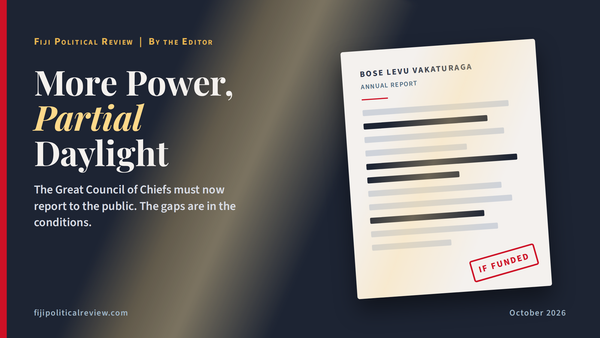
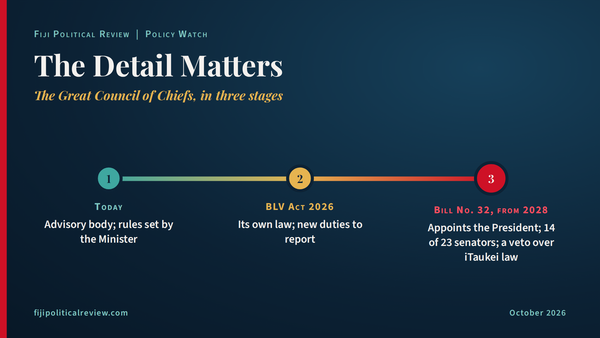
The Bose vaka Turaga preceded the Bose Levu Vakaturaga, or Great Council of Chiefs. The council was abolished by decree in 2012, reinstated by regulation in 2024, and in September 2026, Cabinet supported establishing it through a stand-alone Act. Each change has been a state decision, altering a structure Gordon described as "purely native, and of spontaneous growth" to which he had "added" the annual meeting with the Governor. The state has continued to modify what Gordon began.
He publicly explained this system on 18 March 1879 in a paper presented to the Royal Colonial Institute in London. Officially titled Paper on the System of Taxation in Force in Fiji, it appeared to focus on the native tax he introduced. In fact, it defended the entire framework: the layered chiefly system, tax collection in produce rather than money, protection of iTaukei land from sale, and the supporting political structure.
The framework faced criticism. Some settlers wanted land and labour to become commodities more quickly, while others within Gordon’s administration also raised concerns. His Attorney-General privately argued that the produce tax amounted to state-run forced labour. Gordon responded, both in Suva and London, that a money tax would force iTaukei to sell produce "at a sacrifice" and would harm them more than the produce tax. He viewed his actions as protecting the vanua from a harsh monetary economy.
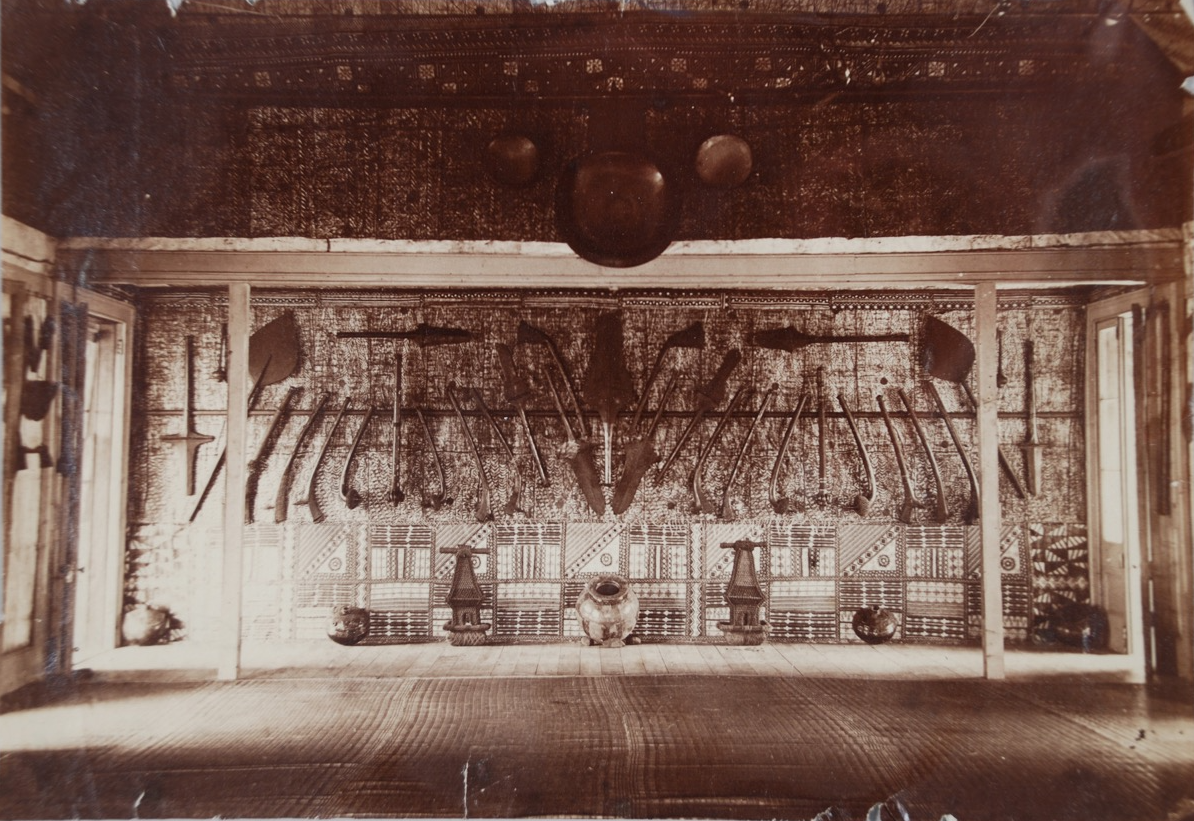
This self-image was evident within his household. In March 1876, Constance Gordon Cumming, a guest at Nasova, wrote to her sister that the dining room at Government House was "so infinitely preferable to any attempt at making a Europeanised 'Government House,' and so much more suitable to Sir Arthur's rôle of premier chief of Fiji." Only six months into his governorship, this perspective had already shaped the household’s language. Cumming called Gordon a chief.
Gordon offered the London audience a memorable comparison, stating that Fijian society "is not that of England in the present day, but more nearly resembles that of the Highlands of Scotland some three or four hundred years ago, or that of the remote parts of Ireland in the days of Queen Elizabeth." For Gordon, Fiji represented an early version of Britain, with institutions that should be protected from exploitation and allowed to develop gradually. This framing was intentional, supporting the case for indirect rule: the vanua would be governed by a state that viewed it as a younger version of itself.
Gordon left Fiji in January 1880, after serving as Governor for four years and four months. In that time, he had codified the Roko Tui offices, formalised the provincial councils, added the annual Bose vaka Turaga at the apex, developed the foreshore and reef doctrine, drafted the early mineral vesting framework, and built a legal system that made the vanua appear self-governing while placing real decisions under state law. Gordon's paternalist theory rested on six premises. He viewed iTaukei society as an organic order worth preserving. He believed, within the Scottish Enlightenment framework he had absorbed, that iTaukei people were at an earlier stage of social development rather than fundamentally different. He argued that direct exposure to settler commerce and British common law would be harmful to them. The state should therefore hold their interests in trust until maturity. European-trained administrators would make decisions on their behalf. This protection required excluding them from ordinary legal remedies.
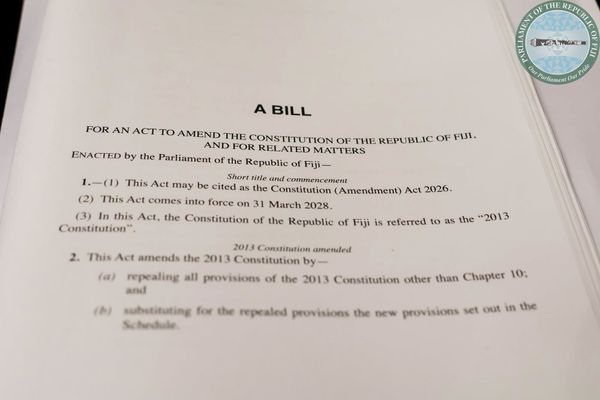
The Deed of Cession was signed on 10 October 1874. Fiji regained independence ninety-six years later, on 10 October 1970. The 2013 Constitution was drafted under a government that had abolished the Bose Levu Vakaturaga by decree the year before. The Constitutional Review Commission delivered its Report and Draft Constitution of the Republic of Fiji 2026 to President Ratu Naiqama Lalabalavu on 31 August 2026, and tabled the Draft in Parliament on 22 September. The TLTB's May 2026 submissions to the Fiji Law Reform Commission ask for the return of foreshore, waterbed, and mineral ownership to iTaukei landowners. Cabinet's September 2026 decision endorsed a stand-alone Act. Parliament unanimously passed that Act, the Bose Levu Vakaturaga Act 2026, on 1 October 2026. The Constitution Amendment Bill 2026 also entrenches BLV constitutionally in its own chapter, giving it the power to appoint the President and Vice-President and to advise on 14 of 23 Senate seats. The Bill cleared its second reading on 2 October (36–5, 9 abstentions) and now sits with the Joint Parliamentary Select Committee for 30 days of public consultation before third reading and referendum.
Each of these questions, of land, of chiefly authority, of constitutional form, sits inside the framework Gordon left behind. His voice, in Volumes 1 and 3 of Fiji: Records of Private and of Public Life 1875-1880, records how it was made. Reading him now, in his own words, is not incidental to the constitutional moment Fiji is navigating. It is the record of how the framework was made.
This is the second entry in the Portrait series by FPR. The series returns to sources, including letters, records, and documents, to examine individuals who have shaped Fiji's history. The first Portrait, featuring Ratu Sir Josefa Lalabalavu Sukuna, is available on the FPR website.
References
Primary sources
Sir Arthur Gordon (Lord Stanmore), Fiji: Records of Private and of Public Life 1875-1880, Volume 1. Edinburgh: R. and R. Clark, 1897. National Library of Australia. Passages cited from book pages 174-175, 194-195, 300.
Sir Arthur Gordon (Lord Stanmore), Fiji: Records of Private and of Public Life 1875-1880, Volume 3. Edinburgh: R. and R. Clark, 1897. National Library of Australia. Passages cited from book pages 209, 367.
Sir Arthur Gordon, Paper on the System of Taxation in Force in Fiji, read before the Royal Colonial Institute, 18 March 1879. London: Harrison and Sons, Printers in Ordinary to Her Majesty, 1879. Reproduced in Volume 3 of Fiji: Records of Private and of Public Life 1875-1880, at pages 13-14 of the paper as reproduced.
Constance Gordon Cumming, letter to her sister, 28 March 1876. Quoted in Museum of Archaeology and Anthropology, University of Cambridge, catalogue record for P.27782.VH. [Verify against At Home in Fiji (1881) or Cumming's papers before publication.]
Legislation
Constitution of the Republic of Fiji 2013.
iTaukei Land Trust Act (Cap 134) (Fiji).
Crown (State) Lands Act (Cap 132) (Fiji).
Mining Act (Cap 146) (Fiji), s 3(1).
iTaukei Affairs (Great Council of Chiefs) Regulations 2024 (Fiji).
Bose Levu Vakaturaga Act 2026 (Fiji), passed by Parliament 1 October 2026.
Constitution (Amendment) Bill 2026 (Fiji), Bill No. 32 of 2026, Parliament of Fiji, 150 pp. Tabled for first reading on 30 September 2026; cleared second reading on 2 October 2026.
Related FPR analysis
From the Hospital at Lyon: Ratu Sir Lala Sukuna, Fiji Political Review, May 2026.
Ceremony as Constitution: The Tui Nayau and the Limits of Written Sovereignty, Fiji Political Review, September 2026.
iTaukei Land Legislation and Vanua Consent: The Framework the Constitution Delegates, Fiji Political Review, September 2026.
Ten Months to Five Weeks: The Compressed Public in Fiji's Constitutional Review, Fiji Political Review, September 2026.
Read more analysis at fijipoliticalreview.com