What the Law Actually Gives the Great Council of Chiefs
Fiji's Great Council of Chiefs now has a statute of its own, and Bill No. 32 would entrench it in a new Constitution. Together, the two measures shift real power to the chiefs while leaving gaps that will be harder to close after 2028.

Update, 2 October 2026: Bill No. 32 passed its second reading on 2 October and now goes to a Special Committee. The Attorney-General's Office expects a third reading in the week of 2 November, requiring two-thirds of all MPs, and a referendum on 9 December 2026, subject to the President issuing the writ.
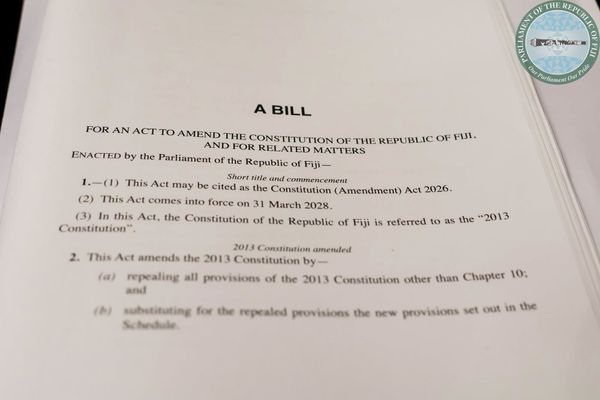
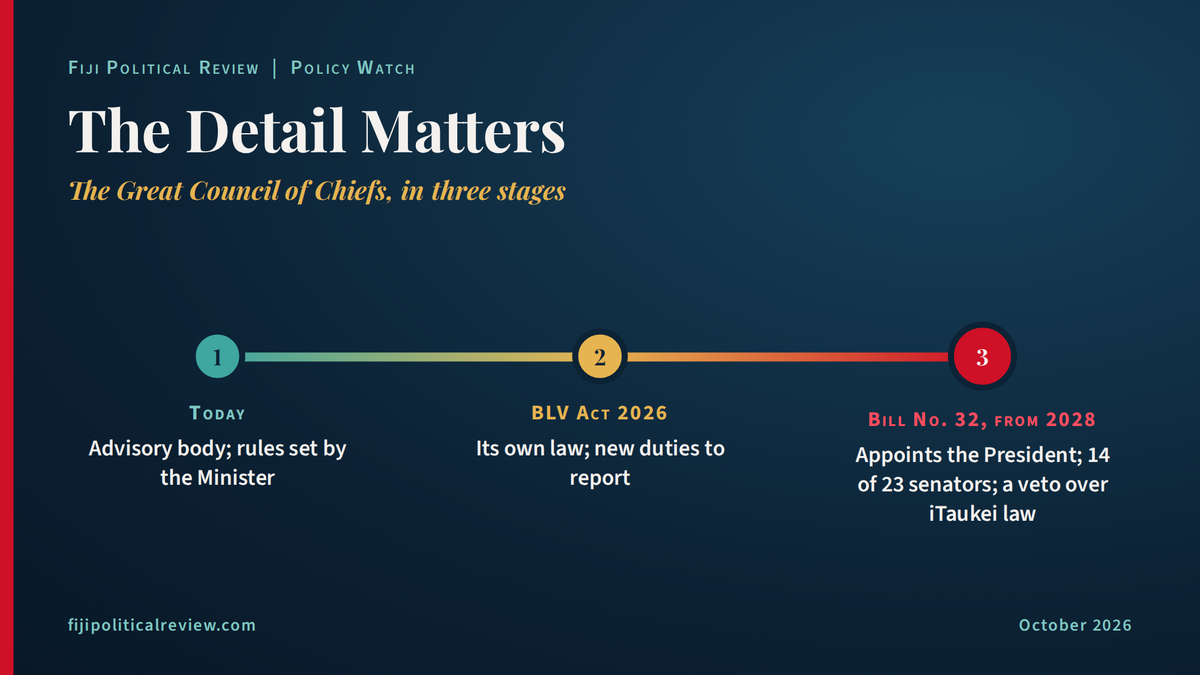
On 1 October, Fiji's Parliament passed the Bose Levu Vakaturaga Bill 2026 without a dissenting vote. The law gives the Great Council of Chiefs a statute of its own for the first time since the Council's restoration in 2023. It arrives as Parliament weighs a second, larger measure: the Constitution (Amendment) Bill 2026 (Bill No. 32), which would write the Council into a new Constitution with the power to appoint the President and to shape a majority of a restored Senate.
Taken together, the two Bills represent the most consequential change to the Council's standing since it was abolished by decree in 2012. Read clause by clause, they also show how much rests on detail: to whom the Council reports, which Bills it must see, and what becomes harder to amend once a new Constitution takes effect.
This Policy Watch sets out the Council's legal position today, what the new Act changes, and how Bill No. 32 would bear on both. The analysis of the new Act is based on the Bill as introduced (Bill No. 34 of 2026); amendments made before passage may alter the detail.
The footing today
Parliament voted 28 to 22 in November 2023 to restore the Council, and the iTaukei Affairs (Amendment) Act 2023 came into force on 1 December that year. Its core provision, a new section 3, revived the 1966 wording almost verbatim. The Council must exist; its members are appointed by the President on the Minister's advice; it may recommend to the President anything it considers to benefit the iTaukei, and decide questions referred to it. None of those decisions binds anyone.
The Act also rebuilt a consultation route for legislation, though one the executive controls at both ends. A proposed Bill affecting the iTaukei goes first to the iTaukei Affairs Board, which may advise referring it to the Council. The Minister can decline on grounds of urgency, withdraw a Bill already referred, or, under section 11(1), bypass the Board altogether for matters certified urgent or secret.
The Council's working design sits in the iTaukei Affairs (Great Council of Chiefs) Regulations 2024, which the Minister made and can remake by legal notice. They provide for 54 members, including 42 chiefs nominated by the provinces, but contain no power to remove a member, no voting rule, and no reporting beyond the Minister. They also bar party office holders from membership while seating the Prime Minister and Minister ex officio.
The Council's financial and land roles were only partly restored. The 2023 Act returned Council autonomy to the stated purposes of the iTaukei Trust Fund and redirected the Fund's annual report from Parliament to the Council. Control of the Fund, however, stayed where a 2009 decree placed it: the Minister appoints the entire board, and section 5 of the iTaukei Trust Fund Act now names both the Council and the Board as setting the rules for beneficiaries, according to the consolidated text on the Laws of Fiji portal. The Council's land roles, transferred to the iTaukei Affairs Board by decree in 2012, were not returned at all.
What the new Act changes
The Bose Levu Vakaturaga Act replaces the 2024 Regulations once the Minister brings it into force by notice in the Gazette (ss1(2), 39). On governance, it answers most of the gaps above. Members may be removed only on stated grounds, after a committee inquiry and a hearing (s22). Decisions are taken by majority vote (s11(5)). The President, Prime Minister and Minister become honorary, non-voting members (s14(1)(a)). The Council must make its deliberations public through minutes and published summaries (s28(2)), and its audited accounts and annual reports must be tabled in Parliament within 14 sitting days (s32).
The Act also extends the Council's reach into the institutions that manage iTaukei assets. It would nominate 4 of the 8 members of the Trust Fund board, 4 members of the iTaukei Affairs Board, and 6 of the 11 members of the iTaukei Land Trust Board (Schedule, items 1, 3 and 4). Most significantly, any Bill affecting iTaukei rights and interests, levies, chiefs, Provincial Councils or land must be referred to the Council before it is introduced, with no exception for urgency (s36).
The limits lie in the conditions. Reporting to Parliament applies only "where funds are appropriated" by Parliament, and public summaries of deliberations are issued after consultation with the Chairperson. The referral duty covers only Bills introduced by the Minister for iTaukei Affairs, so a measure on land or levies brought by another minister falls outside it. The Council's recommendations now travel "through the Minister" (s27). There is still no fallback when a province declines to nominate; with 48 voting members and a quorum of 36, the Council can meet with 4 provinces unrepresented. And the Bill as introduced carries drafting errors, among them a Trust Fund board described as 8 members that lists 11.
The constitutional layer
Bill No. 32 would place the Council on a different plane altogether. It awaits its second reading, after which it goes to a Special Parliamentary Committee; if enacted, the new Constitution commences on 31 March 2028. Its chapter on the Council would entrench the institution (s152) and give it the power to appoint the President and Vice-President after consulting the Prime Minister, and to remove them (ss103, 107). Fourteen of the 23 members of a restored Senate would be appointed on the Council's advice (s76), and the State would be obliged to fund the Council on request, subject to available resources (s152(4)).
The chapter leaves the Council's membership to "written law" (s152(3)). The new Act is the obvious candidate to fill that role, which means the Council's composition, and the transparency provisions described above, would remain ordinary legislation. The chapter itself contains no reporting duty.
The provision with the widest practical consequence is section 50. Once the new Constitution commences, any Bill altering the iTaukei Affairs, Lands, Land Trust or Trust Fund Acts, or any new law on iTaukei matters, would require the support of 9 of the 14 Council-appointed senators. Correcting the drafting errors in the new Act, resolving the conflict in section 5 of the iTaukei Trust Fund Act, or widening the reporting and referral duties would then depend on the Council's own appointees. Until commencement, each requires only an ordinary majority. Whether section 50(3) would also constrain the Minister's power to make regulations on iTaukei matters is untested.
| Today | Under the Bose Levu Vakaturaga Act | Under Bill No. 32 | |
|---|---|---|---|
| Legal basis | Section 3 of the iTaukei Affairs Act; working rules in regulations the Minister can remake | Its own Act; the 2024 Regulations repealed (s39) | Constitutional chapter (s152), amendable only with 9 of the 14 Council-appointed senators (ss153, 210) |
| Membership | 54 members, including 6 nominated by the Minister | 48 voting members: 3 confederacy heads, 42 provincial chiefs, 3 from Rotuma; President, PM and Minister non-voting (s14) | Left to written law (s152(3)) |
| Removal of members | No provision | By the Chairperson, on stated grounds, after a committee inquiry and a hearing (s22) | Left to written law (s152(3)) |
| Bills affecting iTaukei | Board may refer; the Minister can bypass for urgency or secrecy (s11) | The iTaukei Affairs Minister's Bills referred before introduction, no urgency exception (s36) | Changes to the iTaukei statutes, and new iTaukei laws, need 9 of the 14 Council-appointed senators (s50) |
| President and Vice-President | No role | No role | Appointed by the Council after consulting the PM; removable only by the Council (ss103, 107) |
| Senate | No Senate | No Senate | 14 of 23 senators appointed on the Council's advice (s76) |
| Trust Fund board | Minister appoints all 8 members | Council nominates 4 (Schedule, item 1) | Changes to the Trust Fund Act need 9 of the 14 senators (s50) |
| Land | Roles held by the iTaukei Affairs Board since 2012 | Council nominates 6 of 11 iTaukei Land Trust Board members (Schedule, item 4) | Changes to the land statutes need 9 of the 14 senators (s50) |
| Funding | A stated purpose of the iTaukei Trust Fund | Appropriations, gifts, fees and borrowing (s29) | State must fund on request, subject to available resources (s152(4)) |
| Reporting | Meeting reports to the Minister only | Public deliberations and summaries (s28); reports tabled in Parliament only where Parliament funds the Council (s32) | No provision in the chapter |
"Today" shows the rules in force now. The Bose Levu Vakaturaga Act has passed but does not apply until the Minister sets a start date. The middle column is based on the Bill as first tabled. Sources: iTaukei Affairs Act 1944; iTaukei Affairs (Great Council of Chiefs) Regulations 2024; iTaukei Trust Fund Act 2004; Bose Levu Vakaturaga Bill 2026 (Bill No. 34 of 2026); Constitution (Amendment) Bill 2026 (Bill No. 32 of 2026).
What to watch
The first marker is when the Minister brings the new Act into force, and whether the text as passed corrects the errors in the introduced Bill. The second is whether Parliament uses the period before Bill No. 32 commences to widen the Act's reporting and referral duties and to settle the Trust Fund's beneficiary rules. The third is how the Special Parliamentary Committee treats section 50.
The chiefs now have a law of their own. Whether it serves as a durable framework or a fixed one will depend largely on what Parliament corrects in the 18 months before Bill No. 32 would take effect.
Sources
- iTaukei Affairs (Amendment) Act 2023 (Act 25 of 2023), commenced 1 December 2023
- iTaukei Affairs (Great Council of Chiefs) Regulations 2024, Legal Notice 11 of 2024
- Fijians Trust Fund (Amendment) (No. 2) Decree 2009
- iTaukei Trust Fund (Amendment) Decree 2012
- iTaukei Affairs Act 1944, iTaukei Trust Fund Act 2004, iTaukei Land Trust Act 1940 and iTaukei Lands Act 1905, consolidated texts on the Laws of Fiji portal, checked 30 September 2026
- Fijian Affairs Act Cap. 120, Revised Edition 2006, including the Fijian Affairs (Great Council of Chiefs) Regulations 2008
- Constitution (Amendment) Bill 2026 (Bill No. 32 of 2026): ss50, 76, 103, 107, 152, 153, 210 and 212
- Bose Levu Vakaturaga Bill 2026 (Bill No. 34 of 2026), as introduced: ss1, 11, 14, 22, 27, 28, 32, 36 and the Schedule
- iTaukei Land Trust (Amendment) Decree 2012
- FBC News, "Chiefs' council gets formal say on iTaukei interests", 1 October 2026