The Clause and the Note: Where Bill No. 32 Departs From Fiji's Constitution Review
Bill No. 32's immunity clause gives a different end date from its own Explanatory Note. Read against the Constitution Review Commission's report, it also hands chiefly nominees a Senate majority, and may run into the Supreme Court's 2025 Advisory Opinion.

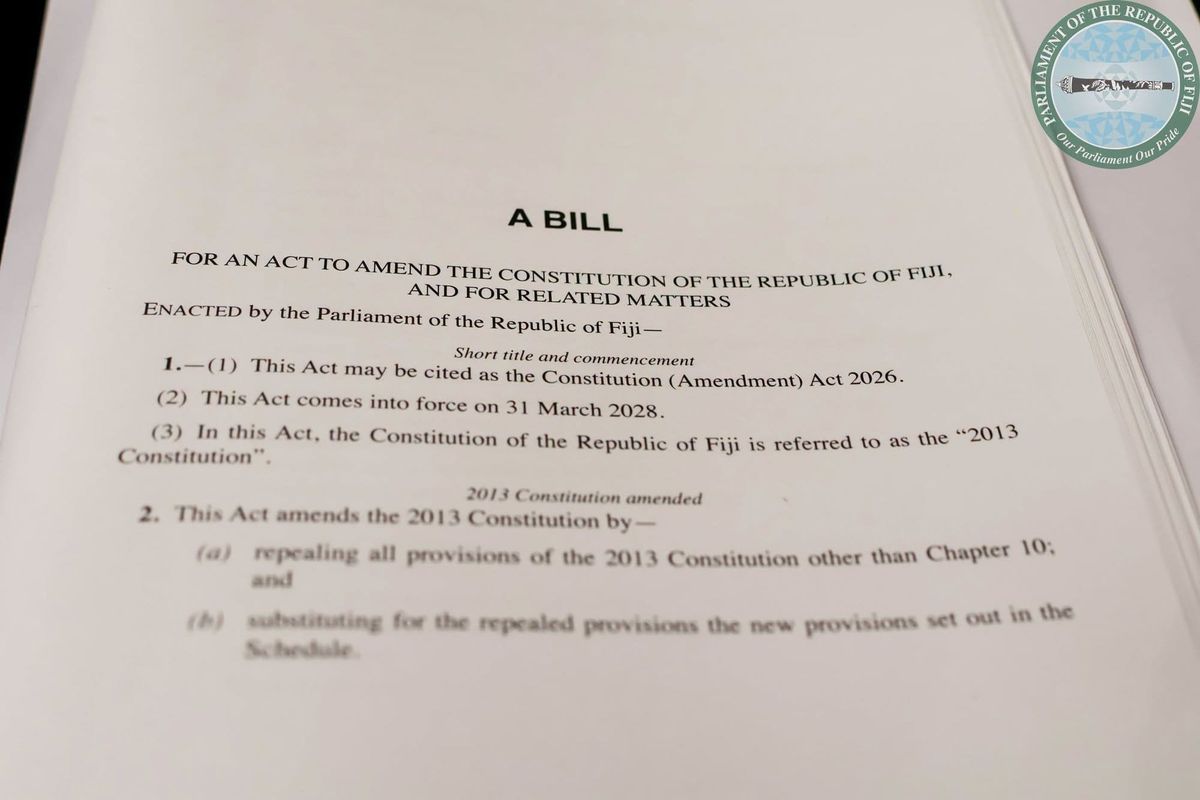
Bill No. 32 of 2026 would replace almost all of the 2013 Constitution. FPR read it against its own Explanatory Note, the Constitution Review Commission's report and the Supreme Court's 2025 Advisory Opinion. Three things stand out: an immunity clause whose text and note give different end dates, a Senate where chiefly nominees would hold a majority on their own, and repeals that may cut across what the Court said can never be repealed.
The Constitution (Amendment) Bill 2026 was tabled for its first reading this week. FPR read the full 150-page Bill, including its Explanatory Note, alongside the Commission's 236-page report delivered to the President on 31 August.
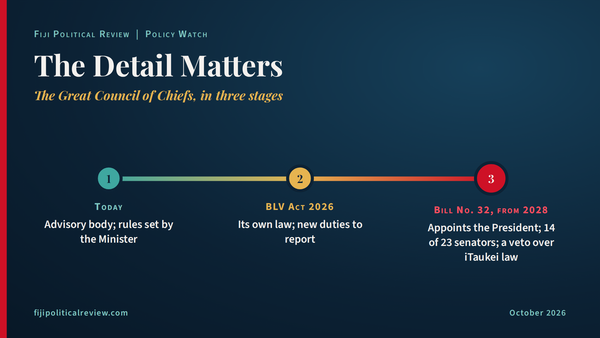
The Bill takes its frame from the Commission's report. It brings back a Senate, adopts a mixed-member proportional system, gives the Bose Levu Vakaturaga (BLV) and Rotuma their own chapters, and confines the military to external defence.
Inside that frame, the Bill moves key powers into new hands.
The immunity clause
The Commission's primary recommendation was to repeal the immunity provisions covering the 1987, 2000 and 2006 coups, the ABC reported. That would include immunity relevant to Prime Minister Sitiveni Rabuka, who led the 1987 coups. Rabuka has previously said the immunity clause didn't protect him.
The Bill keeps them. Chapter 14 (ss 204 to 207) reproduces the 2013 immunity chapter almost word for word.
There's a reason for part of this. In its Advisory Opinion of 29 August 2025, the Supreme Court read the 2013 amendment rules to mean that no amendment may ever repeal any provision in Chapter 10 (immunity) or Part D of Chapter 12 (transitional provisions), or "infringe or diminish" their effect (para 236). The Court acknowledged that immunities "sit uneasily with the concept of equality before the law" (para 227). But given 35 years of unamendable immunities in Fiji's constitutions, it held it "would not be right to withhold recognition of them" (para 229).
The Commission accepted that constraint while still recommending repeal. It offered a fallback: an Oath of Reconciliation and Allegiance for immunity beneficiaries, and a right to remedy and truth in the Bill of Rights.
The Bill contains neither.
Two end dates
The Explanatory Note (para 2.206) says s 206 covers people who held public office "between 5 December 2006 and 6 October 2014". That matches the 2013 Constitution's window, which closed at the first sitting of the 2014 Parliament.
The clause itself says something different. It runs the immunity to "the date of the first sitting of the first Parliament elected after the commencement of this Constitution."
The Bill sets commencement at 31 March 2028 (s 211(2)). Under s 219, the Parliament in office on that date carries on with a four-year maximum term. If the next general election is held by early 2027, the first Parliament elected after commencement would likely sit around 2031.
On the clause as written, immunity would cover anyone holding "any public office" for roughly 24 years, up from about 8. (That's FPR's calculation from the Bill's own dates; it moves if the President proclaims an earlier commencement under s 211(3).)
Only the clause becomes law and the note has no legal force.
The Supreme Court's reading stops any amendment from diminishing the 2013 immunity. Nothing in the Advisory Opinion requires extending it.
A chapter that contradicts itself
Section 207(1) says Chapter 14 "shall not be reviewed, amended, altered, repealed or revoked." Section 209(4) then defines ss 204 to 207 as "entrenched provisions" that can be amended with three-quarters of each House.
Separately, s 2(a) of the Bill keeps Chapter 10 of the 2013 Constitution in force. Chapter 10 is the 2013 immunity chapter. Read together, Fiji would have two immunity chapters running side by side, even as s 229(a) repeals the 2013 Constitution.
A validity question
The Bill may also run into the Supreme Court's own reading of the 2013 Constitution.
At para 236 of the Advisory Opinion, the Court held that no amendment may ever repeal any provision in Chapter 10 or in Part D of Chapter 12. Part D holds the 2013 transitional provisions, ss 165 to 174, including the bar on court challenges to the post-2006 decrees. The Court read "amendment" broadly, to cover any proposal to repeal, replace or revise a provision.
The Bill keeps Chapter 10 but not Part D. Section 2(a) of the Bill repeals every other provision of the 2013 Constitution. The new Constitution carries forward only one Part D provision, the s 173(4) ouster, through s 226(2). And s 229(a) repeals the Constitution of the Republic of Fiji (Promulgation) Decree 2013.
The savings clauses in ss 225 to 228 may be meant to preserve Part D's effect. But the Court barred repeal in terms, as well as anything that diminishes effect. On FPR's reading, the Bill as drafted could leave the new Constitution open to challenge after the referendum.
The Senate
The Commission recommended a 19-member Senate with 8 BLV nominees. The Bill creates a 23-member Senate with 14.
That's the same number of BLV Senators as the 1997 Constitution, in a much smaller chamber.
| Appointing body | 1997 Constitution (s 64) | Commission's draft (s 79) | Bill No. 32 (s 76) |
|---|---|---|---|
| Bose Levu Vakaturaga | 14 of 32 (43.8%) | 8 of 19 (42.1%) | 14 of 23 (60.9%) |
| Prime Minister | 9 | 5 | 6 |
| Leader of the Opposition | 8 (25.0%) | 4 (21.1%) | 2 (8.7%) |
| Rotuma Island Council | 1 | 1 | 1 |
| Rabi Council of Leaders | none | 1 | none |
Under 1997 and under the Commission's draft, no single appointing body held a Senate majority. Under the Bill, BLV nominees would hold one on their own.
The Opposition's share falls to about a third of its 1997 level (8.7% ÷ 25.0% = 0.35). The Banaban community's seat, proposed by the Commission, is gone.
The Commission's report records that some submitters asked for a Senate "in alignment with the 1997 Constitution's composition model", and for the BLV to select the President. The Commission considered both and chose a smaller BLV share and a seven-member Presidential Appointment Commission. The Bill instead has the BLV appoint the President after consulting the Prime Minister (s 103), the 1997 arrangement.
FPR also checked the report's minority views. Neither proposes a larger BLV role. The BLV minority view asks for more accountability: one in three provincial representatives to be women, and BLV members bound by the constitutional Code of Conduct.
The veto
Section 50(3) requires 9 of the 14 BLV Senators to support any future law "relating to iTaukei matters". The Bill doesn't define the phrase.
That sits alongside the existing entrenchment of the iTaukei, Rotuman and Banaban land statutes listed in s 50(2), which the Commission also recommended.
Other departures from the Commission
The pattern repeats across the Bill. Accountability measures the Commission recommended were mostly left out, and appointment powers it wanted spread out were mostly concentrated.
| Issue | Commission recommended | Bill No. 32 |
|---|---|---|
| House of Representatives | 41 seats: 26 constituency, 15 list | 55 seats: 33 constituency, 22 list (s 64) |
| Choosing the President | Seven-member commission: PM, Opposition Leader, 3 BLV, 1 Fiji Council of Churches, 1 interfaith | BLV, after consulting the PM (s 103) |
| President's term | Two terms of 3 years | Two terms of 4 years (s 104) |
| Prime Minister's term | Two-term limit | No limit in s 112 |
| Cabinet size | 15 including the PM | Set by the PM (s 110) |
| Constitutional Offices Commission | Independent members, no political office holders | PM (chair), Attorney-General, Opposition Leader, 3 political nominees (s 179) |
| FICAC | Kept for non-State corruption, investigation only | FICAC Act repealed; no replacement body (s 229(b)) |
| BLV accountability | Code of Conduct, own secretariat, annual reports to Parliament | None in Chapter 8 |
| Future amendments | Supermajorities for core chapters; review every 10 years | Two-thirds of each House, no referendum; no scheduled review (s 209) |
| National identity | "Fijian" for up to 12 months, then consultation and a referendum if needed | "Fijians" permanently; "iTaukeinivanua o Viti" as an option (s 6) |
| Rotuma independence | Two-thirds of Parliament and a national referendum | Government agreement, a Rotuman referendum, two-thirds of the RIC, and a constitutional amendment (s 156) |
Three items in that table need a note.
On the Prime Minister's term, the Explanatory Note (para 2.112) says a person who has held the office twice can't be named again. Section 112 contains no such limit.
On the Constitutional Offices Commission, the Government side holds four of six seats, and decisions need a majority of members (s 187). That body advises on the Electoral Commission, the Supervisor of Elections, the Police Commissioner and the RFMF Commander.
On FICAC, the Commission wanted the agency to stay, stripped of prosecution powers, with the Ombudsman handling State corruption. The Bill brings back the Ombudsman (s 196) but leaves its functions to ordinary law.
What the Bill takes from the Commission
A fair reading has to count what carried across, and a lot did:
- a general test for limiting rights, with the State bearing the burden of justifying a limit (s 8)
- social and economic rights regrouped into their own Part, and a new Land, Environment and Group Rights chapter with free, prior and informed consent for large projects (s 45)
- a 5% threshold, an independent Constituency Boundaries Commission, and a freeze on major election law changes in the last 9 months of a term (ss 64, 94, 96)
- caretaker government rules (s 115)
- the military confined to external defence, under Cabinet direction (s 151)
- a Military Court staffed by a High Court judge (s 123)
- the Ombudsman restored (s 196), and a Salaries and Benefits Commission (s 173)
- a Rotuma chapter with a path to self-determination (ss 154 to 157)
Drafting errors
FPR found inconsistencies that don't depend on any policy view:
- Electoral Commission size: s 92 sets 5 members, but the transitional s 216 staggers terms for 7.
- Commencement: the Bill fixes 31 March 2028, while s 211(3) lets the President proclaim an earlier date. Cabinet had said the new Constitution would take effect by 24 December 2026.
- Enforcing rights: the Note (para 2.10) says the High Court can act on its own initiative and shield public interest applicants from costs. Section 10 provides for neither.
- The electoral system: s 64(2)(b) allocates list seats by votes for constituency candidates, while s 64(3) refers to "the party vote". It's unclear whether voters get one vote or two.
- Rotuma land law: s 50(2)(g) names the Rotuman Lands Act 1959, but s 155(3), which lets the Rotuma Island Council propose changes to Rotuma's land law, names a "Rotuma Lands Act 1905".
- The first Senate: the transitional provisions keep the existing Parliament as the House of Representatives (s 219) but say nothing about when senators are first appointed.
What happens next
The Bill's next step is its second reading. It then goes to a 10-member Special Parliamentary Committee of seven Government and three Opposition members. Opposition Leader Inia Seruiratu said the Opposition hadn't seen the Bill before it was tabled. Opposition MP Premila Kumar said no one has the right to change what Fijians asked for "on an individual basis or as a Cabinet subcommittee".
Lands Minister Filimoni Vosarogo said the committee would have at least 30 days to consult before a final vote in the November sitting, the ABC reported. The Government needs 37 of 55 votes (two-thirds of 55 is 36.67, rounded up).
If Parliament passes it, the Bill goes to Fiji's first referendum, proposed for between November and mid-December. The Supreme Court has advised that a majority of those who vote in the referendum is enough.
The timing is crucial. The last date for the next general election is 6 February 2027. With commencement set for 31 March 2028, that election would run under the 2013 rules. Under s 219, the Parliament it elects would then carry on as the new House of Representatives until its four-year term ends, probably around 2031. The new electoral system would first apply at the election after that.
The BLV's power to appoint the President would apply sooner, to the first appointment after commencement (s 220).
The Senate is less clear. The Bill doesn't say when senators are first appointed. Their seats fall vacant before "the first sitting of the Senate after a general election" (s 78(2)), which ties the Senate to the election cycle, and the transitional provisions (ss 211 to 229) make no provision for a Senate before then. If no Senate sits until around 2031, it's unclear how the BLV Senators' veto in s 50, or any Bill needing Senate passage, would work in the meantime.
Sources
- Constitution (Amendment) Bill 2026 (Bill No. 32 of 2026), with Explanatory Note, Office of the Attorney-General, September to October 2026 (primary document, as tabled)
- Fiji Constitution Review Commission 2026, report delivered to the President on 31 August 2026, including Appendix A (Draft Constitution) (primary document)
- Supreme Court of Fiji, Miscellaneous Case No. 1 of 2025, Advisory Opinion of 29 August 2025 (as described in the Commission's report)
- Constitution of the Republic of Fiji 2013, Fiji Law Reform Commission
- President of the Republic of Fiji Islands v Kubuabola [1999] FJSC 8 (3 September 1999), PacLII, quoting s 64 of the 1997 Constitution
- Review of Fiji's constitution recommends sweeping changes to its supreme law, ABC News, 23 September 2026
- Constitution (Amendment) Bill 2026 brings back Senate, Fiji Sun, 30 September 2026
- No one can change what Fijians asked for, says Opposition MP, Fiji Sun, 30 September 2026
- Plans to have new Constitution by Dec 24th 2026, Fijivillage, 16 September 2026