Fiji's first referendum: no votes to spare and rules still being written
Fiji's first referendum could be held on 9 December. The path there rests on a one-vote margin in Parliament, a counting rule that sits uneasily with the Standing Orders, and campaign rules still to be written.


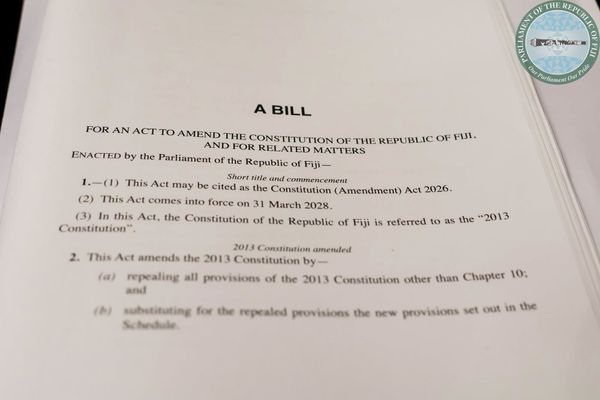
Fiji is on course to hold its first national referendum. On 2 October, Parliament passed the Constitution (Amendment) Bill 2026 at its second reading and, earlier that day, passed the law that will govern the vote. If the Bill clears its third reading in early November, Fijians will be asked on 9 December whether they support a new Constitution.
That would be a significant moment. None of Fiji's four constitutions has been put to its people: the 1970 Constitution came by order of the British Crown, the 1990 and 2013 Constitutions were promulgated after coups, and the 1997 Constitution was passed by Parliament. Earlier this year I wrote for the DevPolicy Blog about the referendum Bill's restrictions on public debate. The events of the past week raise a broader concern. The path to the referendum now rests on a one-vote margin in Parliament, a counting rule that sits uneasily with Parliament's own Standing Orders, and campaign rules that have yet to be written.
A one-vote margin
Parliament's published voting record shows the Bill passed with 36 votes for, 5 against and 9 abstentions, with 3 members present but not voting. Every vote in favour came from the Government. Under the threshold the Speaker applied, 36 votes were required.
That threshold was itself the product of a ruling delivered earlier that day. Parliament's Standing Order 93 requires three-quarters of all members at the second and third readings of a constitutional amendment, and in March 2025 the same Speaker applied it to declare an earlier amendment Bill defeated with 40 of 55 votes. Since then, the Supreme Court's 2025 advisory opinion has read the constitutional threshold down to two-thirds. The Speaker ruled that Parliament must follow it.
Two further steps produced the number 36. Standing Order 8(2)(a) excludes vacant seats from any threshold, and two seats have been vacant since the passing of Inosi Kuridrani and Agni Deo Singh, which leaves 53 sitting members. And, in the ruling's most consequential part, the Speaker held that if members are absent, the threshold becomes two-thirds of those present in the chamber, including approved virtual attendees. He cited Standing Order 52(1) and section 69 of the Constitution.
That last element did not matter on 2 October, because Parliament's voting record shows all 53 sitting members present. It could matter a great deal at the third reading. Under a rule based on members present, an MP who stays and abstains counts toward the base, while one who leaves the chamber lowers it. A boycott would make the Bill easier to pass.
The rule also sits uneasily with the text it relies on. Standing Order 93 requires a vote of "all members", and Standing Order 4(3) defines that phrase as "all current members of Parliament, not merely those members present". Section 69 applies "except as otherwise provided" in the Constitution, and Standing Order 52 yields to "any express requirement in any other Standing Order". The Speaker's ruling governs proceedings, and only the courts can settle what the Constitution requires. Still, a constitutional change that rests on a contested counting rule invites challenge.
The machinery, and a tight window
The National Referendum Bill passed unanimously in the early hours of 2 October. The Standing Committee on Justice, Law and Human Rights substantially revised the original Bill, largely on the advice of the Electoral Commission and the Fijian Elections Office. The revised scheme applies the Electoral Act 2014 to referendums with necessary modifications, confirms that registered voters overseas can take part, and requires the President to issue a writ setting out the referendum question once the Speaker gives notice. Results are tallied nationally by the Supervisor of Elections and endorsed by the Electoral Commission before the President declares them. Ministers have said voters will answer a single question and that approval needs 50 per cent plus one.
The committee also replaced the original Bill's five-day notice period, one of the criticisms in my earlier piece, with a requirement that polling day fall 30 to 45 days after the writ. That is a real improvement for voter awareness. It also sets a hard constraint on the timetable. For a vote on 9 December, the writ must issue between 25 October and 9 November. The Special Committee examining the constitution Bill reports on 2 November, and the third reading cannot come earlier than 30 days after the second. If the third reading or the writ slips past 9 November, the Government's preferred date becomes legally unavailable.
Once it receives presidential assent, the law takes effect only when the Acting Attorney-General publishes a commencement notice in the Gazette. At the time of writing, that has not happened.
The rules not yet written
The Electoral Commission and the Fijian Elections Office told the committee the original Bill omitted much of what a credible referendum needs: voter education, campaign regulation, campaign finance and donations, media access, misinformation, foreign influence, the use of government resources, and a way to challenge the result in court. According to the committee's report, its response was to empower the Minister and the Electoral Commission to make regulations on voter education, campaigning, campaign financing, public consultation and dispute resolution.
Delegation has its advantages. Regulations can be drafted quickly and adjusted without new legislation. But with the referendum possibly ten weeks away, none of those regulations appears to have been published, and Parliament has not seen them. During the debate, Opposition MP Premila Kumar made the same point: too many fundamental rules have been left to regulation.
The second open question concerns free expression. As introduced, the Bill banned referendum badges, posters and advertisements "at any time either before, during or after" a referendum (clause 22), prohibited any attempt to persuade someone how to vote (clause 23), defined an unlawful assembly by reference to "annoyance" (clause 25), and barred under-18s from any referendum activity (clause 27). Submitters from the Fiji Law Society to the Fiji Women's Crisis Centre urged that these be removed or narrowed. The committee's report sets out its other revisions in detail but does not address these clauses. Until the final text is published, it is not clear whether they survived.
If they did, voters will be asked to decide on a new Constitution in a campaign where persuading a neighbour may be an offence. If they did not, the rules that replace them will sit in regulations still to be written.
Why the process matters
A first referendum sets precedents that outlast its result. The Constitution Review Commission received more than 1,200 submissions, and the Prime Minister has said the Special Committee's work should be more than a formality. Public engagement on that scale deserves a process whose rules are settled before the campaign begins.
Three steps would help. The Speaker could clarify, before the third reading, whether the two-thirds threshold will be calculated on all 53 sitting members or on those present when the vote is called. The Government could publish the referendum regulations now, giving the Special Committee and the public time to examine them. And the final text of the National Referendum Bill as passed should be released promptly, so that voters and civil society know what they may lawfully say and do during the campaign.
All of this fits within the current timetable. What it asks is that the rules governing Fiji's first referendum be visible to the people being asked to vote.
Lanieta Tukana is the founding editor of Fiji Political Review, an independent publication covering Fijian politics and governance. She made a personal submission to the Constitution Review Commission in April 2026 and intends to make one to the Special Committee on the Constitution (Amendment) Bill 2026.
Primary sources
- Constitution of the Republic of Fiji ss 64(3), 69.
- Constitution (Amendment) Bill 2026 (Fiji) (Bill No 32 of 2026).
- National Referendum Bill 2025 (Fiji) (Bill No 46 of 2025).
- Standing Orders of the Parliament of the Republic of Fiji (as amended 23 May 2024) orders 4(3), 8(2)(a), 52, 93.
- Parliament of the Republic of Fiji, 'Voting Result Details: Constitution (Amendment) Bill 2026' (67th Sitting, 2 October 2026).
- Parliament of the Republic of Fiji, 'Live Parliament Sitting: 3.30pm Session, Friday 2 October 2026' (Facebook, 2 October 2026) 26:00–30:10 <https://www.facebook.com/fijiparliament/videos/1580208677213135/>.
- Standing Committee on Justice, Law and Human Rights, Parliament of the Republic of Fiji, Report on the Review of the National Referendum Bill (Bill No 46 of 2025) (Parliamentary Paper No 129 of 2026, 29 September 2026).