Fiji's Great Council of Chiefs: More Power, Partial Daylight
Parliament has given the Great Council of Chiefs new duties to report. Yet those duties are conditional, and Bill No. 32 would soon require the chiefs' own senators to approve any change. The case for completing the paper trail is strongest now.

Update, 2 October 2026: Bill No. 32 passed its second reading on 2 October. A third reading is expected in early November, and a referendum on 9 December.
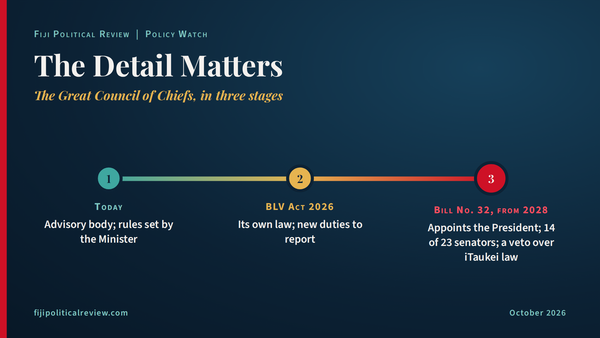
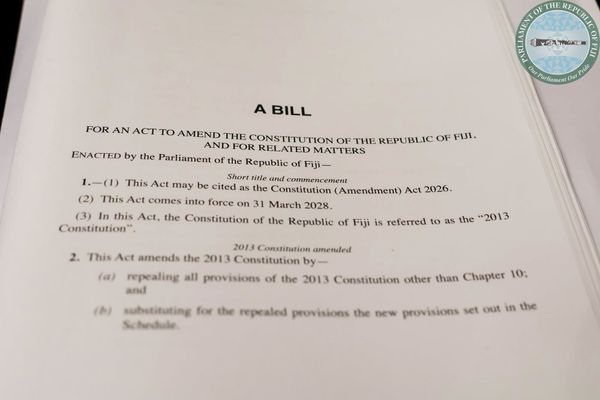
Fiji's Parliament is considering a Bill that would make the Great Council of Chiefs, the Bose Levu Vakaturaga, one of the most powerful institutions in the country. The Constitution (Amendment) Bill 2026 (Bill No. 32) gives the Council its own constitutional chapter. The Council would appoint the President and Vice-President, after consulting the Prime Minister, and would be the only body able to remove them. It would advise on 14 of the 23 seats in a new Senate, and those 14 senators would hold a veto over any change to the main iTaukei statutes.
The Bill awaits its second reading, after which it goes to a Special Parliamentary Committee. If enacted, it would take effect on 31 March 2028.
The debate so far has centred on how much authority the chiefs should hold. It has paid far less attention to a question that matters to every Fijian, iTaukei or otherwise: how the exercise of that authority will be made visible.
A new law
Parliament has also just rewritten the Council's own law. On 1 October it passed the Bose Levu Vakaturaga Bill 2026 without opposition, replacing the regulations the Minister could rewrite at will with an Act of Parliament.
On paper, and going by the Bill as introduced, the new Act is a real step forward for transparency. Members can be removed only after an inquiry and a hearing. Decisions are made by majority vote. The Council has a duty to make its deliberations public, and its audited accounts and annual reports must be tabled in Parliament. The President, the Prime Minister and the Minister become honorary, non-voting members.
Until this week, almost none of that existed. The detail still matters, though, because some of the new transparency is conditional, and Bill No. 32 could soon make the Act much harder to fix.
The Council's political weight is a separate question from its legal powers. The Attorney-General has described the Council as the body empowered to review the principal iTaukei statutes. The Council's own submission to the review sought the power to appoint the President and Vice President, and Bill No. 32 would give it exactly that.
That authority derives from the chiefs themselves: their titles, their vanua, and the standing those confer. Statute simply gives it a seat within the state. The Council's influence has long outrun its formal role, most visibly in the crises that followed the 1987 and 2000 coups.
What remains open
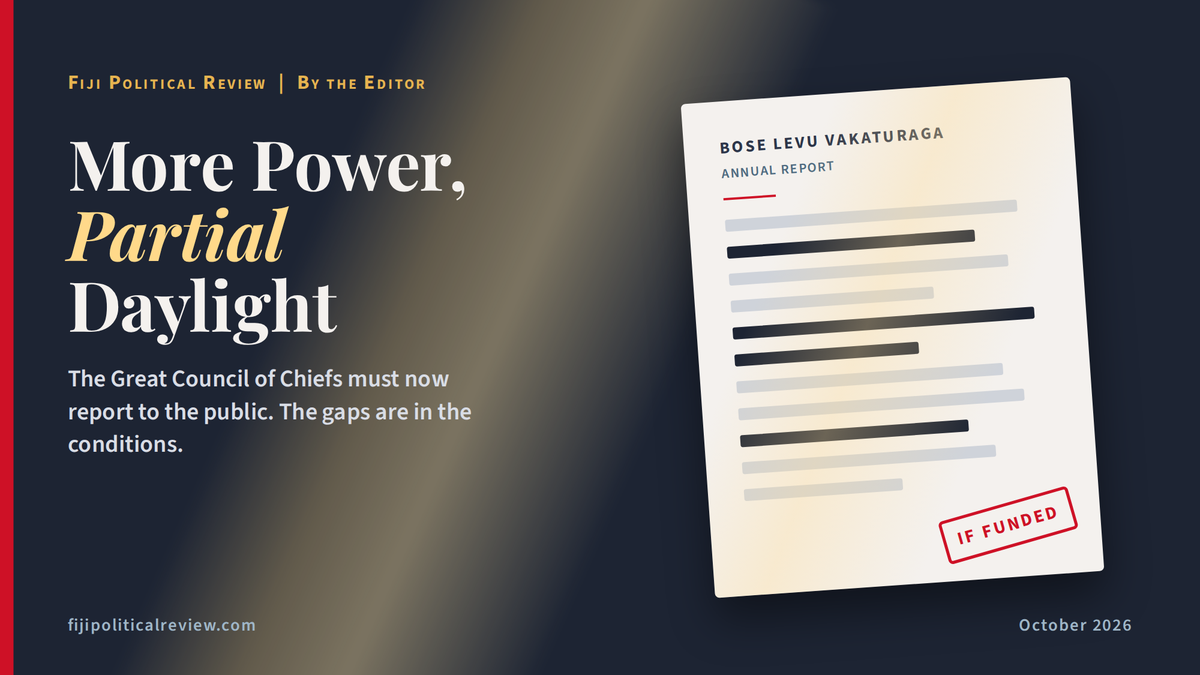
The gaps that remain are narrower than before. Annual reports reach Parliament only "where funds are appropriated" by Parliament; a Council funded by gifts, fees or borrowing could fall outside that duty. Public summaries of its deliberations are issued after consultation with the Chairperson.
The new Act makes the Minister for iTaukei Affairs send certain Bills to the Council before they reach Parliament. But the rule covers only that Minister's own Bills. If another minister introduces a Bill on land or levies, it is not covered, and the Council never sees it. Separately, the iTaukei Trust Fund's annual report, which went to Parliament until 2023, still goes to the Council.
The Bill as introduced also carries drafting errors. Its Trust Fund board is described as 8 members, then lists 11.
The strongest argument against reporting rules runs like this. Chiefly authority answers to the vanua, and requiring the Council to report to Parliament risks subordinating a customary institution to political control. The precedent is recent: the last government to take a firm hand with the Council made the Minister its chair, gave him the power to dismiss members, and then abolished it by decree in 2012.
Yet the 2008 regulations were an instrument of control. They let the state decide who sat on the Council, who chaired it and who was dismissed. Reporting works differently: it shows the public what the Council has done, without giving a Minister any say in what it does.
Fiji has asked this of the Council before. The 2008 regulations, whatever their other failings, required the Council's annual report to be tabled in Parliament, and the 2004 Trust Fund Act sent the Fund's report there as well. The 2023 amendments and the 2024 regulations quietly dropped both requirements. The new Act restores the first, in part.
Before 2028
Bill No. 32 would write the Council's powers into the Constitution, but its chapter on the Council says nothing about reporting. The Council's transparency would rest entirely on the new Act, an ordinary law.
Once the new Constitution commences, any Bill changing the iTaukei Affairs Act or the iTaukei Trust Fund Act will need the votes of 9 of the 14 Council-appointed senators. Parliament can add these rules now with an ordinary vote. After 2028, it would need the chiefs' own senators to agree.
Before 2028, Parliament could close these gaps with four modest amendments:
- Annual reports tabled in Parliament, however the Council is funded.
- Referral of every Bill affecting iTaukei interests, whichever minister introduces it.
- Return of the Trust Fund's annual report to Parliament, with a copy to the Council.
- Correction of the drafting errors, including section 5 of the Trust Fund Act and the new board that does not add up.
None of these would alter what the Council deliberates on or what it recommends. They would complete the paper trail Parliament started this week.
Entrenchment under Bill No. 32 would protect the Council from being undone by ordinary law, as it was undone by decree in 2012. Transparency would give the public a matching protection. In a democracy, an institution granted greater authority should expect its use of that authority to be seen.
Sources
- iTaukei Affairs (Amendment) Act 2023
- iTaukei Affairs (Great Council of Chiefs) Regulations 2024
- Fijians Trust Fund (Amendment) (No. 2) Decree 2009
- Fijian Affairs (Great Council of Chiefs) Regulations 2008, in Fijian Affairs Act Cap. 120, Revised Edition 2006
- Fijians Trust Fund Act 2004 and iTaukei Trust Fund Act 2004 (consolidated), Laws of Fiji portal
- Bose Levu Vakaturaga Bill 2026 (Bill No. 34 of 2026), as introduced: ss14, 22, 28, 32, 36 and the Schedule
- FBC News, "Chiefs' council gets formal say on iTaukei interests", 1 October 2026
- RNZ, "Fiji chiefs push bold constitutional changes, sparking public debate", 9 April 2026