The Constitutional Monitor: Tracking How Fiji Is Actually Governed
Pacific democracy scholarship has leaned on constitutions, election results, and historical narrative. Very little tracks what institutions actually do over time. The Monitor is our attempt to close that gap.

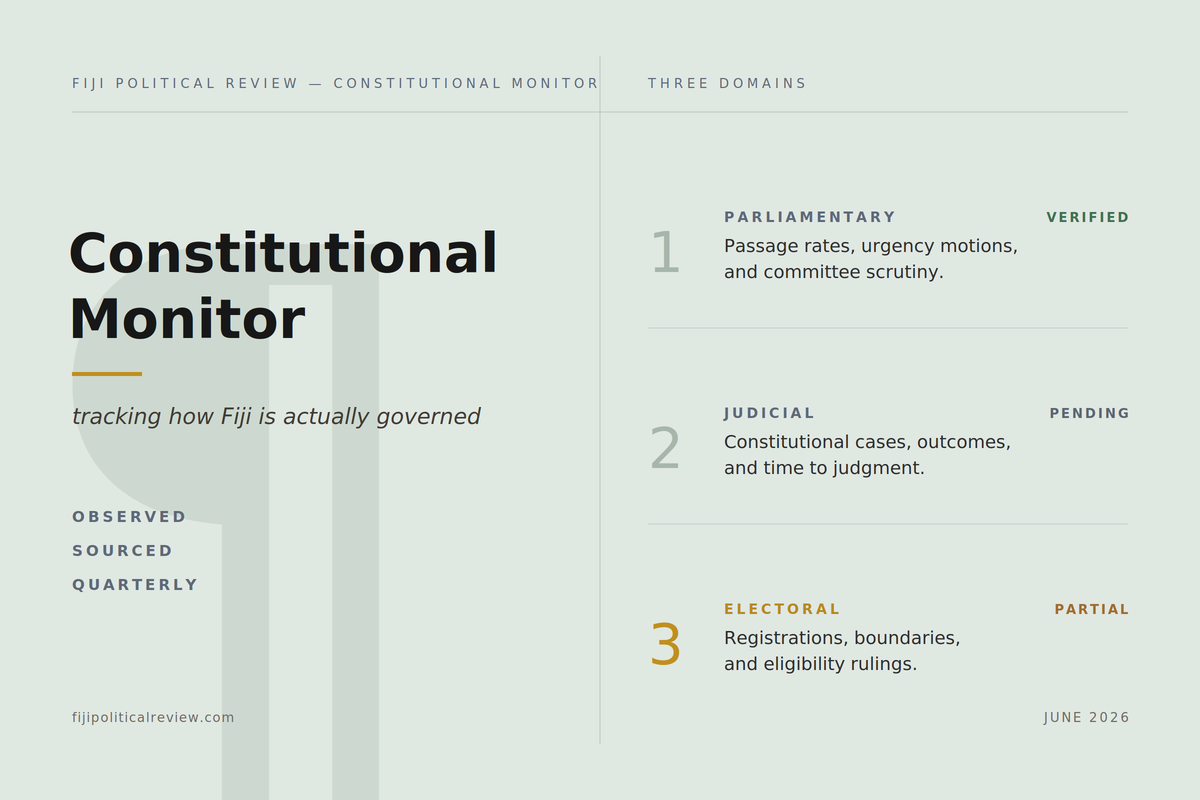
Tracking how Fiji's 2013 Constitution functions in practice, not what its text permits. Three domains, updated quarterly.
Legislative behaviour across each parliamentary session.
- Bills introduced vs. bills passed
- Bills passed without committee amendment
- Urgency motions used
- Select committee referrals
- Average days from introduction to passage
- Opposition speaking ratio
Constitutional case activity and outcomes.
- Constitutional cases filed
- Cases decided vs. pending
- State win rate
- Average days from filing to judgment
- Provisions litigated
Decisions of the Supervisor of Elections and Electoral Commission.
- Party registration decisions and refusals
- Boundary determinations
- Party and candidate eligibility rulings
- Rulings appealed and outcomes
A government-commissioned review of Fiji's electoral legislation was completed in July 2025. It has not been released, tabled in Parliament, or had its terms of reference disclosed. The Acting Attorney-General has confirmed the review exists; its contents remain sealed. With a general election constitutionally due between August 2026 and February 2027, this flag stays active until the review is tabled.
A government-commissioned review of Fiji's electoral legislation was completed in July 2025. Almost a year on, it hasn't been released, tabled in Parliament, or had its terms of reference disclosed. The Acting Attorney-General has confirmed the review exists, but its contents remain sealed.
A general election is constitutionally required between August 2026 and February 2027. As things stand, Fijians haven't been told what changes are proposed to the system that will run it.
That gap is exactly the kind of thing the FPR Constitutional Monitor exists to record. The Monitor tracks how Fiji's 2013 Constitution functions in practice, not what its text permits. It follows what constitutional actors actually do: how Parliament legislates, how the courts handle constitutional cases, and how the Supervisor of Elections administers the vote. The idea has a name in the literature, behavioural constitutionalism, but it comes down to something plain. Watch the practice, quarter by quarter, and build a record.
That record hasn't existed in Fiji's democratic literature before. Pacific democracy scholarship has, for decades, leaned on constitutional text, aggregate election results, and historical narrative. Very little of it tracks what institutions actually do over time. The Monitor is our attempt to close that gap.
The parliamentary domain is live now, with verified data covering 2023 Q1 to 2026 Q2, drawn from public records. Electoral administration has its first entries, with party registration decisions recorded for April 2026, and is marked partial while the rest is sourced. The judicial domain remains pending until it can be properly retrieved from PacLII.
That's the standard the Monitor holds itself to. Every indicator keeps what's recorded separate from what's interpreted. Where data can't be obtained, we say so plainly. The electoral review flag will stay active until the review is tabled in Parliament.
The Monitor is built to be read, not just consulted. You can browse each domain, review the quarterly record, and export any view as a PDF for your own archive.
Browse the Constitutional Monitor →
It grows with each quarter. The cumulative record is the whole point.