Esrom Yosef Immanuel
Minister for Finance. People's Alliance. Sworn in October 2025 after Biman Prasad resigned on FICAC charges. His first budget as Minister is due 26 June 2026. The numbers are stable. The room to move is not.

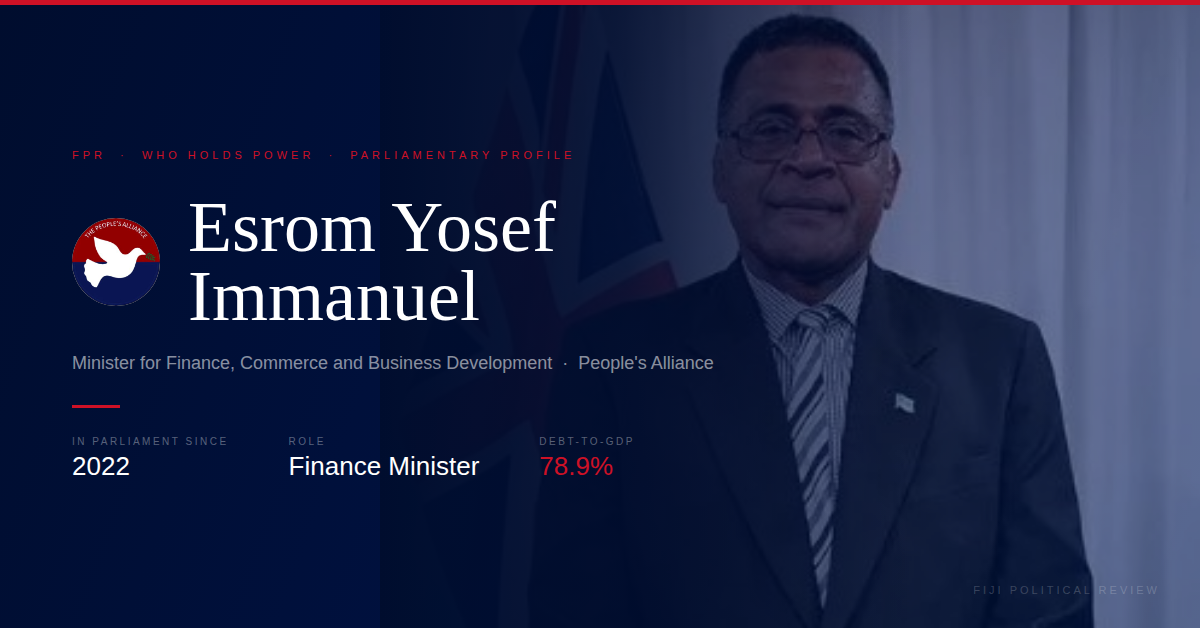

People's Alliance · Parliament of Fiji
Esrom Yosef Immanuel is a Fijian politician and Minister for Finance, Commerce and Business Development. He's a member of the People's Alliance and has been in Parliament since December 2022. He came to the Finance portfolio not through the usual academic or public service route, but through three decades in Fiji's private financial sector, including as a stockbroker and corporate executive.
He is from Navolau Village in the Tikina of Viria, Naitasiri. He attended Dravuni District School for his primary education and Ratu Sukuna Memorial School for secondary. He holds a Bachelor of Arts from the University of the South Pacific and a Postgraduate Diploma in Applied Finance and Investments from the Securities Institute of Australia.
Immanuel entered Parliament in December 2022 as a PA list candidate, polling 1,751 votes. Rabuka immediately appointed him Assistant Minister for Finance, where he served under Biman Prasad for nearly 3 years.
On 27 October 2025, Prasad resigned from Cabinet after FICAC charged him with allegedly failing to declare his directorship in hotel ventures under the Political Parties Act. The resignation came less than a week after Deputy PM Manoa Kamikamica also resigned on separate FICAC charges. Two Deputy Prime Ministers gone inside a fortnight. Opposition parties called it a coalition in free fall.
Immanuel was sworn in as Minister for Finance on 28 October 2025. He was the clear choice: he'd shadowed the portfolio for 3 years, knew the numbers, and posed no political risk to Rabuka. Finance now sits entirely within the People's Alliance for the first time since the coalition was formed.
| Party | People's Alliance |
| Electoral basis | PA list MP, 2022. 1,751 personal votes. |
| In Parliament since | 14 December 2022 |
| Previous role | Assistant Minister for Finance, 24 December 2022 to 28 October 2025 |
| Education | BA, University of the South Pacific; Postgrad Diploma in Applied Finance and Investments, Securities Institute of Australia |
| Economic approach | Fiscal prudence, private-sector-led growth, debt reduction, continuity with the Prasad-era framework |
Immanuel spent the bulk of his career in Fiji's financial services sector. He joined the Fiji Development Bank as a loans officer in 1988, then moved to Colonial Fiji Life Ltd, rising from Senior Investment Clerk to Assistant General Manager between 1989 and 2005.
He was CEO of Yasana Holdings Ltd from 2006 to 2013, then moved to Fiji Stockbrokers Ltd where he served as CEO, Investment Advisor and Broker Representative from 2014 until entering Parliament in 2022. He held board roles concurrently across multiple Fijian companies up to June 2013, including the South Pacific Stock Exchange, Data Bureau Limited, Yasana Holdings Limited, Fiji Television Ltd, and RB Patel (retail and wholesale chain). He was also Deputy Chair of Media New Guinea Limited, a PNG-based TV company, and Chair of Communication Pacific Limited (Compac). He is a member of Leadership Fiji and an Associate member of the Securities Institute of Australia (FINSIA).
Among Pacific finance ministers, his direct capital markets experience as a broker is unusual. That background shapes how he reads economic data and engages with the private sector.
The Ministry of Finance covers the national budget, fiscal policy, debt management, commerce, and business development. Immanuel's portfolio is the broadest and most consequential in Cabinet. Every spending decision by every other ministry flows through his office.
The 2025/26 National Budget, delivered by Prasad in June 2025, is the budget Immanuel is now managing. The 2026/27 budget will be his first as Minister and is scheduled for announcement on 26 June 2026. Consultations have been underway since March 2026, with stated priorities of household relief, fiscal prudence, and private-sector growth.
He's also taken on Commerce and Business Development, expanding the portfolio's scope beyond pure fiscal management into trade facilitation and SME support.
The 2026/27 budget had not been delivered as of the publication date of this profile. Figures cited here relate to the 2025/26 fiscal year. This profile will be updated following the June 2026 budget.
The fiscal position Immanuel inherited is stable but tightening. Debt-to-GDP fell from around 92 per cent in December 2022 to a projected 77.5 per cent (FJ$10.8 billion) by the end of July 2025, the date used in the 2025-26 Budget. The same budget projected the ratio to rise to 79.8 per cent by end-July 2026.
Foreign reserves stood at FJ$3.4 billion as of 9 June 2026, sufficient to cover approximately 4.7 months of retained imports (RBF Press Release 13/2026). Reserves have eased since 29 January 2026, when they sat at FJ$3.7 billion or 5.4 months of imports, reflecting higher fuel import costs and softer tourism inflows.
GDP growth has been revised down twice in three months. The IMF, following its March 2026 Article IV mission, forecast 2026 growth at around 2.5 per cent, citing softer tourism bookings and rising global fuel prices linked to geopolitical tensions in the Middle East. In June 2026 the RBF Macroeconomic Committee revised that figure down further to 1.5 per cent, with year-end inflation now expected to exceed 6 per cent.
The 2025-26 Budget reduced VAT from 15 per cent to 12.5 per cent, effective 1 August 2025, framed as a $250 million cost-of-living measure. The IMF, in its March 2026 statement, recommended restoring VAT to its previous 15 per cent rate as part of a revenue-mobilisation package to rebuild fiscal buffers. Whether Immanuel reverses the cut, holds the line, or finds an alternative path to fiscal consolidation is the central tension in his first budget.
Fiscal figures sourced from Reserve Bank of Fiji press releases (01/2026, 13/2026), IMF Article IV Mission Statement (27 March 2026), 2025-26 National Budget documents, Islands Business, and Fiji Times. FPR has not independently audited these figures.
The 2026-27 budget on 26 June is the test. Immanuel's first budget as Minister will set out his own fiscal priorities rather than managing someone else's. The RBF's June 2026 downward revision of growth to 1.5 per cent, combined with year-end inflation now projected to exceed 6 per cent and the IMF's call to restore VAT to 15 per cent, narrows his room to move. Whether he delivers meaningful household relief without widening the deficit, and whether he reverses or holds the VAT cut, is the question.
His private sector background gives him credibility with business, but Parliament is a different room. He's yet to face a sustained parliamentary test as Minister, and with the 2026 election approaching, the opposition has every incentive to press hard on cost-of-living figures and debt management.
The broader coalition context matters too. Finance returning to PA after Prasad's departure consolidated Rabuka's hand. But Prasad's FICAC case continues, and the political instability that preceded Immanuel's appointment hasn't fully resolved.
⚠ FPR welcomes corrections: editor@fijipoliticalreview.com