What the Republic Requires and Deserves
A republic is the most demanding form of government. It requires its citizens and its rulers to want something beyond their own immediate interest. FPR examines what that means for Fiji right now.


FPR publishes analysis. This piece does something different. It asks.
Fiji is about to ask its citizens to believe in something the country has never fully honoured.
In 1987, Fiji held an election; a coalition won. Seven weeks later, then-Lieutenant Colonel Sitiveni Rabuka deposed the recently elected, Indo-Fijian-led coalition government of Prime Minister Dr Timoci Bavadra. In 1999, Fiji held another election. Mahendra Chaudhry became the prime minister. A year later, George Speight took him hostage in that same parliament.
Both times, the majority had voted. Both times, the result was overturned. The reason, never quite stated plainly, was the same: the wrong people had won. Thirty-nine years later, Fiji is preparing for another election. The sentence hasn't been retired.
The Pattern
The 1987 coup was Fiji's first. For a generation of young people who had grown up in what felt like a stable, quiet Pacific island, military uniforms in the halls of government were new, and for Indo-Fijians and others, terrifying.
A new constitution followed in 1990. It was supposed to settle things. It didn't.
In 2000, George Speight walked into parliament and took Mahendra Chaudhry hostage. The same generation, now older, recognised something: this had happened before. The mechanism was different. The logic was the same. Another constitution in 1997 had tried to build a multiracial framework. It hadn't held either.
2006 was different in one respect. The target this time was an indigenous Fijian prime minister. Frank Bainimarama framed the coup as a corruption clean-up. But that same generation, now watching their third military intervention, noticed something else: the military, once it tastes executive power, doesn't easily give it back. Bainimarama governed for eight years before holding an election. The 2013 Constitution, drafted without a constituent assembly and imposed by decree, was the settlement he chose. It was supposed to end the cycle.
It didn't answer the question. It buried it in clauses and called that progress.
The Constitutional Question
The 2013 Constitution arrived without a question. That was the point.
Frank Bainimarama had governed Fiji for seven years by the time he promulgated it. He had abrogated the 1997 Constitution in 2009, ruled by decree, and closed down the space where disagreement might have lived: opposition politics, a free press, public assembly. The constitution that emerged from that environment was drafted by a committee he appointed, ratified by no referendum, put to no constituent assembly. Fijians didn't shape it. They received it.
What it built wasn't without substance. Equal citizenship. Ethnicity removed from the electoral rolls. A civic nationalist framework that made the 2014 election technically legitimate. These weren't nothing.
But the absences were evident.
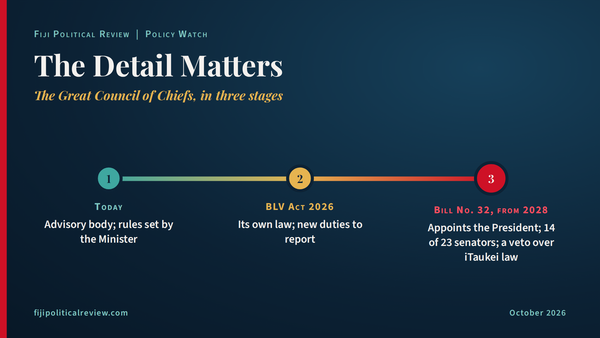
The Great Council of Chiefs was abolished. iTaukei paramountcy, not resolved on indigenous terms but written around, was subordinated to a framework that suited the government's political project. Communal representation, removed without asking the communities it most affected what they wanted instead. These weren't oversights. They were decisions, made by one man, about what Fiji would and wouldn't be allowed to argue about.
And then there were the citizens. Who were never asked. Not really. The consultation process operated under decree governance, in a political climate where dissent carried risk. What Fijians actually thought about their constitution, what they wanted it to say about land, about chiefly authority, about who they are as a people, was never formally put to them. The Constitutional Review Commission, established by the coalition government that came to power after Bainimarama's 2022 election loss, is the current attempt to open that conversation. Its mandate is to review the 2013 Constitution through public submissions and engagement. The deadline for submissions closes on 30 June 2026.
For many Fijians, engaging with it felt like something being restored. The act of sitting down, drafting a submission, putting into words what you believed about how your country should be governed and how its laws should be made, carried a weight that went beyond civic duty. It felt like mattering. Like being a citizen in the full sense of the word, not just a subject of a document someone else wrote. Indigenous voices came in strong. Some pushed toward greater iTaukei constitutional recognition, toward chiefly authority restored, toward land protections written on indigenous terms. Others pulled in directions that sit uneasily with the multiracial civic framework established in 2013. The range was wide, sometimes hopeful, sometimes troubling, always honest.
What it revealed was a people who had things to say and nowhere to say them for a very long time. The CRC did what 2013 never did. It asked. That matters, regardless of what comes next.
But what comes next is the question. The CRC was commissioned by a government with its own constitutional interests, its own coalition tensions, its own electoral calculations. The process was real. The concern now is whose voices the amendments will amplify, and whose they will bury. Fiji has had processes before. It has had documents. It has had settlements that arrived as answers and turned out to be postponements. The CRC opened something. Whether the government honours what came through that opening is the test this constitution, and this political class, still has to pass.
The Political Class
The coalition government that came to power in December 2022 has worked hard to be legible as something new. Cabinet reshuffles, institutional reforms, the CRC, and a tone in public life measurably different from the decade that preceded it. The effort is visible and in some respects genuine.
But the political class of 2026 is not a clean break from the political class that produced the pattern. It is a rearrangement of it.
Sitiveni Rabuka, Fiji's prime minister, led the coups of 1987. Members of the Bainimarama administration sit in the current cabinet, and others sit in opposition. The faces have moved, yet the framework they're operating inside hasn't.
The coalition's most visible democratic credential is the CRC. And it is a credential: commissioning a genuine public consultation on a constitution imposed by decree is not nothing. But the CRC is unfinished, and no amendments have been adopted. Campaigning on an incomplete process is either an act of genuine faith or a sophisticated form of papering. The electorate cannot yet tell which. So the coalition enters 2026 campaigning inside the same partially unresolved framework it inherited, carrying figures from the previous regime, governing under a constitution it hasn't yet changed, asking for four more years based on a process whose outcome it controls. From the other side, one voice has begun to cut through.
Savenaca Narube, former Governor of the Reserve Bank of Fiji and leader of Unity Fiji, is saying things the current political configuration finds uncomfortable. In a video interview circulated in June 2026, he called for the law to serve everyone equally, naming Rabuka and Bainimarama as men who should face accountability for their actions. He has positioned himself against military executive power and toward smaller government and fiscal discipline.
What he's for in full is less clear, Unity Fiji's platform is still being defined. What Narube wants to build, who he's governing for, what his economic vision means for ordinary Fijians, hasn't yet been laid out in enough detail for voters to fully measure. But that itself is significant. The most distinct voice in the 2026 field is the one saying plainly that the pattern has to stop and that no one who participated in it should be exempt from consequence. Fiji's citizenry is noticing. Whether that translates to seats is one of the things the election will answer.
The Citizenry
The generation that remembers Fiji before 1987 carries something the younger generations don't: a before.
They remember a Fiji where the question of who belonged and who could lead hadn't yet been settled by force. Where the democratic idea felt, however imperfectly, like it might hold. That before is not nostalgia. It's a reference point. A measurement of the distance between what Fiji was reaching toward and what it became.
When they go to the polls in 2026, they carry that distance with them.
The generation that came of age inside the coups carries something different. They didn't lose the before. They never had it. Their political formation happened inside rupture, inside the slow normalisation of military power in civilian spaces, inside the lesson, learned young and reinforced repeatedly, that votes could be erased. They watched 1987, then 2000, then 2006, and absorbed what those events taught: that democracy in Fiji comes with an asterisk.
Both generations are being asked, in 2026, to vote as though the asterisk has been removed.
It hasn't. Not yet. And they know it. Which is why the question of what Fijian citizens are actually voting for in 2026 is more complicated than any party platform suggests.
To the generation that remembers before 1987, and to those who came of age watching the pattern repeat: what are you voting for this time? Not which party. Not which face. What theory of Fiji are you carrying into the booth? Do you still want the inheritance of military power, in whatever shape it takes, inside your halls of government? Or is 2026 the election where that question finally gets answered differently?
These aren't rhetorical questions. They're the questions the political class isn't asking because several of them can't answer cleanly.
And they sit alongside something more immediate.
Because the citizens going to the polls in 2026 are not only carrying history. They're carrying this week.
Petrol on Viti Levu hit $3.93 per litre on 1 June 2026. Diesel reached $4.58. The FCCC confirmed these are the highest recorded fuel prices in Fiji's history. A 12kg LPG cylinder now costs $46.60, up from $37.58. Headline inflation reached 3.9% year-on-year in May, with the Reserve Bank of Fiji forecasting it will exceed 6% by year's end. Transport prices surged 7.5% year-on-year, the highest since July 2024. Food inflation is accelerating, with the FCCC warning of a second inflationary wave through the remainder of 2026.
The GDP growth forecast for 2026 has been halved, from 3.0% to 1.5%. Youth unemployment sits at 18.3% for the 15 to 24 age group. Debt to GDP remains at 79.4%.
The budget Finance Minister Esrom Immanuel delivers on 26 June 2026 will have to answer for all of it. It arrives not as a technical document but as a political statement, in an election year, to a citizenry that is already stretched.
So the citizen in 2026 is being asked to do something genuinely hard. To vote with a theory of the country's future while managing the cost of this week. To weigh historical reckoning against immediate relief. To look at a political class that is a rearrangement of what came before and decide whether any of it represents something new enough to trust.
Whether they are fully informed enough to make that choice is the question the political class should be asking itself. It mostly isn't.
The Election as Mirror
An election is not a reckoning; it is a measurement. It measures where a citizenry is on a given day, with the information they have, inside the framework they've been given. It doesn't resolve the questions underneath; it reflects them.
Fiji will vote in 2026 inside an unfinished constitutional process, under a framework imposed by decree, led by candidates who carry the pattern in their histories. The ballot paper won't ask the deep question. It never does. But the result will answer it, partially, obliquely, in the only language elections speak: numbers, seats, margins, who turned out and who didn't.
Watch those numbers carefully. They will say something about whether the pattern is holding, whether something is shifting, whether the citizenry that lived through 1987 and 2000 and 2006 is voting from exhaustion or from hope.
The election won't tell us if Fiji has reckoned with itself, but it will tell us if Fiji is ready to.
What the Republic Requires
A republic is the most demanding form of government. It requires its citizens and its rulers to want something beyond their own immediate interest. Every other system can run on fear, or habit, or force. A republic cannot. It runs on the willingness of a people to believe they share a future worth building together.
Fiji is going to the polls, at the latest by February 2027. And the question that hangs over that moment is not who will win. It is what each voter is carrying when they walk through the door.
To those who remember Fiji before 1987: you carry something no other generation has. You carry the before. The memory of a country that had not yet been broken by force, that was still, however imperfectly, reaching toward something. That memory is not nostalgia. It is evidence. Evidence that Fiji was once capable of a different kind of politics. What do you believe about this country now? And what do you hope for it still? Because your hope, grounded in memory, carries a weight that younger generations can't manufacture. Bring it.
To those who came of age inside the coups, who watched 1987, then 2000, then 2006, who learned young that votes could be erased and that the asterisk was real: your political formation happened inside rupture. You absorbed the pattern at the age when what you absorb becomes permanent. How does that memory sit with you at the voting booth? Does it produce exhaustion or determination? Because the country needs your determination more than it has ever needed it. The pattern you watched form, you are also the generation most capable of breaking it. What do you hope for?
To those who grew up from 2006 onwards, who have never known a Fiji that wasn't already carrying all of this: you see something the older generations sometimes can't. You didn't lose the before, so you aren't grieving it. You are simply looking at what is and asking whether it has to stay this way. You grew up with a constitution you didn't choose, an economy you inherited, a political class shaped by events you were too young to witness. What do you see that is different? What do you refuse to accept that your parents learned to live with? That refusal is not ingratitude. It is the republic asking to be renewed.
The republic exists. Whether it exists for you is a different question.
What must all of these memories bring together, into that voting booth? Not agreement. Not the erasure of difference or grief or competing loyalties. But the willingness to want something beyond the pattern.
Fiji has been to this place before. The difference, this time, is that the question is finally being asked out loud.
Sources
- Fijian Competition and Consumer Commission, Fuel and LPG June 2026 Prices Media Release, 1 June 2026. fccc.gov.fj
- Islands Business, Fiji Central Bank Cuts 2026 Growth Forecast as Inflation Climbs, June 2026. islandsbusiness.com
- Australia Fiji Business Council, Inflation Surges as Fuel Costs Push Up Prices, June 2026. afbc.org.au
- Trading Economics, Fiji Inflation CPI. tradingeconomics.com
- Fijian Competition and Consumer Commission, Media Advisory: Ripple Effects of War, What Fijians Need to Know, 9 May 2026. fccc.gov.fj
- Food and Agriculture Organisation of the United Nations, FAO Food Price Index, May 2026. fao.org
- Fiji Bureau of Statistics, Employment and Unemployment Survey 2023-24, published March 2026. statsfiji.gov.fj
- Fiji Ministry of Finance, Medium Term Fiscal Strategy FY2025-2026, February 2025. finance.gov.fj
- Savenaca Narube, video address, YouTube, June 2026. youtube.com
- Fiji Times, Food Poverty is Rare in Fiji, HIES Survey. fijitimes.com.fj