Before the Budget: What to Watch in Fiji’s 2026–2027 National Budget
The 2026–2027 budget lands inside Fiji's election window. Here's what the numbers will actually tell you.

A pre-budget brief. The handful of numbers that will tell you whether this is consolidation or a campaign.
When the Minister for Finance rises in Parliament on Friday, 26 June, the statement he reads will be the first fiscal document of the election period. The earliest possible writ day falls on 24 June, two days before. Whatever else the 2026–2027 budget is, it’s written with a vote in mind, and it should be read that way.
That timing is important. Fiji’s general election will be held somewhere between 24 June 2026 and 6 February 2027. A budget delivered inside that window is part fiscal plan, part manifesto. The test isn’t whether it contains good news; election budgets always do. The test is what the good news costs, and who pays for it later.
A new name on the cover
The budget will be delivered by Esrom Immanuel, as Minister for Finance, Commerce and Business Development. The 2025–2026 budget was delivered by Biman Prasad. The change of hands on the country’s central economic statement, in an election year, is itself worth noting: when it happened, why, and what it signals about the Coalition’s internal arrangements heading into the campaign.
Consolidation, or spending
Here is the fault line the whole budget turns on.
The 2025–2026 budget was expansionary. It carried total spending of roughly FJD 4.8 billion and a net deficit of about FJD 886 million, more than 6 per cent of GDP. Heavy deficit spending was expected to push the debt stock toward FJD 11.7 billion by July 2026, with the debt-to-GDP ratio climbing back toward 80 per cent.
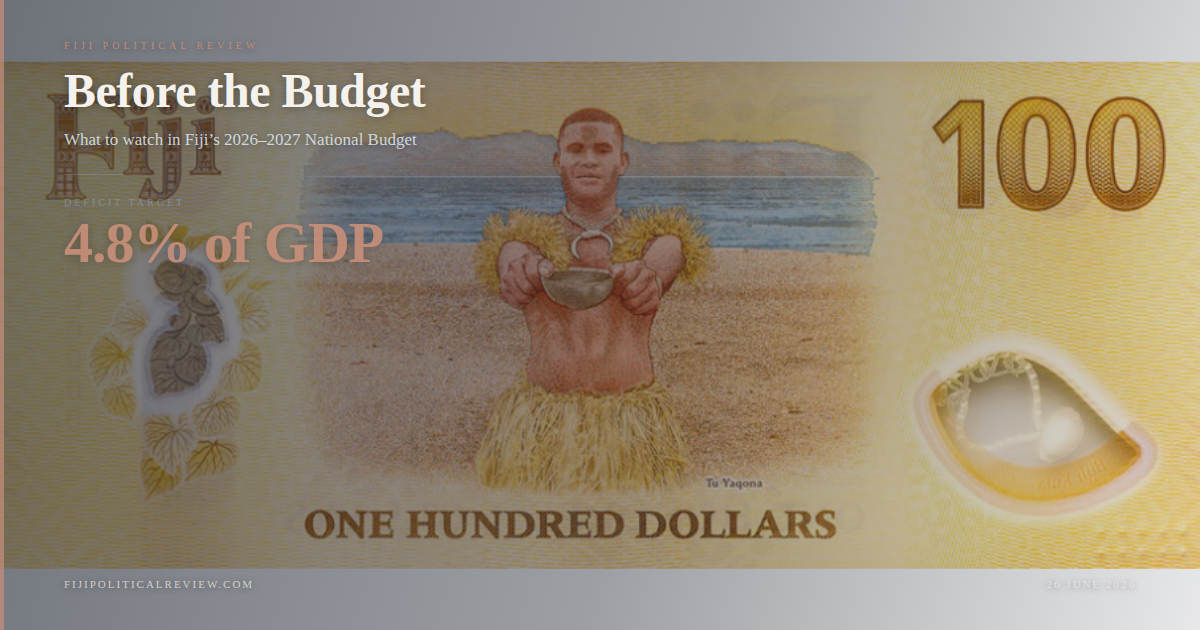
Against that, the government’s own medium-term fiscal strategy points the other way. The strategy tabled ahead of this budget signals a narrower deficit, on the order of 4.8 per cent of GDP. The precise FY2026–2027 target should be read straight off the budget documents on the day rather than taken from the strategy paper, since the two can diverge.
Now set that consolidation signal next to the pre-budget reporting. Fuel tax relief and a temporary cut to FNPF contribution rates have been reported as under consideration. Both are giveaways. Neither is confirmed, and FPR should treat them as flagged until the minister reads them out or doesn’t.
So the question on 26 June is simple to state and hard for the government to dodge: does the deficit move toward the strategy target, or away from it? A budget that promises consolidation in its strategy paper and then widens the deficit for the campaign is telling you which document it actually believes.
The debt number, and the base it’s quoted on
Government debt recently stood at about FJD 10.8 billion, or 78.9 per cent of GDP. The same debt load can appear materially different depending on the GDP base used to measure it. On the 2019 GDP base, the FY2025–2026 ratio reads around 83.3 per cent. On the older 2014 base, it reads closer to 80 per cent.
Expect the more flattering figure in the speech. The accurate way to report it is to give both numbers, state which base each uses, and make clear that the gap is a choice of denominator, not a change in what the country owes. Any coverage that repeats a single debt-to-GDP figure without naming its base has already lost the thread.
Where the resilience risk sits
This is the line that connects the budget to the longer fiscal-resilience story.
Fiji’s debt is climbing back toward a level that leaves little room to absorb a shock. A budget that pushes the ratio toward 80 per cent or beyond, while leaving no contingency for the next cyclone, is quietly spending a buffer the country may need within the same fiscal year. Borrowing after a disaster, at distressed rates, is the most expensive money a government can raise.
So watch the small lines, not just the headline. Is there a disaster-contingency allocation? Any renewal of the catastrophe-deferred drawdown facility? Any climate-financing provision that substitutes for ordinary borrowing? Those entries, or their absence, say more about resilience than the deficit headline does.
What we’ll be watching on the day
When the documents drop, read them in this order: the deficit (in dollars and as a share of GDP), the debt-to-GDP figure and its base, the split between capital and recurrent spending, and the revenue measures. Everything else is detail around those four.
At a glance, here’s what FPR will be checking, and why each one earns its place:
We’ll publish the numbers, with sources, as soon as the documents are tabled.
Sources
- Ministry of Finance (Fiji): budget announcement date and minister; June 2026 budget consultation updates.
- Government of Fiji election timeline: earliest writ day 24 June 2026; election window to 6 February 2027.
- Republic of Fiji, Medium-Term Fiscal Strategy FY2026–2027 to FY2028–2029: debt stock and debt-to-GDP figures; GDP-base comparison; deficit target.
- The Fiji Times, feature on the 2025–2026 budget: total spending ~FJD 4.8b; net deficit ~FJD 886m; debt trajectory toward ~80 per cent and FJD 11.7b by July 2026.
- Mai TV, pre-budget reporting on fuel tax and FNPF contribution-rate measures under consideration.
- Minister for Finance Esrom Immanuel, parliamentary statement: debt stock FJD 10.8 billion at 78.9% of GDP as at end of July 2025; debt projected at FJD 11.7 billion or 84% of GDP by end of July 2026 (The Fiji Times, April 2026).
Note on debt-to-GDP figures: this piece uses 78.9% of GDP, the figure cited by Minister Immanuel in Parliament (end of July 2025). The MTFS cites 77.4% against the same FJD 10.8 billion debt stock, reflecting a slightly different reference date and GDP base. Both figures refer to the same nominal debt position.
Figures are in Fijian dollars (FJD). Measures reported as "under consideration" are unconfirmed and should be verified against the budget documents on 26 June 2026.