Election Watch: Part 2 of 5
One vote in December 2022 ended sixteen years of Bainimarama. Three years on, that coalition is heading into a campaign where each party's interest in votes competes directly with their collective interest in governing. The fault lines are showing.
Coalition Stability: Can the Three-Party Government Hold Through a Campaign?
Three parties govern Fiji. People's Alliance was built by a man who led two coups. The National Federation Party is Fiji's oldest Indo-Fijian institution, rooted in the sugar cane labour movement. SODELPA's founding identity is the paramountcy of iTaukei interests. In 2022, its leader's son-in-law was Aiyaz Sayed-Khaiyum, the architect of the government they were helping to displace.
They formed a coalition by one vote. They have governed for three and a half years. The question heading into 2026 is not whether that coalition survives until the writ. It will. The question is whether it survives the campaign, and whether the votes it wins separately add up to a second term.
What held it together
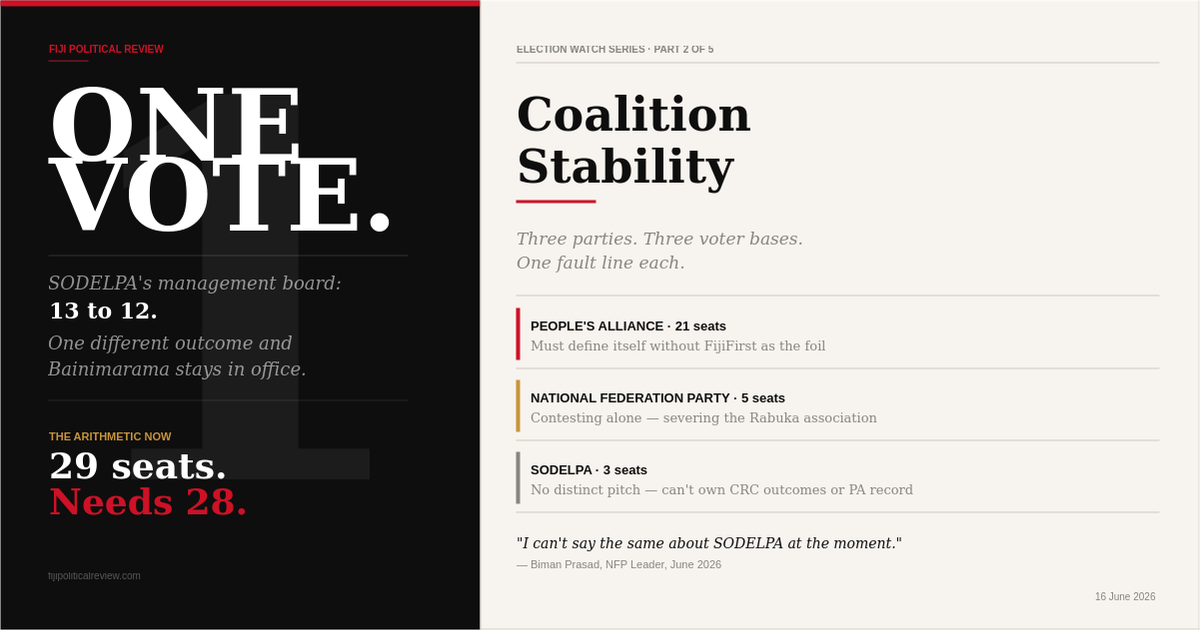
SODELPA's management board voted 13-12 to join PA and NFP in December 2022. One invalid vote. One different outcome, and Bainimarama stays in office.
The coalition's 29 seats gave it a one-seat majority over FijiFirst. That margin concentrated minds. Defection meant collapse. Each party understood the cost of breaking ranks.
Biman Prasad described the coalition as "very strong and determined," acknowledging that "like any coalition anywhere in the world, there would be discussions about issues." Discussions about issues is the diplomatic phrasing for the affirmative action debates, the resource allocation disputes, and the land tenure disagreements that run along the coalition's ethnic fault lines without breaking it.
That incentive structure changes in a campaign. Under open-list PR, every vote NFP wins is a vote that doesn't go to PA or SODELPA. The coalition's collective interest in governing and each party's individual interest in votes are, in campaign mode, at odds.
NFP contests alone
The most significant development this cycle arrived last week. Prasad confirmed the NFP will contest the election on its own, with no pre-election coalition arrangement.
This is a clean break from 2022, when PA and NFP entered a formal working arrangement. Prasad and Rabuka attended each other's events. NFP confirmed joint campaigns were likely. The two parties ran the election as a unit.
The reason for the break is specific. NFP's association with Rabuka cost it Indo-Fijian votes in 2022 that FijiFirst and Sayed-Khaiyum successfully weaponised. His 1987 coup, his SVT history, his identification with iTaukei interests: that association was used against the NFP across three consecutive elections. NFP found, as Jai Ram Reddy did before Prasad, that Indo-Fijian voters can absorb a lot, but that name carries weight.
With FijiFirst deregistered, the enforcer of that formula is gone. NFP can run on its own government record, appeal to its base without the Rabuka association, and negotiate post-election from whatever seat count it earns.
Prasad said he expects more support with the coalition than without it, but added: "I can't say the same about SODELPA at the moment." That qualifier is the most revealing sentence he has said about the coalition's prospects.
SODELPA's position
SODELPA enters 2026 holding three seats.
In 2022, it was the kingmaker, courted by both sides, needed by both sides, and it decided the government. In 2026, it is a junior partner in a coalition it joined by one vote, governing alongside a party founded by the man who walked out of SODELPA and took eight members with him.
Its base is iTaukei communal politics, chiefly structures, and land rights. In government with the NFP, it has moderated its public positioning on affirmative action, the issue its base cares most about. The CRC consultations are generating submissions that track SODELPA's founding concerns: restoration of the Senate, stronger indigenous protections, and chiefly recognition. SODELPA cannot credibly own those outcomes. The report lands after the election, if it lands before the vote at all. The coalition has governed under the 2013 Constitution for its full term.
SODELPA's campaign problem is identity. It cannot distance itself from a government it has been part of. It cannot run on indigenous rights outcomes it hasn't delivered. It cannot run on Rabuka's record without giving votes to PA.
Aseri Radrodro leads SODELPA into 2026, elected party leader at the April 2024 AGM. He holds the Education portfolio. Gavoka, 75, remains Deputy PM and holds Tourism and Civil Aviation. The leadership transition was not smooth. Radrodro was dismissed from Cabinet in January 2024 over alleged insubordination related to FNU Council appointments, before being reinstated after the management board intervened. A party that entered the 2026 campaign period with that history on record has a credibility problem that goes beyond messaging.
People's Alliance: governing party, not yet campaign machine
PA holds 21 of the coalition's 29 seats. It is the dominant partner. Rabuka is the dominant figure. That concentration of weight creates a specific problem in a three-party coalition: NFP and SODELPA both need to differentiate from PA to justify their own existence to voters, which means differentiating from the coalition's most prominent face.
Rabuka's personal approval sits at 51% satisfied in the February 2025 Lowy Institute poll. That is the coalition's strongest electoral asset. It belongs to him and to PA specifically, not to the coalition as a whole. A vote for Rabuka is a vote for PA. NFP and SODELPA have to make the case for why voters should choose them rather than simply voting for PA and letting the coalition form again post-election.
In October 2024, Rabuka confirmed that some PA members intend to form a new political entity. Internal defection from the dominant partner, even at the margins, is the scenario that most directly threatens the margin of a second term.
Campaigning separately
Under open-list PR, there is no joint ticket. Parties contest independently. The coalition is a post-election construct, not a ballot option.
What the parties can do is coordinate without formally aligning: avoid actively campaigning against each other, share infrastructure where useful, signal to voters that they remain natural post-election partners. That is Prasad's stated model. Contest alone, negotiate after.
The risk is that the discipline required to hold that line frays under campaign pressure. A SODELPA candidate competing with a PA candidate for the same iTaukei votes has an incentive to differentiate. An NFP candidate appealing to Indo-Fijian voters has an incentive to put distance between NFP and Rabuka. The candidates are not the party leaders. Their incentives are their own vote counts, not the coalition's seat total.
The seat count
The coalition holds 29 seats. It needs 28 to govern.
If the component parties hold their 2022 positions, PA 21, NFP 5, SODELPA 3, the equation works. The question is whether they hold those positions in a more fragmented field.
The FEO had reserved names for 30 proposed new parties as of late 2024. Each is a potential vote-splitter, and most will fall below 5%. Some won't. Every party that clears the threshold draws votes from somewhere. The coalition's job is to hold its base while the field around it multiplies.
PA losing two seats to a reorganised opposition or independent surge, and SODELPA falling to two seats, leaves the coalition at 27. That requires a new partner to govern. Whether a new partner exists after the count, and on what terms, is a question the coalition has not yet had to answer.
What to watch
The 2022 coordination model is already gone. Prasad is running a separate NFP circuit: branch AGMs in Nadi, Rewa, and Ra, provincial working committee meetings, and a party convention in Suva in September. None of these involves PA.
The question is no longer whether Prasad appears at PA events. That is not happening. Watch instead for whether Rabuka signals publicly that NFP remains his preferred post-election partner. If that signal doesn't come, it tells you something about how confident each party is that the other will be in a position to negotiate after the count.
SODELPA's polling trajectory matters more than is currently being discussed. Three seats on roughly 7% of the vote in 2022 is not a comfortable buffer in a field with 30 new parties competing for fragments of the same electorate. A SODELPA below 5% ends the current coalition configuration. That outcome is not probable. But it is plausible, and no one appears to be treating it as a planning risk.
The NFP's language about "any future post-election arrangement" is also worth monitoring. Prasad is leaving the door open to a coalition that does not include SODELPA, or conceivably one that does not include PA. If the numbers produce an unexpected post-election configuration, that careful phrasing will matter.
Part 3 of this series examines opposition prospects: who can actually challenge the coalition, and whether the field has the organisation, funding, and candidate depth to mount a credible alternative.
Sources: Fiji Village; RNZ Pacific; FBC News; Fiji Sun; Fiji Times; The Conversation; Lowy Institute.
All factual claims are sourced. Analysis and scenario assessments are editorial interpretation of verified facts, clearly identified as such.