Election Watch: Part 1 of 5
The writ window opens 24 June. Rabuka can call the election any day from here — but timing is strategy. This analysis maps the factors pulling him toward an early poll and those pushing him to wait, the three scenarios in play, and what the date he picks will tell us about where he thinks he stands.
Rabuka's Strategic Calculus: When Will He Call It, and Why?
The writ window opens 24 June.
From that date, Prime Minister Sitiveni Rabuka can issue the formal order that starts the election clock. The constitutional deadline is 6 February 2027. That gives him roughly seven months of manoeuvre.
It is not a neutral window. Every week Rabuka waits, conditions shift. The question is which direction they shift in, and whether he reads them correctly.
The admission
When the Electoral Commission declared the campaign period open on 25 May, Rabuka went on Mai TV and said his party had been "caught napping." He confirmed the People's Alliance had no dedicated treasurer. Candidates hadn't been finalised. The party needed to "take it up a notch."
He said this publicly, on camera, as Prime Minister, at the start of an election campaign.
Rabuka deploys directness strategically. But the substance is real. A party that governed through a hung Parliament, managed a three-party coalition on a one-seat majority, delivered a constitutional review, a referendum bill, and a budget under external economic pressure, had not apparently spent those years building the campaign machine it needed to win a second term.
That gap matters for timing. Going to the polls in August, the earliest possible date, means the People's Alliance campaigns are under-resourced with an incomplete candidate list. That is a significant disadvantage in a system where candidate quality drives votes under open-list PR.
The case for waiting
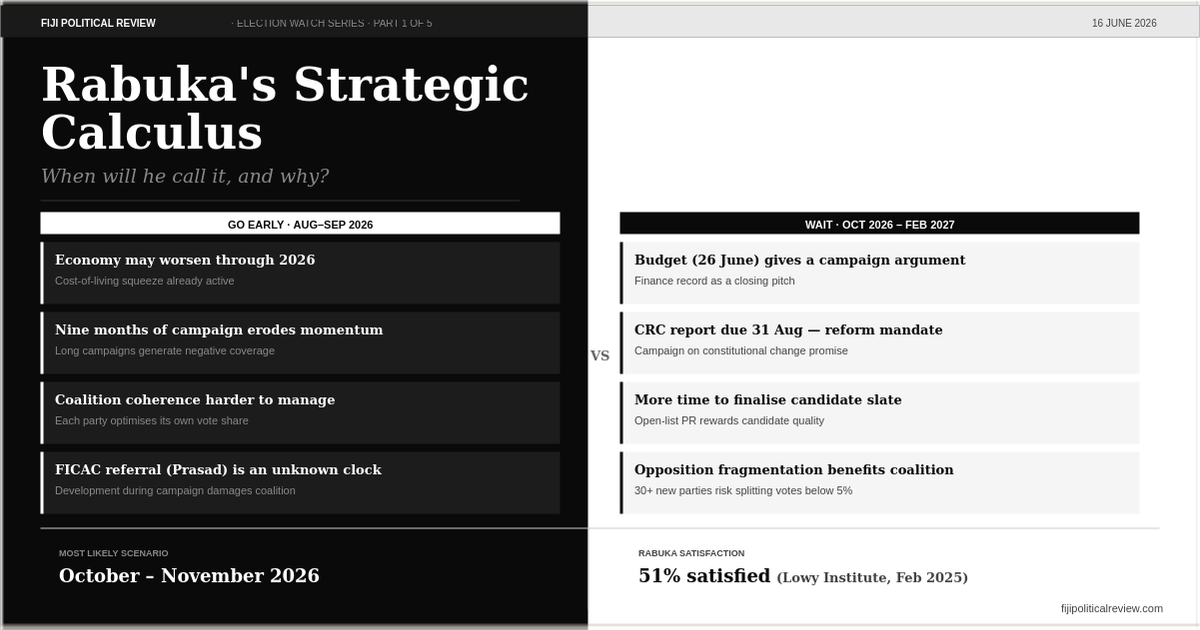
Four factors push Rabuka toward a later call.
The budget. Fiji's national budget is due 26 June, two days after the writ window opens. A government that goes to the polls before the budget drops leaves its fiscal record open to interpretation. A government that hands down a budget, then calls the election, campaigns on what it spent and why. If Finance Minister Esrom Immanuel produces a budget that addresses cost-of-living pressure, the coalition buys itself a material campaign argument.
The CRC report. The Constitutional Review Commission submits its final report by 31 August 2026. Rabuka has staked significant political capital on constitutional reform. A referendum on the 2013 Constitution was central to the coalition's 2022 pitch. If Rabuka calls the election before the CRC reports, that agenda remains unresolved. If he waits, he can campaign on what the coalition intends to do with it. The reform mandate argument is stronger with a report in hand than without one.
Candidate readiness. Rabuka confirmed candidates hadn't been finalised and the party would fast-track its shortlisting process. Under open-list PR, where voters rank individual candidates within their chosen party, candidate quality matters. A longer run-up gives the People's Alliance time to field a stronger slate.
Opposition fragmentation. The collapse of FijiFirst is restructuring the electoral landscape in ways that are still working themselves out. Former FijiFirst MPs are positioning themselves as independents. New parties are forming. The longer the campaign period runs without a fixed polling date, the more time smaller parties and independents have to collide with each other, fragment the non-coalition vote, and fall below the 5% threshold. A more fragmented field is a better field for the incumbent coalition.
The case for going early
Four factors push the other way.
Economic deterioration. The government faces domestic fiscal challenges, including bus operator fare increase requests and warnings from Electricity Fiji Limited of possible power rationing. These are not isolated pressures. They reflect a cost-of-living squeeze that is likely to worsen through 2026. An incumbent government campaigning through a deteriorating economic environment faces a harder argument. Going early, before conditions worsen further, is a standard incumbents' play.
Campaign fatigue. Rabuka cited "voter fatigue" as a reason to defer the municipal elections. The same logic applies to a long campaign window. A campaign that stretches from May 2026 to February 2027 is nine months of electioneering. Long campaigns generate negative coverage, internal party disputes, and public irritation. The longer Rabuka waits, the more his coalition is in campaign mode rather than governing mode.
Coalition coherence. The three-party coalition has held together because each party understood that defection meant collapse. As the election approaches and each party starts optimising its own vote share rather than the coalition's collective position, those internal tensions become harder to manage. A shorter campaign window gives less time for the coalition to fray publicly.
The FICAC factor. Former Deputy PM Biman Prasad was charged by FICAC in October 2025 and resigned from Cabinet. He has pleaded not guilty and his case is at pre-trial conference stage as of May 2026. A trial proceeding during the campaign is a problem for the coalition. Rabuka has limited control over that clock.
The referendum complication
Rabuka stated his intention to hold a constitutional referendum before the general election.
That sequence, CRC report, then parliamentary debate, referendum, then election, was never going to fit in 2026. The CRC reports in August. The referendum bill still needs to clear Parliament. A referendum campaign takes time. The logistics of holding a referendum and a general election in the same narrow window, with the same FEO infrastructure, are formidable.
This means the referendum, if it happens, will take place after the election. The election itself becomes a mandate for constitutional change rather than a post-referendum confirmation of it. That is a harder argument to make, but a coherent one. Rabuka's coalition ran against Bainimarama's constitution in 2022. It can run for its 2026 replacement.
Three scenarios
August to September 2026. Rabuka issues the writ shortly after the budget. Short campaign. People's Alliance is under-resourced, but the economy hasn't worsened further. Opposition fragmentation benefits the coalition. The budget is the closing argument. Risk: the party isn't ready and loses seats it could have held with more preparation.
October to November 2026. The most likely window. Budget absorbed. CRC report out. People's Alliance has had several months to organise. Rabuka campaigns on a governance record and a constitutional reform mandate. The opposition has had time to consolidate somewhat, but not enough to fully regroup.
December 2026 to February 2027. Rabuka sits on the writ until close to the constitutional deadline. This implies either that internal conditions require more time, the coalition is managing a specific development, or Rabuka is waiting on a late-breaking factor. Historically, late calls signal a government that isn't confident. The campaign runs into the summer holiday period.
The number that matters
A February 2025 Lowy Institute poll found that 51% of respondents were satisfied with Rabuka's performance, compared with 33% dissatisfied. That is a workable position for an incumbent. Comfortable but not dominant.
Under open-list PR with a 5% threshold, the People's Alliance doesn't need a majority. It needs to be the largest party in a coalition capable of commanding 28 seats. In 2022, it did that with 21 seats. The question in 2026 is whether it holds those 21 seats against a more fragmented and reorganised opposition, and whether its coalition partners hold theirs.
The timing of the writ won't answer that. But it will tell us whether Rabuka thinks it's answerable yet.
Part 2 of this series examines coalition stability: whether the People's Alliance, NFP and SODELPA can hold together through a campaign without cannibalising each other's votes.
Sources: Fijian Elections Office; Electoral Commission; Mai TV; RNZ Pacific; Fiji Sun; East Asia Forum; Lowy Institute Pacific poll, February 2025.
All factual claims are sourced. Analysis and scenario assessments are editorial interpretations of verified facts, clearly identified as such.