The Agreement that Built the 1997 Constitution
In September 1987, a political settlement was signed. It lasted 48 hours. The Truth and Reconciliation Commission has not yet asked why.

Most Fijians know about the 1987 coups. Fewer know that between them, Fiji's political leaders signed a settlement that could have changed everything. And almost nobody has asked what happened to it.
Bavadra’s Government
It was 1987 in Fiji's Parliament, as Dr Timoci Bavadra, a retired medical doctor and trade unionist, a month into office as Prime Minister, rose to speak. His Fiji Labour Party-National Federation Party Coalition had just won the April general election, ending the long leadership of Ratu Sir Kamisese Mara's Alliance government.
One observer had noted of that historic election: "It had been a long, too long, campaign, and at times some unpleasant elements of bitterness had crept in. These were now set aside. Democracy, clearly, was well and alive in Fiji." "In the public gallery on that day sat Lieutenant Colonel Sitiveni Rabuka, dressed in civilian clothes. As the clock struck 10, armed soldiers moved into the chamber. A man in a balaclava announced: 'Sit down everybody, sit down. This is a takeover.' Rabuka entered, faced Bavadra, and ordered him to lead his team out. The MPs were loaded onto army trucks and taken to Queen Elizabeth Barracks."
Fiji's coup culture began with that gesture and would consume the next four decades: a second coup occurred that same year, Fiji was declared a republic and suspended from the Commonwealth. Further coups followed in 2000 and 2006, four constitutions in forty years.
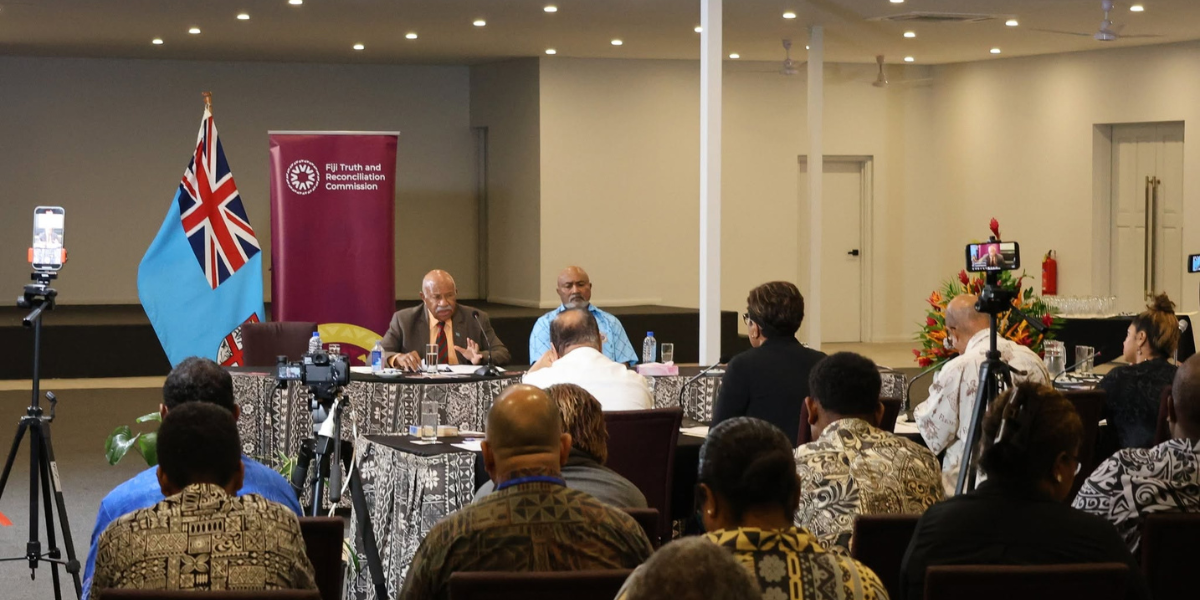
Thirty-eight years later, on 28 November 2025, Rabuka entered another room. Wearing a tie in the colours of the Fiji Army at The Novotel in Lami, he appeared before the Fiji Truth and Reconciliation Commission (FTRC), which his own coalition government had established. He is now Prime Minister and came voluntarily to confess that what happened in 1987 was wrong. In his submission, which ran for nearly two hours, Rabuka spoke of his family and the exodus of talent that followed the coups. He also repeated an older claim: that the coup was a pre-emptive action whereby the situation had reached a boiling point. In the same submission, he had repeated an older claim: that he had always believed there was no other way, the phrase that became the title of his 1987 book.
‘Wrong’, and yet ‘no other way’, his words that were used in the same afternoon in that room, under oath to history. What the FTRC did not ask in November 2025, and what Rabuka's testimony did not address across nearly two hours of sworn evidence, lies at the heart of Fiji's constitutional history. There was another way; it had a name, a date, and signatures on paper.
The Deuba Accord
The Fiji Labour Party-National Federation Party Coalition won 28 seats out of the 52 seats in Parliament in the 1987 elections. Dr Bavadra gave his first press conference as Fiji’s Prime Minister on 12 April; Brij Lal records that Dr Bavadra "viewed the ‘peaceful and honourable change of government’ as the reaffirmation of the ‘deep democratic roots of our society and the profound unity of our people’. He saw in his triumph the dawn of a new era, full of new potential and opportunity. ‘Together’, he said, ‘let us write a new chapter, which, God willing, will be one which we and our children will be proud of’. Unfortunately for him and his supporters, neither the gods nor his opponents were willing or prepared for change.”
Immediately following the May 1987 coup, Fiji’s Governor General, Ratu Penaia Ganilau, appointed an 18-member advisory council, 14 of whom were endorsed by Rabuka, and Dr Bavadra and Harish Sharma from the coalition. Critics noted that the process was designed to realise the coup’s aims through legal means. The Governor General then appointed a Constitution Review Committee in July to ‘gauge public opinion on how best to achieve the goal of strengthening the political rights of indigenous Fijians.’ The Coalition defended the 1970 constitution. Five days after the first coup, the Great Council of Chiefs met; in Rabuka’s own words before the FTRC in November 2025, “the general consensus was to support me.” The GCC, headed by Ratu Mara and supported by Rabuka, demanded a Christian state, a Fijian parliamentary majority, and Fijian-reserved control of the prime ministership, key ministries, the military, and the police. After the review committee failed to reach agreement among all parties, Ganilau convened secret negotiations. The Alliance and the Coalition negotiated the proposal at Deuba, which gave the Accord its name, and on 23 September settled its terms: a joint caretaker government, equal representation, and a constitutional review led by an independent overseas expert. A participant described them leaving the negotiations as "suitably inebriated," convinced the country was about to turn a corner.
There is one detail Brij Lal records1 that the broader historical narrative has largely ignored. Rabuka was not present at Deuba. He had been, in Lal's words, "inexplicably excluded" from the negotiations. He felt, Lal notes, "marginalised and vulnerable, used and discarded like Kleenex tissue." Urged on by hardline supporters who saw the accord as capitulation, he moved. The agreement was nullified before it could take effect.
The Deuba Accord and the 1997 Constitution
The Deuba Accord did not disappear; it had simply waited.
Between 1987 and 1996, Fiji began to see a wave of emigration, more than 50,000 people leaving the country permanently, with 84 to 90 per cent of them Indo-Fijian, taking with them the professional and economic base the country could not afford to lose. The accord’s replacement arrived in the form of the 1990 constitution, designed to permanently entrench indigenous Fijian political paramountcy. It failed on its own terms within three years, unable to hold governing coalitions together even with a heavily weighted Fijian parliamentary majority.
In 1995, Fiji established the Constitution Review Commission, chaired by Sir Paul Reeves, a former New Zealand Governor-General, an independent overseas expert heading a constitutional review, with terms requiring early return to parliamentary democracy, an account of indigenous Fijian aspirations, and a multiracial framework protecting all communities.
These were also the Deuba Accord’s terms, almost word for word.
The 1997 Constitution was steered through parliament by Rabuka and Jai Ram Reddy, the NFP leader whose party had signed the Deuba Accord a decade earlier. The coup leader and his political victim built the settlement together. The Deuba Accord’s proposition in 1987 was finally realised in July 1997; the fault was not in the design or the timing, it was the fact that one man was left out of a room, felt discarded and reached for the only power he still held.
Fiji did not find another way; it found the same way ten years later, at a cost the country is still counting.
Rabuka’s testimony to the Truth and Reconciliation Commission is not an account of September 1987. Admitting that 1987 was wrong is not the same as explaining what occurred in the 48 hours after 23 September 1987. A confession without a chronology is not truth-telling; it is closure without the truth. The Commission’s unfinished business is clear: why Rabuka was pressured to stage the second coup, who pressured him, and whether his exclusion from the Deuba negotiations was deliberate.
These are not merely questions about the past; Fiji is heading into a general election in 2026. The constitutional architecture under which the 2026 election will be conducted is a direct descendant of the Deuba Accord and realised in the 1997 constitution. The Accord’s near destruction, and the decade of instability that followed, shaped every constitutional settlement that came after it. That history has never been settled.
The Commission is due to submit its final report by January 2027; witnesses who know what happened in those 48 hours are ageing, with some already gone. PM Rabuka told the Commission he wanted to live with a clear conscience; however, a clear conscience requires a complete account. He knows what happened after Deuba; the Commission should ask him.
Sources
Lal, B.V. (1998). Another Way: The Politics of Constitutional Reform in Post-Coup Fiji. Canberra: Asia Pacific Press.
Reeves, P., Vakatora, T.R., and Lal, B.V. (1996). The Fiji Constitution Review Commission Report. Suva: Parliament of Fiji. Available at paclii.org.
Field, M., Baba, T., and Nabobo-Baba, U. (2005). Speight of Violence: Inside Fiji's 2000 Coup. Wellington: Huia Publishers.
Fiji Truth and Reconciliation Commission. (28 November 2025). Public Hearing, Testimony of Sitiveni Rabuka. Novotel, Lami, Fiji.
Fiji Truth and Reconciliation Commission. (2025). About Us. fijitrc.org. Retrieved July 2026.
Migration Policy Institute. (2003). Fiji Islands: From Immigration to Emigration. migrationpolicy.org.
Minority Rights Group International. (2008). Indo-Fijians in the Fiji Islands. minorityrights.org.
International Journal of Constitutional Law. (2007). Tale of Three Constitutions: Ethnicity and Politics in Fiji, 5(4), 639.
ConstitutionNet. Constitutional History of Fiji. constitutionnet.org.
Devpolicy Blog. (2024). Is the time ripe for constitutional change in Fiji? devpolicy.org.
Radio New Zealand. (28 November 2025). Fijian PM Rabuka blames 'insulated' upbringing for racially motivated '87 coups. rnz.co.nz.
Fiji Sun. (11 November 2025). Survivors' voices first, says Fiji Truth and Reconciliation Commission. fijisun.com.fj.
1 Brij V. Lal (1948–2019) was a Fijian historian and one of three commissioners on the 1995 Fiji Constitution Review Commission. Another Way was published in 1998. He died in Canberra in December 2019. ↩