Leaders missing and China ‘furious’: the Pacific Islands forum off to a decidedly shaky start
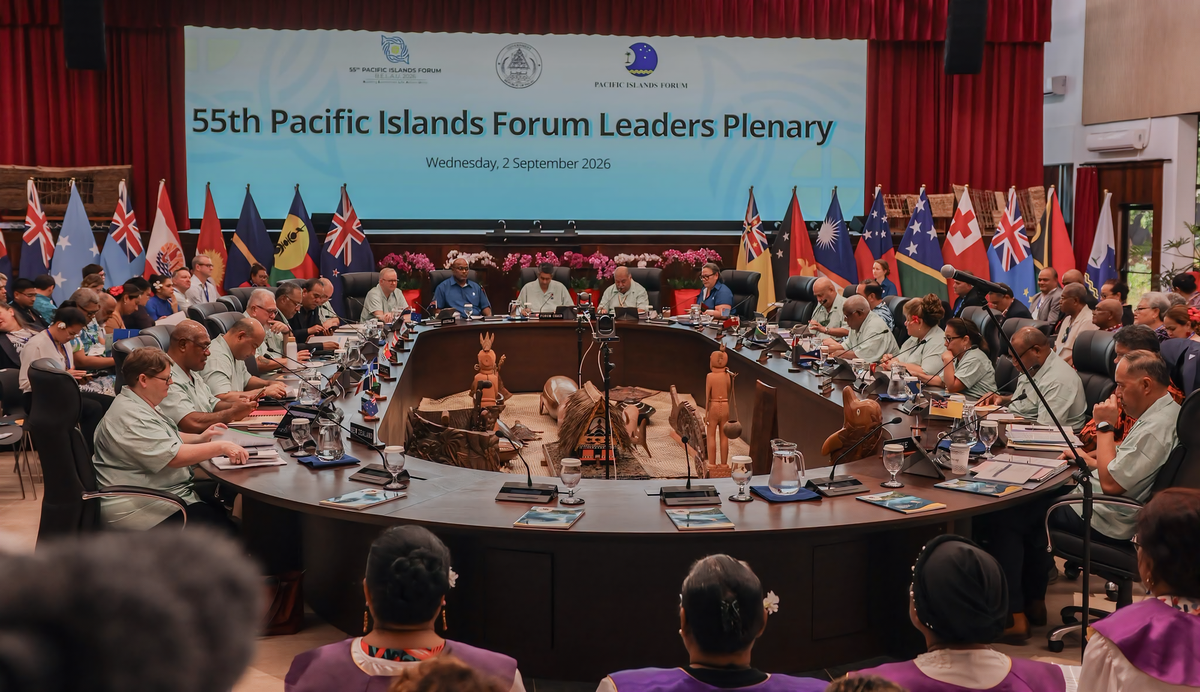
Five Pacific leaders absent, China furious over Taiwan's inclusion. The 55th Pacific Islands Forum in Palau. Republished from The Conversation.

Republished from The Conversation
Editor's note: The 55th Pacific Islands Forum Leaders Meeting is underway in Palau (30 August – 4 September 2026). It is the first Forum since Fiji signed the Vuvale Union and Ocean of Peace Alliance with Australia on 6 July, and since China's ballistic missile test in the Pacific the same day. Five heads of government are absent — from Fiji, Vanuatu, Samoa, Solomon Islands and Kiribati. The Forum's foreign ministers meeting in Suva in August failed to agree on a joint statement responding to China's missile test. FPR is republishing this analysis from The Conversation to give readers immediate coverage of the Forum while FPR develops its own analysis of Fiji's positioning within it. FPR's earlier coverage of the Vuvale Union and Ocean of Peace Alliance signing is available in our Pacific Politics section.
The annual Pacific Islands Forum (PIF) Leaders Meeting is underway in Palau, and already there has been controversy.
First, it’s a leaders meeting with a distinct lack of leaders. Second, China is reportedly furious that Taiwan is represented at the meeting in its own right.
The fact the leaders of five of the forum’s 18 members are absent – Kiribati, Fiji, Vanuatu, Samoa and Solomon Islands – has raised questions about China’s role in their withdrawal. New Zealand Foreign Minister Winston Peters said the collective absence was “highly suspicious” but did not make any direct accusation.
It has come at a time when there are many pressing issues facing Pacific Islands nations, which the forum is ideally placed to tackle.
The forum’s importance
The leaders meeting is central to Pacific diplomatic architecture. It’s the preeminent regional diplomatic institution providing a platform to voice a Pacific agenda.
On occasion, Australian prime ministers have been criticised for non-attendance, and the excuse has usually been domestic politics. This is clearly the case for several Pacific Island countries this year. For example, Solomon Islands Prime Minister Matthew Wale returned home to respond to a no confidence motion. It is a reminder that all foreign policy is driven by domestic considerations. Nonetheless, non-attendance is regionally significant.
It has been suggested some of the missing leaders may have been influenced by China. Beijing has threatened “consequences” over the Taiwanese delegation’s participation in Palau.
All this means this year’s meeting theme, “Building Economies: Life. Action. Unity”, is looking shaky.
The Pacific prides itself on unity. The “Pacific way” of diplomacy focuses on consensus. It is distinctive and effective in managing diverse interests in a culturally sound way. But the Pacific way is being challenged by outside forces and from within.
Geopolitics causing ructions in the region
Geopolitics is the prime reason, and its influence can be seen at all levels in this crisis. Core issues are China’s increasing assertiveness in the Pacific and the unintended consequences of Australia’s successful bilateral approach.
Australian Prime Minister Anthony Albanese would have been looking forward to this year’s meeting, but Canberra’s recent geopolitical successes may be a double-edged sword.
China competes with Australia by attempting to gain influence through persuasion. Aid is used to benefit Pacific Island countries. China challenged Australia in the 2010s, but Canberra responded and never lost its position as the top donor. The Lowy Aid map has clearly tracked the rise and decline in Chinese aid.
Within aid budgets a key battleground was infrastructure, which Australia largely avoided to focus on capacity-building in governance, education and health. China’s approach directly benefited elites. It was also electorally useful as benefits trickled down to ordinary Pacific islanders through their leaders. Canberra met China’s infrastructure challenge, albeit with rigorous engineering and anti-corruption standards.
Another issue is the threat of China establishing a military “base” in the Pacific. Rumours led to panic by some elements in the Australian media and a firm diplomatic response from Canberra. Australia ensured this diplomatic “red line” was never crossed through rigorous military and policing diplomacy.
China signed a security arrangement with the Solomons in 2022. Australia then secured security treaties with Tuvalu (2023), Naoero (formerly Nauru) (2024), Papua New Guinea (2025), Vanuatu (2026) and Fiji (2026).
Many Pacific Island leaders have embraced Australia’s bilateral entreaties that elevate Canberra’s geopolitical concerns. This is in contrast to the forum’s multilateral approach and could be viewed as contrary to the Pacific way.
Meanwhile, China was planning an intercontinental ballistic missile test that splashed into Pacific waters while the Ocean of Peace treaty was being signed in Suva. Needless to say, Pacific Islands leaders were not impressed, but taking sides in a geopolitical contest has consequences.
Why unity is key
Much of China’s assertiveness is focused on combating the diplomatic recognition of Taiwan. The Pacific is a central battleground in this contest. Palau is one of the few countries that recognises Taiwan. So it is difficult to separate China’s geopolitical motives with respect to competing with Australia or countering Taiwan.
Without unity, a Pacific agenda cannot be furthered. Sustainable economics is certainly a worthy focus for leaders. The Pacific has been disproportionately affected by the disruption of global supply chains caused by the US-Iran War. Belts have been tightened, and the transition to renewable energy accelerated.
But the reality is the wellbeing of Pacific islanders has been adversely impacted. Pacific governments have had fewer resources to respond. The long shadow of COVID still hangs over the region, so coordinated regional action is needed.
The forum secretariat in Suva handles routine diplomacy between Pacific Islands countries. Without the unity of Pacific leaders, it loses the authority to further core agendas on vital issues such as climate change, the Blue Pacific strategy and the Ocean of Peace Alliance between Australia and Fiji.
Pacific Island leaders can benefit from engaging in the geopolitical contest between China and Australia. But ultimately, this is distraction from the pressing issues facing the Pacific.
Michael O'Keefe, Director, Master of International Relations, Department of Politics, Media and Philosophy, La Trobe University
Michael O'Keefe has in the past worked for AusAID, the Pacific Islands Development Forum and Fijian Ministry of Foreign Affairs. La Trobe University provides funding as a member of The Conversation AU.