Policy Watch: The Vuda Incinerator Is Rejected
The Ministry of Environment and Climate Change said no. After a 1,500-page EIA, submissions and petitions, TNG Fiji's proposed 900,000-tonne waste-to-energy plant at Vuda has been rejected. TNG has until 3 July to appeal.

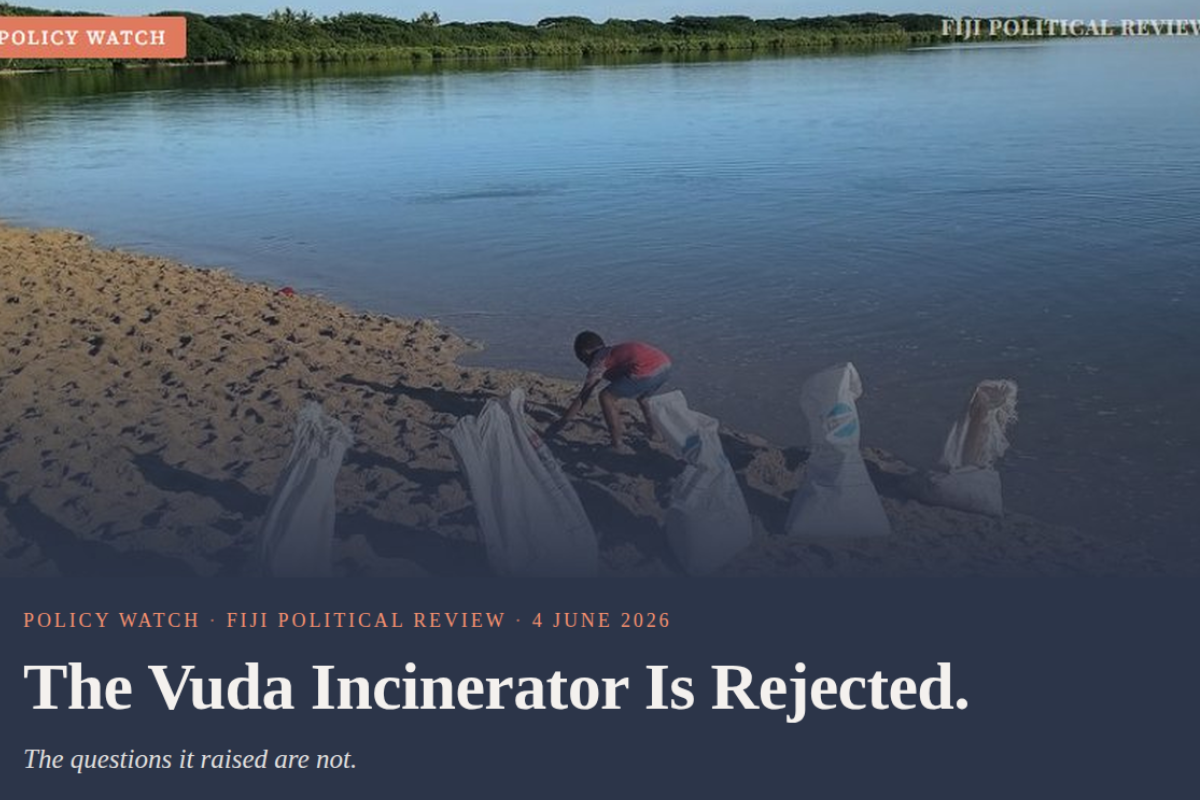
After reviewing a 1,500-page Environmental Impact Assessment, public submissions, and signed petitions, the Ministry of Environment and Climate Change formally rejected TNG Fiji's proposal for a 900,000-tonne waste-to-energy plant and deepwater port.
TNG has until 3 July to appeal.
Prime Minister Rabuka has confirmed that he respects the decision. "The strength of good governance lies in allowing institutions to do their work, respecting the law, and making decisions in the public interest."
Permanent Secretary Dr Sivendra Michael listed eleven areas where the EIA left questions unresolved: the scale of the project, waste supply, imported waste, hazardous ash management, water supply, public health risks, environmental impacts, road and port infrastructure, social and cultural impacts, tourism impacts, and the overall economic case. That list covers almost every serious concern that communities, landowners, and civil society raised during months of public debate.
Prior to the rejection, Foreign Affairs Minister Sakiasi Ditoka published a Facebook post defending waste-to-energy technology, citing his personal visit to the TuasOne plant in Singapore. He called for a debate based on evidence rather than fear. He acknowledged that any proposal in Fiji must undergo rigorous due diligence.
The Ministry of Environment conducted due diligence. It found the TNG proposal failed it.
Ditoka was not wrong about WtE technology in general. Singapore, Japan, and parts of Europe run modern, well-regulated plants. The technology itself is not the problem. This proposal, at this scale and at the proposed site, was the problem. The rejection confirms what the due diligence standard looks like.
Will TNG appeal?
Almost certainly. TNG's principal backer Ian Malouf spent seven years trying to get a comparable waste-to-energy plant approved in Western Sydney before it was rejected as a risk to human health in 2018. He did not walk away from that quietly, and there is no reason to expect a different response here.
The appeal window is short, but the pathway exists. An appeal to the Environmental Tribunal shifts the terrain from technical assessment to legal argument, where TNG can challenge whether the process itself was sound rather than relitigating the environmental merits. If the Tribunal rules in TNG's favour, the government retains the right to appeal to the High Court. If TNG appeals and loses at the Tribunal, it may seek judicial review in the High Court on a question of law. That pathway extends the process well beyond the current parliamentary term.
An appeal to the Environmental Tribunal is not a rehearing of the environmental merits. The Tribunal's role is to determine whether the Ministry applied the correct legal standard and followed the prescribed process under the EMA and the Environment Management (EIA Process) Regulations 2007. TNG cannot simply arrive with better environmental data and ask the Tribunal to reach a different conclusion. It must identify a legal error in the decision itself.
The one thing that might give TNG pause is the breadth of the rejection. Eleven unresolved issues across every dimension of the proposal are not a narrow technical deficiency that a skilled appeal can argue around. It is a finding that the proposal was fundamentally inadequate. That is harder to overturn than a single procedural error.
The political calendar also matters. With a general election due between August 2026 and February 2027, TNG may conclude that a protracted Tribunal process will outlast the current government. FPR will treat the 3 July deadline as a live tracking event.
The rejection settles the immediate question, but it does not settle Fiji's waste problem. The Taskforce noted that this process sparked a long-overdue national conversation, including the ongoing situation at the Vunato landfill. Dr Michael was careful to say: "This is not a decision against investment or against new waste solutions."
What the rejection does confirm is something worth holding onto. Fiji's environmental institutions, when given the space to do their work, applied the standard the Prime Minister described, which matters, especially with a general election approaching and major infrastructure decisions ahead.
What FPR is watching
One. Whether TNG appeals to the Environmental Tribunal before 3 July 2026
Two. Whether the government now open a public process on Fiji's long-term waste management strategy
Three. Whether the Vunato landfill and municipal waste infrastructure receive serious policy attention
Four. Whether any future WtE proposal addresses the scale, waste supply, and ash management concerns that ended this one
Sources: Sakiasi Ditoka, Minister for Foreign Affairs and External Trade, Facebook post, 1 June 2026; Ministry of Environment and Climate Change rejection announcement, 4 June 2026; Permanent Secretary Dr Sivendra Michael press conference, 4 June 2026; Prime Minister Rabuka statement, 4 June 2026; Protect the Heritage Coast — Vuda-Saweni Taskforce statement, 4 June 2026, Fiji Village.