Mapping Fiji's Drug Trade: An Interactive Network

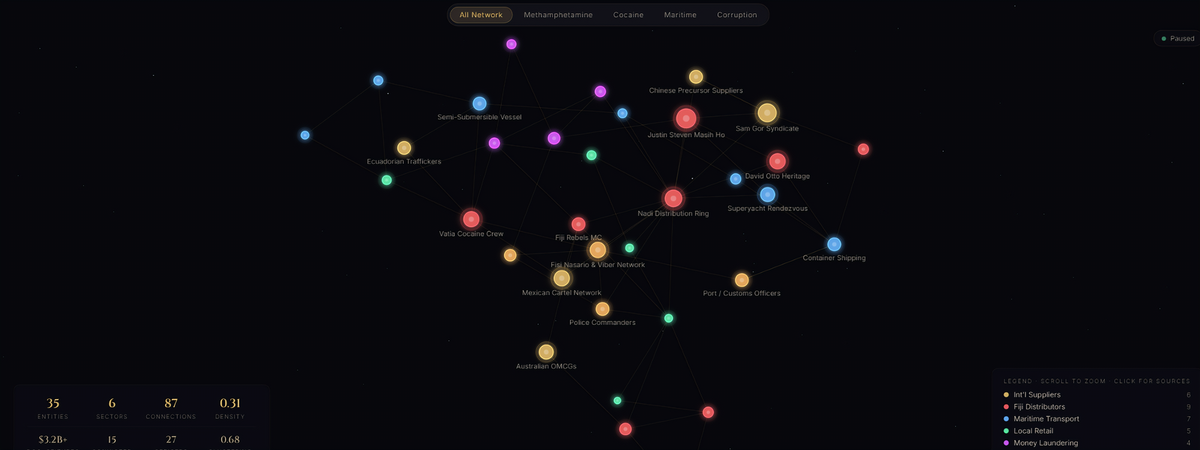
Who connects to whom, where the money goes and where the system breaks down.
A timeline tells you what happened and when, but a network map tells you how it works.
FPR has built an interactive constellation of Fiji's documented drug trade, 35 entities, 87 connections, every node sourced to court records, official reports, or verified published reporting. International suppliers, local distribution rings, and maritime transport methods. Money laundering infrastructure and corrupt officials.
How to Read It
Each point of light is a documented entity. The size of a node reflects its centrality in the network; larger nodes have more connections and greater documented significance. The colour indicates the type of actor: gold for international suppliers, red for Fiji-based distributors, blue for maritime transport, green for local retail, purple for money laundering, and orange for corrupt officials.
Click any node for the source evidence behind it. Every entry distinguishes between court-verified facts, intelligence-reported information, and pattern-inferred connections; the confidence level is visible on each node.
Use the filters at the top to isolate specific drug types or sectors. The corruption filter is particularly instructive.
What the Network Reveals
Three things stand out when you look at the full constellation.
The first is the logistics depth. International cartels don't connect directly to street-level retail. Between the Mexican cartel network and the Ecuadorian traffickers, and between a Suva nightclub and a kava bar, there are multiple intermediary layers: maritime transport, local distributors, and storage sites. The 2024 Nadi meth case documented this in court: a satellite phone call, a superyacht rendezvous on the high seas, a barge hired as cover, a jetty landing, a house in Legalega. Each step is a node. Each node is a potential interdiction point. Each node is also a potential point of compromise.
The second is the financial infrastructure. Trafficking revenue doesn't disappear. The network shows it operating across real estate investment,remittance services, cash-heavy businesses, and trade-based laundering. This is standard transnational organised crime methodology, documented by UNODC, NZ Customs, and the Pacific Organised Crime Index. The constellation makes it visible as a parallel network running alongside the drug supply chain.
The third, the one that matters most for governance analysis, is where the corruption layer sits. Not at the edges of the network; at the centre. Port and customs officials connect directly to container shipping and to the core distribution nodes. Police commanders connect to the Nadi distribution ring. The Director of Serious Organised Crime and six senior officers, as documented in OCCRP reporting based on leaked Viber chats, connect outward to both distributors and political contacts.
The corruption layer is not incidental; in network terms, it is load-bearing.
The Evidence Standard
FPR operates under strict evidence. Nothing in this constellation is invented. The node describing Justin Ho's role is sourced to ABC News, PMN, and RNZ trial reporting. He was convicted and sentenced to life imprisonment with a 30-year non-parole period. The node describing the Vatia cocaine crew is sourced to the Fiji Times, RNZ, and ABC News coverage of the January 2026 arrests; those people are before the courts and presumed innocent. The distinction is visible in the confidence badges on each node.
Persons marked CHARGED are before the courts. Presumed innocent. The constellation documents the charge, not a conviction.
Nodes marked COURT-VERIFIED reflect facts established in legal proceedings. Nodes marked INTELLIGENCE-REPORTED reflect published reporting from named organisations. Nodes marked PATTERN-INFERRED reflect documented regional patterns from UNODC, Lowy Institute, or comparable sources applied to Fiji's specific context.
A Living Document
The constellation will be updated as cases progress. The Vatia cocaine matters are before the Ba High Court. The 11 officer files sent to the ODPP in May 2026 have not yet resulted in charges, and the Colombia International Joint Investigations Team, announced at the Pacific Transnational Crime Summit, is now operational.
The network will change. FPR will document it.
The standalone constellation is available at editorfpr.github.io/fpr-drug-tracker/constellation.html. The full Drug Intelligence Hub, timeline and network, are at editorfpr.github.io/fpr-drug-tracker.