Election Watch 2026
Fiji goes to the polls between August 2026 and February 2027. This briefing tracks the electoral timeline, explains how the system works, maps 20 red flags drawn from Fiji's political history and international monitoring standards, and flags what to watch before the writ drops.

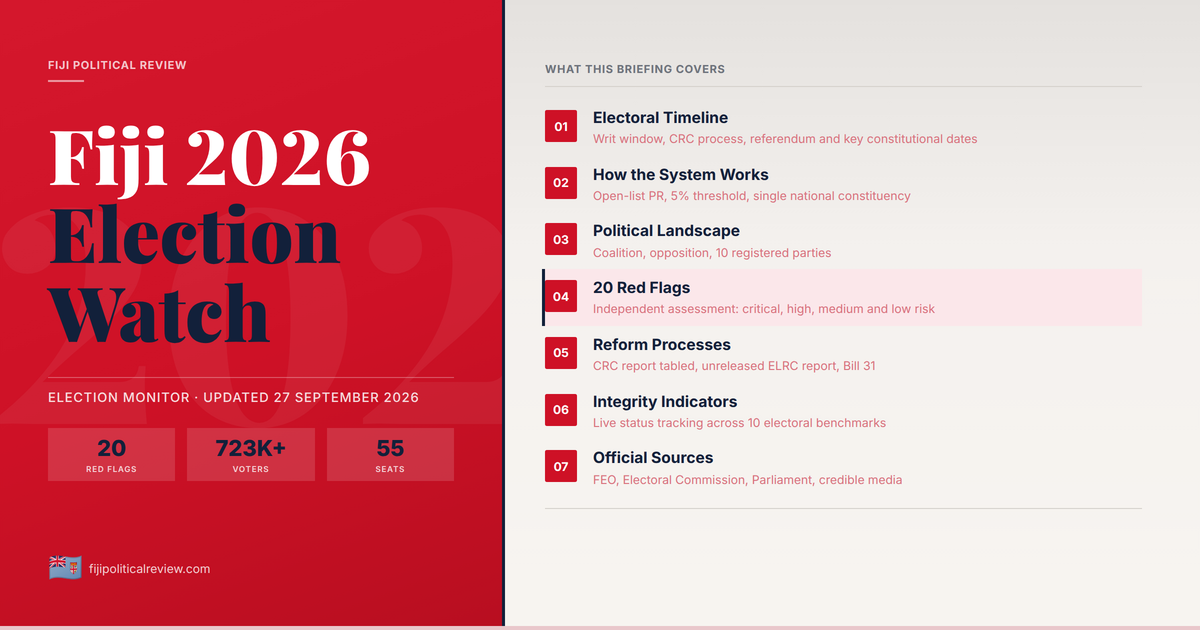
Election Monitor · Updated 27 September 2026
Fiji 2026
Election Watch
Fiji must vote by 6 February 2027. No writ has been issued, and the government now wants a new Constitution in force by 24 December 2026, the same day as the writ deadline. This briefing tracks the timeline, the constitutional rewrite running alongside it, 20 red flags drawn from Fiji's political history and international monitoring standards, and what to watch as Parliament sits from 28 September.
On this page
Electoral Timeline
Fiji's general election must be held within a constitutionally fixed window. The Prime Minister advises the date and the President issues the writ (the formal order that starts the election clock). The writ window opened on 24 June 2026 and closes on 24 December 2026.
The earliest possible election day, 7 August 2026, has passed without a writ. On 23 September, PM Rabuka told RNZ Pacific the government had not set a date and would weigh it against the constitutional amendment process and the Elections Office's preparation time.
| Milestone | Date | Status |
|---|---|---|
| Earliest Writ Day | 24 June 2026 | Window open |
| Earliest Election Day | 7 August 2026 | Passed, no writ |
| Campaign Period | Opened 25 May 2026 | Active |
| CRC Report to President | 31 August 2026 | Delivered |
| CRC Report tabled in Parliament | 22 September 2026 (special sitting) | Public |
| Parliament sitting | 28 September to early October 2026 | Constitution Amendment and Referendum Bills expected |
| Proposed constitutional referendum | November to mid-December 2026 | Proposed |
| Target date for new Constitution | 24 December 2026 | Government target |
| Latest Writ Day | 24 December 2026 | Constitutional deadline |
| Latest Election Day | 6 February 2027 | Constitutional deadline |
| Municipal Elections | Deferred, date TBC | Postponed |
Sources: Fijian Elections Office legal timelines (March 2026); PM Rabuka video update (26 June 2026); Fiji Government statement on the CRC process (September 2026); RNZ Pacific interview with PM Rabuka, Savusavu (23 September 2026). Parliament's September sitting has been reported as ending 2 October (Fiji Sun, fijivillage) and 3 October (Fiji Sun); FPR will confirm against the Parliament order paper.
How the Electoral System Works
Fiji uses an open-list proportional representation system under the 2013 Constitution. There are no electorates. The whole country is one constituency. Unless the Constitution is amended before the writ, this is the system the next election runs under.
How voting works
| Element | Detail |
|---|---|
| Your ballot | You vote for one candidate. That vote counts toward the candidate's party total and decides the order in which that party's candidates win seats |
| How seats are allocated | D'Hondt method: seats distributed proportionally based on party vote share |
| The 5% threshold | A party must win at least 5% of total votes nationwide to enter Parliament. Parties below that threshold win no seats, however many votes they receive |
| No geographic districts | Unlike most Westminster systems, there are no local electorates. Every voter is on the same national roll |
| Election term | 4 years. Current Parliament first sat on 24 December 2022 |
Voter registration trend
| Election / date | Registered voters | Change |
|---|---|---|
| 2014 | 591,101 | – |
| 2018 | 637,527 | +46,426 |
| 2022 | 693,915 | +56,388 |
| 31 December 2025 | 707,982 | +14,067 on 2022 |
| 30 June 2026 | 723,000+ | about +29,000 on 2022 |
Source: Fijian Elections Office, via RNZ Pacific (30 June 2026 figure reported as "more than 723,000"). Change calculations: 707,982 − 693,915 = 14,067; 723,000 − 693,915 = 29,085, rounded because the FEO figure was reported as a floor. The earlier FEO projection of 750,000 has been removed pending an updated FEO figure. Registration closes when the writ is issued.
Political Landscape
Current Coalition Government
| Party | Leader / figure | Role |
|---|---|---|
| People's Alliance | Sitiveni Rabuka | Prime Minister |
| People's Alliance | Manoa Kamikamica | Deputy PM (sworn back in 4 August 2026) |
| People's Alliance | Esrom Immanuel | Finance Minister (from October 2025) |
| National Federation Party (NFP) | Biman Prasad | Party leader. Resigned from Cabinet October 2025 after FICAC charge. Trial under way at Suva Magistrates Court; High Court dismissed his stay application on 21 September 2026 |
| SODELPA | Aseri Radrodro | Party leader and Education Minister. First batch of 2026 candidates announced at AGM, 27 June 2026 |
Opposition & key developments
Opposition Leader: Inia Seruiratu, leader of the People First Party (PFP), registered on 19 January 2026. PFP is largely made up of former FijiFirst MPs and says it will build a manifesto through public consultation.
FijiFirst deregistered. The former ruling party that governed Fiji from 2014 to 2022 was deregistered in 2024 after failing to comply with the Political Parties Act. Former PM Frank Bainimarama was convicted in March 2024 and sentenced to one year imprisonment for attempting to pervert the course of justice. Its former MPs have largely regrouped under PFP and One Nation.
10 registered parties. People's Alliance, SODELPA, NFP, All People's Party, Fiji Labour Party, We Unite Fiji Party, Unity Fiji Party, People First Party, NeXTGEN Alliance Party (NGAP) and One Nation. NGAP was registered on 26 June 2026 after resubmitting an application rejected for failing membership thresholds. One Nation (registered officer Ravindran Kumaran) became the tenth party in late June; the same group had applied as FijiansFirst, which the FEO rejected on 27 April 2026 after objections that the name too closely resembled FijiFirst. Liberation of Fiji Party applied on 3 June 2026; FPR has not confirmed a registration decision.
SODELPA candidates announced. At its AGM at Suvavou Village, Lami on 27 June 2026, SODELPA unveiled its first batch of proposed candidates and said it intends to field candidates for all 55 seats. A proposal for a General Voters' Wing was also put forward.
One vacant seat. Following the death of NFP MP Agni Deo Singh, his seat stays vacant until the election, leaving Parliament with 54 sitting members. That matters for the two-thirds vote a constitutional amendment needs (see Section 05).
Municipal elections postponed. PM Rabuka deferred the September 2026 local government elections (the first since 2005 and a 2022 campaign promise), citing a projected FJ$18 million cost and "global headwinds." Opposition Leader Seruiratu called the deferral a "worrying sign."
Red Flags: Independent Assessment
Compiled from Fiji's political history, Pacific electoral patterns, and international election monitoring standards. The list stands independent of any specific political document or claim.
Critical: immediate threat to electoral integrity
| # | Red flag | Why it matters | Historical parallel |
|---|---|---|---|
| 1 | Military statements on election timing or outcome | Fiji's military has intervened four times (1987, 2000, 2006, 2009). Any statement from RFMF Commander Ro Jone Kalouniwai about "national interest" or "stability" must be treated as a potential intervention signal. | 2006: Commodore Bainimarama cited a "clean-up campaign" to justify the takeover. |
| 2 | State of emergency or public order pretext | Declaring emergency powers before or during the election period could suspend normal electoral processes and civil liberties. | 2009: Abrogation of the 1997 Constitution under "public emergency" pretext. |
| 3 | Judicial independence undermined | Dismissal of judges, interference in court processes, or refusal to enforce court orders related to elections. | 2009: All judges dismissed after the Court of Appeal ruled the 2006 coup illegal. |
| 4 | Media outlets shut down or journalists arrested | Restriction of information flow prevents voters from making informed choices and blocks accountability. | 2006 to 2014: Heavy media censorship under Public Emergency Regulations. |
High: serious risk to fair competition
| # | Red flag | Why it matters | What to monitor |
|---|---|---|---|
| 5 | Selective enforcement of campaign finance laws | If rules apply to opposition but not government parties, the playing field is tilted. | Track FEO enforcement actions; compare treatment across parties. Watch Bill 31 (Section 05), which rewrites donation and disclosure rules mid-campaign. |
| 6 | Government resources used for campaign purposes | State vehicles, civil servants, or public funds directed toward ruling coalition candidates. | Monitor ministerial travel schedules and government advertising timing. |
| 7 | Restrictions on opposition rallies or gatherings | Permit denials, excessive security requirements, or last-minute venue cancellations. | Compare treatment of government vs. opposition events. |
| 8 | Voter intimidation or vote-buying | Direct threats, offers of goods or money for votes, or coercion of public employees. | Document reports from civil society, social media, and observer missions. |
| 9 | Disinformation campaigns targeting candidates | Coordinated false narratives, doctored images, or fabricated scandals spread via social media or anonymous pages. | Track patterns of viral false content; timing often peaks just before election day. |
| 10 | Cyberattacks on electoral infrastructure | DDoS attacks on the FEO website, hacking of the voter database, or disruption of results transmission. | Monitor FEO system uptime and any announced security incidents. |
Medium: erosion of democratic norms
| # | Red flag | Why it matters | Context for Fiji |
|---|---|---|---|
| 11 | Civil society organisations harassed or deregistered | NGOs and watchdog groups provide crucial oversight. Their silencing removes accountability layers. | Fiji has seen NGO restrictions under previous governments. |
| 12 | Academic or expert criticism suppressed | Universities and researchers often identify electoral flaws early. Pressure on them prevents problems from surfacing. | Prof. Wadan Narsey (ELRC Commissioner) has faced political pressure historically. |
| 13 | Diaspora voting restrictions tightened without justification | Fiji citizens abroad have voting rights. Unexplained changes to diaspora registration or voting procedures could disenfranchise specific demographics. | FEO has been expanding diaspora outreach; watch for sudden reversals. |
| 14 | Election date announced with minimal notice | Short campaign periods disadvantage smaller parties and independent candidates who lack established machinery. | Constitutional minimum is 45 days from writ to election; watch if government pushes for the bare minimum. |
| 15 | Seat redistribution or boundary changes without consensus | Any proposal to change seat numbers or introduce districts could be gerrymandered. | Now live. The CRC recommends 41 House seats plus a 19-member Senate, MMP, and a Constituency Boundaries Commission. PM Rabuka said on 23 September that without the census due in 2027, constituencies may have to be mapped from projections of 10-year-old census figures. |
Low: monitor for context and trends
| # | Red flag | Why it matters |
|---|---|---|
| 16 | Unusually high number of last-minute candidate registrations | Could indicate strategic party fragmentation designed to confuse voters or manipulate threshold calculations. |
| 17 | Polling station changes without adequate public notice | Voters arriving at wrong locations equals disenfranchisement. |
| 18 | Results delays without transparent explanation | Slow counting creates a vacuum for false claims; fast counting without verification risks errors. |
| 19 | Rejection of international observer missions | Fiji has invited observers since 2014. Refusal would signal a reduced commitment to transparency. |
| 20 | Post-election refusal to concede or accept results | Peaceful transfer of power is the ultimate test. Watch for premature victory claims or baseless fraud allegations. |
Early warning indicators
These signals often appear 3 to 6 months before major electoral problems.
- Government officials begin questioning the "readiness" of the FEO, which may pretext an intervention
- Military exercises scheduled near the election date
- Coordinated "patriot" accounts proliferate on social media
- Key civil society figures receive threats or leave the country
- Foreign diplomats become unusually vocal about "stability"
- Economic indicators suddenly worsen, creating public anxiety that can be exploited
- Opposition figures face sudden legal charges: selective prosecution as a political tool
- The constitutional amendment timetable slips toward the 24 December writ deadline
What counts as a genuine safeguard
Genuine safeguards are applied equally to all parties, announced transparently in advance, and subject to independent oversight.
| Action | Why it's legitimate |
|---|---|
| FEO conducting voter roll audit | Standard pre-election practice |
| Electoral Law Reform Commission recommendations | Mandated reform process |
| International observer invitations | Transparency best practice |
| Campaign finance disclosure requirements | Accountability measure |
| Media code of conduct agreements | Self-regulation by the industry |
| Security presence at polling stations | Voter protection, if proportional |
Sources: International IDEA electoral integrity framework, Commonwealth election observation guidelines, Pacific Islands Forum democratic principles, and Fiji's political history (1987 to 2022).
Reform Processes
Three processes now bear directly on how and when Fiji votes: the constitutional rewrite, the unreleased electoral review, and a bill rewriting party finance rules. All three are in play during the September sitting.
Constitutional Review Commission (CRC)
Established in March 2026, the CRC ran nationwide consultations and delivered its report and a Draft Constitution Bill to President Ratu Naiqama Lalabalavu on 31 August 2026. Cabinet endorsed tabling, and the 236-page report was tabled and made public at a special sitting of Parliament on 22 September 2026. Cabinet says tabling does not mean it accepts every recommendation.
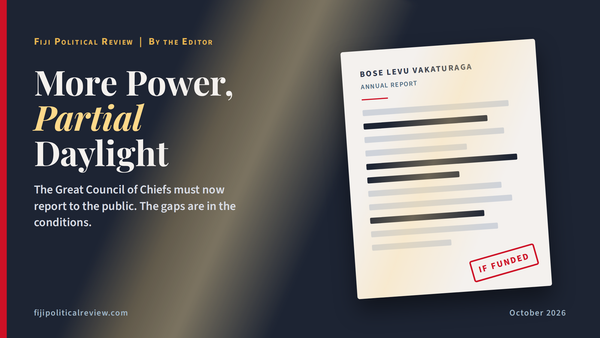
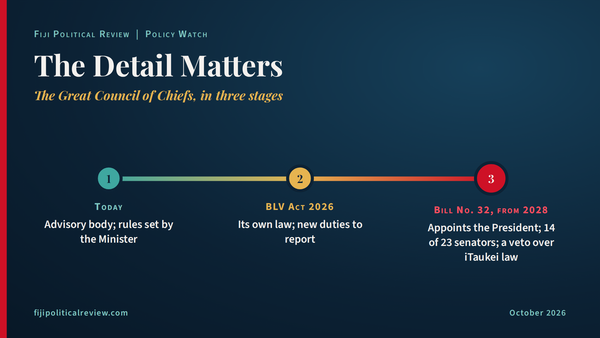
Headline recommendations: a 60-member bicameral Parliament (41-member House of Representatives and a 19-member Senate); a Mixed Member Proportional (MMP) system combining constituency seats with party-list seats; an independent Constituency Boundaries Commission and abolition of the single national constituency; repeal of the 2013 Constitution's broad coup immunity; constitutional recognition of the Great Council of Chiefs (Bose Levu Vakaturaga); a military focused on external defence; and the return of the Public Service Commission.
The path to a new Constitution: under the Supreme Court's 2025 opinion, an amendment needs two-thirds support in Parliament, then a simple majority in a referendum. The National Referendum Bill has not yet passed. The Constitution Amendment Bill and the Referendum Bill are expected in the sitting that opens 28 September. The government proposes a referendum between November and mid-December and wants the new Constitution in force by 24 December 2026. Fiji has never held a referendum.
The two-thirds maths: two-thirds of 55 seats is 36.67, so 37 votes. Two-thirds of the 54 currently sitting members is exactly 36. FPR has not confirmed which denominator Parliament will apply.
Pushback: the Centre for Democracy and Dialogue (formerly Dialogue Fiji) has warned the timetable raises serious constitutional, legal and democratic concerns, arguing Parliament's mandate is time-bound. Opposition MP Ketan Lal objected to rushing the changes into a referendum within a few months. One minor coalition partner has also distanced itself from any rushed reform.
Critical constraint: the 24 December target for the new Constitution is also the last day the writ can be issued. If the amendment passes on the government's timetable, the rules for the election could change in the same week the election must be called. If it slips, the election runs under the 2013 system. PM Rabuka told fijivillage that extending the 6 February deadline would be "outside the law as I see it now."
Electoral Law Reform Commission (ELRC) review
Chair: Former Chief Justice Daniel Fatiaki. Members: Prof. Wadan Narsey, Seini Nabou, Dr Deidre Brookes.
The review's final report, An Electoral System For the People From the People, was handed to Acting AG Siromi Turaga on 8 July 2025. Three draft Bills are annexed: the Political Parties and Candidates Bill 2025, the Electoral Bill 2025 and the Constituency Transition Regulations 2025. In November 2025, Commissioner Narsey released the recommendations himself after the delay, drawing a reprimand from the Acting AG. On 26 June 2026, PM Rabuka publicly acknowledged the report for the first time.
In responses to FPR on 5 and 11 September 2026, Fiji Law Reform Commission Director Raijeli Lebaivalu Tuivaga said the Commission will not publish the report until a Cabinet sub-committee approves it, Cabinet tables it and Parliament introduces the Bills. She rejected the description of the report as suppressed, saying the legal work of reform is complete and the political stage of the process has begun. FPR has received her formal right of reply.
Status: Report not publicly released. Not tabled in Parliament as at 27 September 2026. Recommendations disclosed by Commissioner Narsey (November 2025).
Bill 31 of 2026: party finance and disclosure
The Political Parties (Registration, Conduct, Funding and Disclosures) (Amendment) Bill 2026, introduced by Acting AG Siromi Turaga, was gazetted on 20 August 2026 and sits with the Standing Committee on Justice, Law and Human Rights ahead of the sitting from 28 September.
What it changes: a FJ$3 million campaign spending ceiling per party and FJ$300,000 per candidate; deletion of the FJ$10,000 annual cap on individual donations; a rewrite of section 22(3) that turns the ban on donations from non-citizens and former Fijian citizens into a permission; deletion of section 24's personal asset, income and liability disclosure for candidates and officeholders; and disclosure falling due 60 days after polling.
The Centre for Democracy and Dialogue calculated a possible national campaign spend of FJ$19.5 million under the new ceilings. The Fiji Labour Party publicly opposed removing the FJ$10,000 cap.
Truth & Reconciliation Commission
Enacted December 2024. Commissioners sworn in 30 January 2025. Operational since May 2025. Chaired by Austrian diplomat Marcus Brand. Hearings are running across Fiji, receiving testimonies on the 1987, 2000 and 2006 coup periods. The government allocated FJ$1.5 million in the 2025-2026 budget for operations. Final report due to the President by January 2027.
Election Integrity Indicators
| Indicator | Status | Notes |
|---|---|---|
| Election date announced | Pending | No date set as at 23 Sept (PM Rabuka). Writ due by 24 Dec 2026; election by 6 Feb 2027 |
| Voter roll | Figures released | 723,000+ registered as of 30 June 2026 (FEO). Registration closes when the writ issues |
| Party registration | 10 registered | Closes when the writ issues. Liberation of Fiji Party decision not confirmed by FPR |
| Candidate nominations | Not open | Open after the writ is issued |
| Campaign finance rules | Under amendment | Campaign period opened 25 May 2026. Bill 31 would rewrite donation and disclosure rules mid-campaign |
| Rules the election runs under | Uncertain | Depends on whether the constitutional amendment passes Parliament and a referendum before the writ |
| Referendum framework | Pending | National Referendum Bill not yet passed |
| Media access regulations | Existing | Monitor compliance during campaign |
| International observers invited | Pending | Typically announced closer to election |
| Results tabulation transparency | Committed | FEO committed; track any process changes |
Red Flags to Watch
Not every controversy is equal. Here's how to triage what you see.
- Calls to delay or postpone the general election beyond 6 February 2027, the constitutional deadline
- Proposals for an unelected interim government. Any framing ("reform," "stabilisation," "caretaker") that suspends the 4-year election mandate
- Unverified claims of mass voter fraud circulated without evidentiary basis
- Attacks on FEO independence or attempts to replace electoral leadership
- Changes to electoral law without proper parliamentary process, or rushed through close to the writ
- Restrictions on party registration or candidate eligibility
- Media censorship or restricted campaign access
- Violence or intimidation against candidates or voters
- Debate over the 5% threshold: legitimate policy discussion
- Voter registration expansion: normal pre-election activity
- Technology procurement: watch for transparency, not existence
Official Sources
Reporting used in this update
Credible news sources
Why this matters
Fiji has a history of extra-constitutional takeovers in 1987, 2000 and 2006. All were initially justified as necessary interventions. Any proposal to suspend elected government, however it's framed, should be read against that history and against the 2013 Constitution's explicit 4-year election mandate.
The 2026 cycle adds a second test. A lawful constitutional rewrite is now running on a timetable that ends on the writ deadline. Whether Fiji gets a new Constitution, an election under the old one, or both in quick succession, the transfer of power still has to happen by 6 February 2027.