When the Quad Comes Calling: Multilateral Architecture and Fiji’s Embedded Alignment
On 25 May, the Vuvale union appeared on the Fiji Parliament's order paper. The next day, the Quad named Fiji pilot for its first joint infrastructure project. The timing was coincidental; the architecture it exposed was not. They reveal how Fiji's strategic position is being shaped, and by whom.


Part I of II
The Quad port announcement, the Vuvale Union, and the architecture of accumulated dependency
On 26 May 2026, the day after the Vuvale Union appeared on the order paper for Parliament, the foreign ministers of the United States, Australia, Japan, and India met in New Delhi and announced Fiji’s inclusion in a new multilateral port infrastructure project. Australian Foreign Minister Penny Wong described it as “the strongest ever commitment from the Quad to the Pacific.” US Secretary of State Marco Rubio said it would “serve as a model for other projects in the future.”
The timing was not planned as a single coordinated moment. The Quad meeting and the parliamentary sitting were both scheduled. But their coincidence within twenty-four hours is analytically useful precisely because it was not staged. It makes visible what is otherwise easy to obscure: that Fiji’s strategic position is being shaped simultaneously at the bilateral and multilateral levels. The two processes are distinct in their origins and their legal character. Their combined effect on Fiji’s strategic autonomy is not.
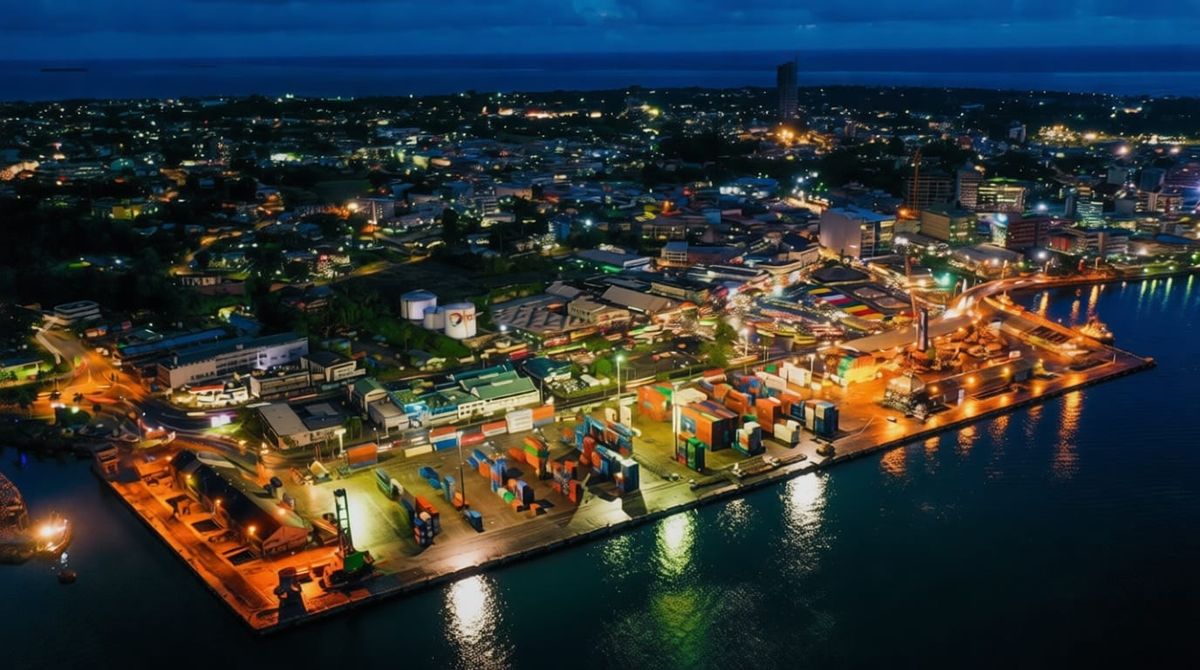
Fiji’s position in this architecture is not accidental. It is the most strategically significant nation in Melanesia, home to the University of the South Pacific, headquarters of the Pacific Islands Forum Secretariat, and a hub for regional trade, logistics, and disaster response across the Pacific. For Australia and the Quad nations, investment in Fiji’s port infrastructure serves simultaneous purposes: economic connectivity, maritime surveillance, customs enforcement, supply chain resilience, and a visible counter to China’s growing regional presence. Fiji’s own ports in Suva, Lautoka, and Levuka are ageing infrastructure that requires replacement regardless of the geopolitical context. The strategic logic of the investment is coherent. The question this piece examines is not whether the investment is welcome, but what it commits Fiji to, and whether those commitments have been made transparently, on Fijian terms, with Fijian consent.
What the Quad port announcement adds to an already documented architecture of Australian strategic investment in Fiji, what the combined structure means for non-alignment in practice, and what remains genuinely unconfirmed pending the release of the Vuvale Union text: the evidence that follows addresses each.
The Bilateral Foundation
What follows pre-dates the Quad entirely. It is Australian, bilateral, and a decade in the making.
Blackrock
In 2019, Australia committed A$100 million to redevelop the Blackrock Peacekeeping and HADR Camp in Nadi, a reallocation outside normal budget cycles, while Fiji was simultaneously negotiating with China.3 The Lowy Institute reported at the time that the facility “is believed to be poised as the centre for Canberra’s proposed Australian Pacific Security College.”4 Australia’s bid prevailed over China’s because it was holistic rather than piecemeal. Blackrock is now a permanent Australian-funded facility on Fijian soil, training Pacific security personnel in Australian doctrine and accessible to Australian-aligned partners, not Chinese ones.
Bushmasters
Australia supplied ten Bushmaster vehicles to Fiji in 2017, executing the deal in two months from acceptance to full delivery. The official Australian Army account noted the transaction “fed into Australia’s larger geopolitical ambitions in the region insofar as potentially hostile states were denied the influence associated with such a project." Russia, South Korea, and potentially China had competing offers.5 An additional fourteen Bushmasters followed by 2024, bringing Fiji’s fleet to twenty-four vehicles.6 Standardisation on an Australian platform creates dependency that is technical, not coercive: spare parts, training, and interoperability all point in one direction.
Pacific Security College
Launched at the Australian National University in 2019 with A$15 million and extended through 2026 at A$4.2 million annually, the Pacific Security College has trained more than 280 participants from fifteen Forum Island Countries.7 Its December 2019 Fiji National Security Strategy Implementation Workshop involved twenty-eight participants from essentially every Fijian security and governance agency: Defence, RFMF, Police, Immigration, Customs, Biosecurity, Maritime Safety Authority. This is not capacity-building for a single agency. It is the professional socialisation of an entire national security apparatus into Australian strategic frameworks.
Personnel embedding
130 RFMF personnel are embedded in the Australian Army’s 7th Brigade at Gallipoli Barracks, Brisbane, described by the ADF as a “non-reciprocal rotational company,” the first of its kind with any Pacific defence force.8 Simultaneously, three ADF personnel are embedded in the RFMF: one in the Officer Training School, two at the Stanley Brown Naval Base.9 The arrangement is asymmetric. Fiji integrates into the Australian command architecture. Australia is not integrated into the Fijian command architecture.
None of this required the Quad. It was already there.
The Multilateral Layer
The Quad Ports of the Future Partnership adds something new to this structure.
The Quad is not a tightly coordinated enforcement mechanism. It is a consultative forum that, by its own account, has until now struggled to move from dialogue to delivery.10 The Fiji port project is, explicitly, the Quad’s first joint infrastructure initiative anywhere. Japan and India’s Pacific engagement profiles differ substantially from Australia’s. There is no evidence that Japan or India have been party to bilateral security negotiations with Fiji to the same depth as those Australia has conducted.
What the Quad port project does do is multilateralise a logic that Australia has applied bilaterally. The mechanism is familiar from BlackRock: when major infrastructure is funded, designed, and built by Quad partners operating under Quad standards, it is trusted. Alternatives built to different standards, by different actors, are, by definition, not trusted. The practical effect (that Chinese-funded infrastructure becomes strategically inaccessible) is achieved without any directive requiring it. Rubio said the port project was “a practical demonstration of our collective ability to deliver high-quality, resilient infrastructure.”11 The emphasis on quality and resilience is the standard-setting move. China is nowhere in the text. It is everywhere in the logic.
The Fiji port project was announced in the context of “deteriorating strategic circumstances in the Indo-Pacific” and the Quad’s declared commitment to a “free and open Indo-Pacific.”12 Fiji had previously explored port and shipbuilding modernisation deals with China under the Belt and Road Initiative. That option is now materially less viable: not because it has been prohibited, but because the Quad’s “trusted” infrastructure framework has been extended to cover the port itself.
The Democratic Legitimacy Contradiction
The Quad’s self-description at the New Delhi meeting was consistent: four leading democracies, committed to a rules-based order, opposing coercion. Wong called the port project the “strongest ever commitment from the Quad to the Pacific.”13 What was not mentioned in New Delhi is that the bilateral treaty underpinning Australia’s most consequential security commitment to Fiji, the Vuvale Union, has not received parliamentary approval, as required by Section 51 of Fiji’s Constitution.
Section 51 is unambiguous: a treaty binds Fiji only after Parliament approves it.14 Cabinet approved the Vuvale Union on 8 May 2026. Parliament has not voted. The treaty text has not been released. On 25 May 2026, Minister Ditoka addressed Parliament on the treaty, confirming that twelve ministries and agencies were involved in negotiations, but did not indicate when the text would be tabled or when a vote would occur.15
The Quad’s claim to democratic legitimacy sits uncomfortably alongside this. Australia has said nothing publicly about Section 51. Its foreign minister described a Cabinet decision (not a parliamentary approval) as a “bedrock for generations to come.” The same minister in New Delhi described Quad infrastructure engagement in Fiji as a commitment by four democracies. Whether a treaty that Fiji’s Parliament has not approved can credibly be framed as a democratic partnership is a question the Quad’s own democratic rhetoric invites.
The standard Australia applies to other powers: opacity is not partnership. It has not applied that standard to itself in the Vuvale Union process.
What Remains Unconfirmed
Analytical discipline requires distinguishing what the evidence establishes from what it suggests but does not confirm. On two points, the evidence is incomplete.
First, whether the Vuvale Union contains provisions that limit Fiji’s ability to enter into security arrangements with third parties. Comparable Australian agreements do contain such provisions. The Falepili Union with Tuvalu, Article 4(4), requires that Tuvalu “mutually agree with Australia any partnership, arrangement or engagement with any other state or entity on security and defence-related matters.”16 Equivalent provisions have been confirmed in the Nauru and PNG bilateral agreements. Vanuatu’s proposed Nakamal Agreement has been stalled since 2025, specifically due to concerns raised by the Vanuatu government about constraints on third-party engagement.17 Whether the Vuvale Union contains an analogous clause is the single most consequential unknown in assessing Fiji’s embedded alignment. The treaty text has not been released.
Second, the operational command implications of the RFMF embedding arrangement in a genuine security contingency. In exercises and training, the arrangements are clear. In a real contingency involving an attack on Australia or a regional crisis where Quad and non-Quad interests diverge, the chain of operational authority for an RFMF company embedded in the 7th Brigade is not established in any public document.
The Agency Question
Any systematic analysis of Fiji’s alignment must engage with an obvious counter-argument: Fiji’s elected government has actively sought and welcomed these partnerships. Rabuka proposed elevating the Vuvale Partnership to treaty level. The Cabinet approved it. These are the actions of a sovereign government making sovereign choices.
The accumulated dependency argument does not require Fiji’s government to be passive, coerced, or deceived. Accumulated dependency can coexist with genuinely expressed preference. The more precise claim (and the one the evidence supports) is different: that the accumulated architecture of Blackrock, Bushmasters, the Pacific Security College, personnel embedding, and now the Vuvale Union and the Quad port project creates conditions in which future strategic independence becomes progressively more costly, regardless of which government is in office.
A previous piece in this publication put the point: “development partnerships structured around dependency risk eroding the strategic autonomy that non-alignment is designed to protect.”18 The argument is not that Fiji’s current government has been captured. It is that the conditions taking shape constrain the choices available to any future Fijian government, including one that might, in different geopolitical circumstances, wish to exercise genuine non-alignment.
There is a further dimension to the agency question. Rabuka’s government has endorsed the Vuvale Union without releasing its text to Parliament or the public. Whatever the motivations, the effect is that this alignment is being locked in before the people’s representatives have been given the instrument to examine. Section 51 exists precisely to ensure that consequential decisions of this kind pass through parliamentary scrutiny. Its application (or non-application) to the Vuvale Union is not merely a procedural question. It is a question about whose consent is required before Fiji’s strategic direction is set for generations.
The Cumulative Outcome Argument
What does the evidence, taken together, actually establish? Not a conspiracy. Not a deliberate sequential enforcement plan executed in lockstep by a unified Quad actor. The Quad’s Fiji port project is its first joint infrastructure initiative; the coordination is newer and shallower than its framing implies.
What the evidence does establish is this: a set of individually rational decisions, among them Fiji accepting Bushmasters because they were available; Blackrock because it was comprehensive; the Pacific Security College because training is beneficial; the 7th Brigade embedding because it improves capability; and the Vuvale Union because it formalises a relationship that already exists. Together, they have produced a cumulative outcome in which Fiji’s defence doctrine, infrastructure, officer culture, and treaty obligations are oriented toward a single strategic pole. The Quad port project extends that orientation to port infrastructure, under a partnership framework explicitly designed to exclude Chinese-built alternatives on standards grounds.
This is the cumulative outcome argument. It is more analytically defensible than the intentional-design argument and harder to refute. Governments do not need to plan for systemic domination for it to result from their individually rational choices. The accumulation is the mechanism.
'Friends to all and enemies to none' is Fiji’s stated doctrine. The structure being built around it increasingly means being deeply integrated with one set of partners and progressively less able to engage with others on equal terms.
The question Fiji’s Parliament, when it receives the Vuvale Union text, should ask is not whether Australia is a good partner. By most measures, it is. The question is what the treaty’s operative provisions commit Fiji to, in a contingency Fiji’s current government did not anticipate, under a government it may not be. That is precisely what Section 51 was designed to require Parliament to examine. It has not yet done so.
Notes and Sources
- Quad Foreign Ministers' Meeting, New Delhi, 26 May 2026. Joint press conference, Indian Ministry of External Affairs. Fiji Parliament first sitting on Vuvale Union: author's observation of parliamentary schedule.
- Penny Wong, joint press conference, New Delhi, 26 May 2026: "We are also today announcing the strongest ever commitment from the Quad to the Pacific through the Quad Ports of the Future Partnership, where we are launching a pilot for port infrastructure in Fiji." Marco Rubio, joint press conference, New Delhi, 26 May 2026: "It will serve as a model for other projects in the future." US Department of State, 2026 Quad Foreign Ministers' Meeting in New Delhi: https://www.state.gov/releases/office-of-the-spokesperson/2026/05/2026-quad-foreign-ministers-meeting-in-new-delhi/ Also: https://www.prokerala.com/news/articles/a1767443.html; ANI, 26 May 2026.
- Australian Government, A$100 million commitment to redevelop Blackrock Peacekeeping and HADR Camp, 2019. Department of Defence Integrated Investment Program reallocation. Fiji's concurrent negotiations with China were reported in regional media during 2018-2019.
- Tess Newton Cain, Lowy Institute Interpreter, 2019. The Lowy Institute reported Blackrock "is believed to be poised as the centre for Canberra's proposed Australian Pacific Security College."
- Australian Army, official account of Bushmaster supply to Fiji, 2017. Cited in Tess Newton Cain and Graeme Smith, Lowy Institute, 2022. The strategic rationale quotation appears in the Army's own documentation of the transaction.
- Australian Department of Defence, Defence Cooperation Program: Fiji, 2023-2024. Confirmed in ministerial statements by Richard Marles, October 2025.
- Australian National University Pacific Security College. Funding: A$32.7 million across 2019-2026 (DFAT). Workshop participant data: ANU Pacific Security College annual reports, 2019-2024.
- Pat Conroy, press conference, Suva, 6 May 2026: "We right now have an entire company of the Fijian military embedded in the 7th Brigade of the Australian Army." The ADF characterisation as "non-reciprocal rotational company": Defence Cooperation Program documentation.
- Conroy, press conference, Suva, 6 May 2026 (as above): "We also have Australian Defence Force officers embedded in your armed forces." Specific placements (Officer Training School; Stanley Brown Naval Base): ADF-RFMF cooperation documentation.
- Al Jazeera, 26 May 2026: "No leaders' summit was held in 2025. Trump has never attended one, and neither has Japan's Takaichi. The grouping has been essentially leaderless at the top level for over a year." https://www.aljazeera.com/news/2026/5/26/as-trump-woos-china-the-quad-alliance-drifts-toward-irrelevance
- Marco Rubio, joint press conference, New Delhi, 26 May 2026: "We're announcing plans to work with Fiji to advance that country's port infrastructure. It'll be the first time that the Quad partners work together on a port infrastructure project, a practical demonstration of our collective ability to deliver high-quality, resilient infrastructure." ANI, 26 May 2026.
- The Tribune (India), 26 May 2026: Quad ministers "announced a landmark joint port project in Fiji to counter 'deteriorating' strategic circumstances in the Indo-Pacific." https://www.tribuneindia.com/news/world/amidst-strait-of-hormuz-crisis-quad-ministers-launch-indo-pacific-surveillance-plan-fiji-port-deal
- Penny Wong, joint press conference, New Delhi, 26 May 2026 (as note 2).
- Constitution of the Republic of Fiji 2013, s 51: "An international treaty or convention binds the State only after Parliament has approved it." https://www.laws.gov.fj/Acts/DisplayAct/2378
- Sakiasi Ditoka, Minister for Foreign Affairs and External Trade, response to Oral Question No. 65/2026, Parliament of the Republic of Fiji, 25 May 2026, pp. 718-720. Daily Hansard, Monday 25 May 2026 [Corrected Copy]. https://www.parliament.gov.fj/wp-content/uploads/2026/06/Daily-Hansard-Monday-25th-May-2026.pdf
- Falepili Union (Australia-Tuvalu Treaty), Article 4(4), 2023. Treaty text published by the Australian Department of Foreign Affairs and Trade. https://www.dfat.gov.au/geo/tuvalu/australia-tuvalu-falepili-union-treaty/treaty-text-falepili-union
- Islands Business, 7 May 2026: "Fraught negotiations over the long-delayed Nakamal Agreement with Vanuatu, which has been stalled since 2025." https://islandsbusiness.com/news-break/australia-eyes-security-pact-with-fiji/ CSIS, 'What Australia and Fiji's New Treaty Means for the Pacific', 8 May 2026, confirms equivalent provisions in the Nauru and PNG agreements. https://www.csis.org/analysis/what-australia-and-fijis-new-treaty-means-pacific-state-play
- Andrew Levula, 'Pacific Dependency Culture and the Development Partnership Trap', Fiji Political Review, May 2026. https://fijipoliticalreview.com/pacific-dependency-culture-and-the-development-partnership-trap/