What Heredity Cannot Teach
The GCC requires no formal education and no formal leadership record from the chiefs who sit on it. That is not an oversight. FPR examines what the law says and what the institution reveals by funding training it does not mandate.

Part One of the series: What the Law Actually Says
The Great Council of Chiefs requires no formal education, no professional experience, and no prior formal or institutional leadership record from the men and women who sit in it. That is not an oversight. It is a position the institution deliberately holds, and is now quietly beginning to question. But the question it is asking may not be the only one in play.
"Until now, I did not have any recognised qualification. After completing this programme, I will receive a certificate that will attest to my skills and knowledge."
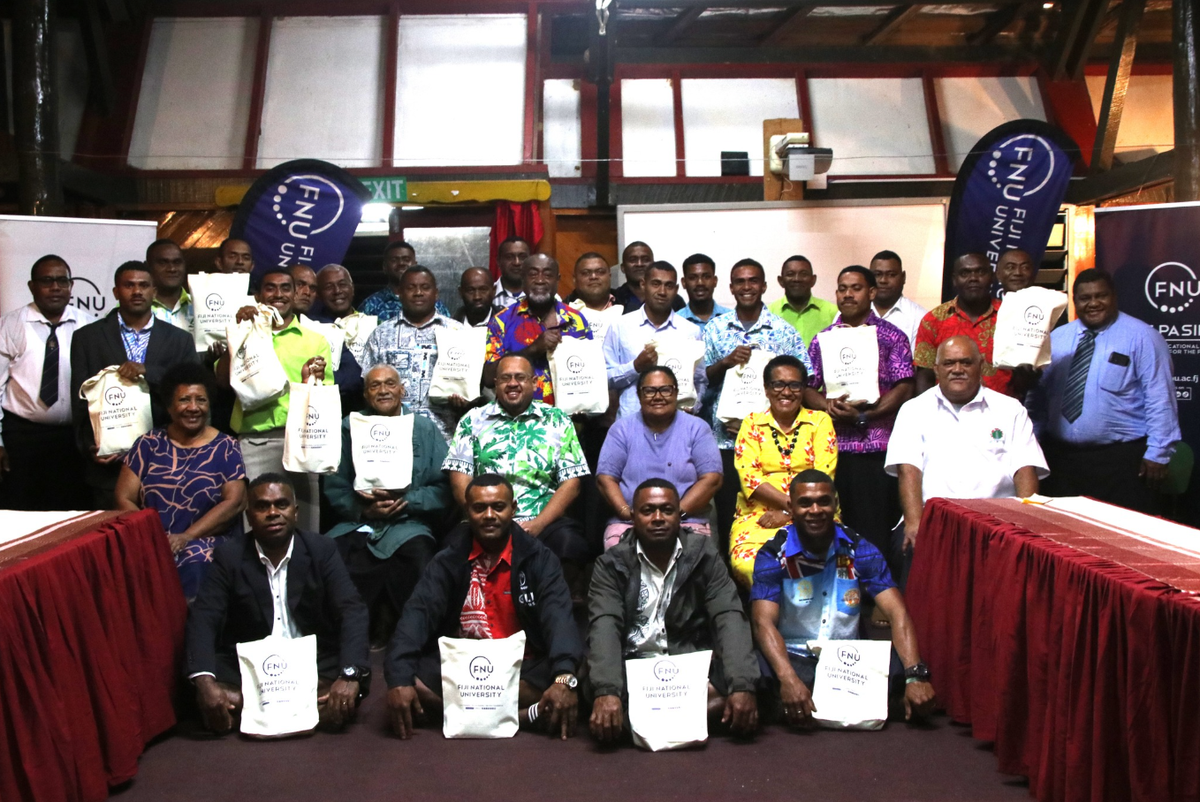
Joji Koroilagilagi Kabakoro is 69, a former factory worker in Australia, now farming in his village of Naweni in Cakaudrove. He is the oldest of the thirty young chiefs, not twenty-eight, as originally planned, who arrived at the Centre for Appropriate Technology and Development in Nadave, Tailevu, in October 2025 to begin something that had never been done in Fiji before. He shares a classroom with Rupeni Vesukuru Tamani, 21, whose father is the current chief of Tavia village in Levuka, and who sees the course differently: "I am here to learn discipline and how I can practice it in the future because discipline is the most important thing in life. If a person from a chiefly background is disciplined, then he will be able to make the right decision without depending on anyone." Tamani worries about something Kabakoro does not mention: "We are living in a digital age, and many young people are disconnected from our traditional and cultural practices."
They are the first cohort of the Diploma in Vanua Leadership, a one-year programme developed jointly by the Great Council of Chiefs and the Fiji National University, funded by the GCC and by the Australian Government through DFAT, and accredited by the Higher Education Commission Fiji. The curriculum covers governance, conflict resolution, environmental stewardship, sustainable development, and the history, customs, and spiritual responsibilities of chiefs as custodians of cultural heritage. The course runs in both iTaukei and English.
None of what they learn at Nadave is a legal requirement for the role they will one day hold.
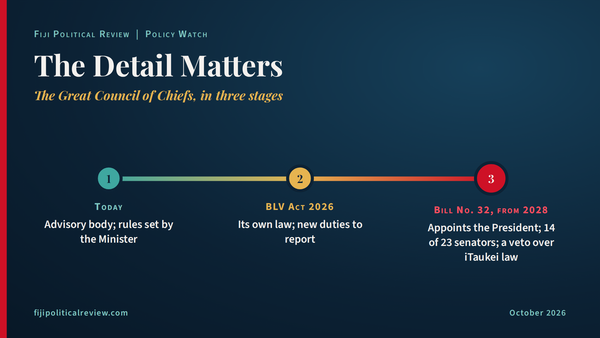
The Great Council of Chiefs, the Bose Levu Vakaturaga, reconstituted in 2023 after a sixteen-year suspension and now Fiji's pre-eminent indigenous advisory body, is investing institutional money and Australian donor funds in formal leadership training for future chiefs while simultaneously maintaining that formal leadership training is not, and perhaps cannot be, a requirement for the position itself. Understanding why the GCC holds both of these things at once tells us something important about where the institution is, and where it is headed. But it may not tell us the whole story.
What the law requires
The governing instrument for the reconstituted GCC is the iTaukei Affairs (Great Council of Chiefs) Regulations 2024, gazetted on 26 February 2024 under section 5 of the iTaukei Affairs Act 1944. For the forty-two provincial seats, three from each of Fiji's fourteen provinces, and the numerically dominant membership category, Regulation 4(2) sets out what a nominee must be:
A chief who has been traditionally installed as Turaga iTaukei, Marama iTaukei, Liuliu ni Yavusa or Liuliu ni Mataqali and recorded as such in the Register of iTaukei Lands administered by the iTaukei Lands Commission, possesses exemplary leadership qualities and has served in his or her province.
That is the complete list of requirements for a provincial GCC seat. Traditional installation in one of four recognised title categories. Registration in the Commission's land register. Nomination by the provincial Bose Vanua. And two qualitative criteria, exemplary leadership qualities and service in the province, that are not defined anywhere in the Regulations and whose assessment is left entirely to the nominating body. There is no educational requirement. No minimum age. No professional experience required. No prior service in any governmental, civic, or community institution. A chief who meets the first two conditions, installation and registration, and secures the nomination of their Bose Vanua, is eligible for the GCC regardless of what they have studied, what they have done, or what they know about governance, law, finance, or any other field the GCC is called upon to advise on.
The Regulations were made by the Minister for iTaukei Affairs under delegated powers and gazetted without parliamentary debate. Their form reflects the political conditions of their making: the GCC's reconstitution in 2023 was the price of SODELPA's support for the coalition government, and the party made clear that restoration, not modernisation, was its condition. What the Regulations do not require is as telling as what they do. And there is no mention of the Diploma in Vanua Leadership, which did not yet exist when the Regulations were drafted.
This is not unique to the 2024 Regulations. It reflects a consistent position running through every version of the GCC's membership framework, from its establishment by the British colonial administration in 1876 through its various constitutional iterations under the 1990 and 1997 Constitutions. The GCC has, at various points, included commoners and parliamentarians with ex-officio membership; by the late 1970s, sometimes half its members were commoners or people of modest chiefly rank. But for the chiefly seats themselves, the principle has always been the same: legitimacy derives from genealogy and installation, not from qualification.
The deliberate logic of hereditary authority
GCC chairman Ratu Viliame Seruvakula made this explicit in May 2025. Commenting on the Vanua Leadership Diploma, he said: "It's not something you get qualified for or apply for. It's something you're born into. And when your time comes, that is it." This is not a failure of imagination. It is a coherent theory of political authority, one that operates on a fundamentally different set of premises from the credentialist assumptions of modern liberal governance. In the iTaukei understanding of chiefly legitimacy, authority flows from ancestry, from the relationship between a title and its vanua, from ceremonial recognition by the community, and from the mana that is understood to inhere in the lineage. These are not things that can be acquired through education or accumulated through professional achievement. The formal installation ceremony, the registration of the title in the iTaukei Lands Commission's register, and the nomination of the Bose Vanua are the instruments through which this legitimacy is recognised, not constructed.
To require a university diploma or a professional background as a condition of GCC membership would, on this logic, be a category error: it would treat chiefly authority as though it were an earned credential rather than an inherited status. It would introduce a standard of eligibility external to the vanua, determined by a university, a government regulator, or a statutory body, into a process that the vanua considers its own.
Some iTaukei historians argue that the pre-colonial system was more merit-based than the colonial order that replaced it — that leadership emerged from courage, wisdom, and service to the vanua, and that birthright was institutionalised by the British to produce compliant intermediaries. Asesela Ravuvu, Director of Pacific Studies at the University of the South Pacific and one of the foremost iTaukei scholars of his generation, made precisely this argument. Traditionally, he said, chiefs had been selected on merit and could be removed if they failed their people. Colonial rule from 1874 changed that, establishing a hierarchy that became, in his words, "increasingly hereditary and difficult to change." On this reading, the Diploma is not an external modern imposition on tradition but a partial restoration of it. The question is not simply whether hereditary legitimacy can coexist with formal education. It is the version of tradition that the GCC is preparing its chiefs for.
This is not the first time
But there is a history here that the Diploma's advocates have not fully reckoned with, because the GCC has been in this position before. In 1879, the Bose Levu Vakaturaga itself approved a motion for the British colonial government to establish a school specifically for the sons of chiefs aged twelve to sixteen, to prepare them for future leadership roles. This was not a colonial imposition. It was a GCC initiative, documented as part of a broader pattern in which the chiefs actively shaped their own capacity for governance within the colonial order. The immediate catalyst was the overseas education of two chiefly sons, Ratu Penaia Kadavulevu of Bau and Ratu Josefa Lalabalavu of Somosomo, Taveuni, who were sent to Sydney in 1874 by the Chief Secretary, John B. Thurston. What those young men came back with convinced the GCC that the same preparation should be available to future leaders across the provinces.
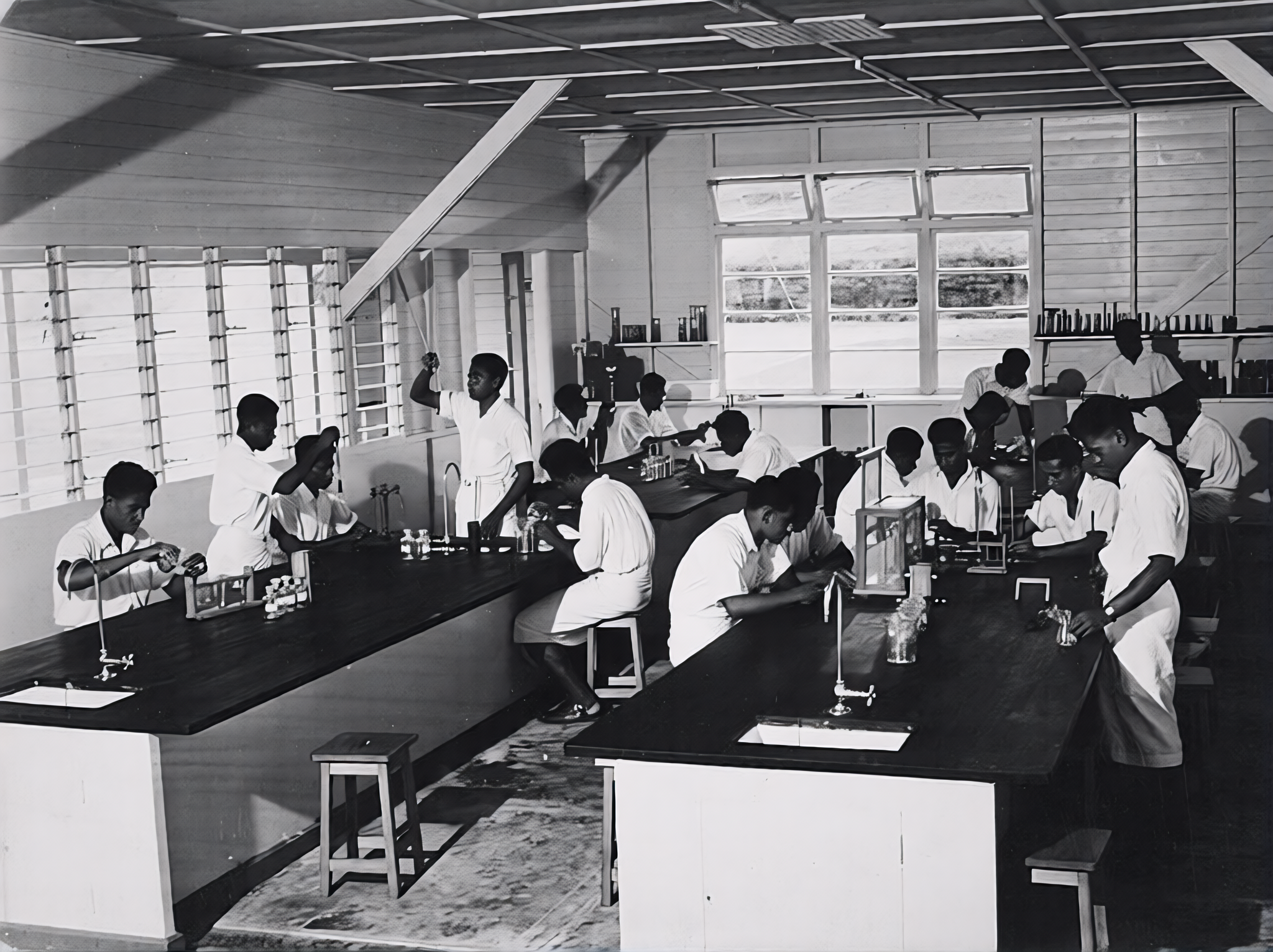
The school that resulted, Queen Victoria School, opened at Nasinu in 1907 and became the institution through which Fiji's chiefly class was educated for modern governance. By 1910, admission was restricted to the sons of chiefs. The first headmaster was explicit about the purpose: chiefs' sons would become roko and buli, and the government would benefit from the training they received. The curriculum covered English, arithmetic, agriculture, carpentry, and cadet drill — a practical and academic preparation for the administrative roles chiefs were expected to fill. Subsequent research has shown that chiefly educational networks in Fiji created durable governance advantages that persisted well into the post-independence era. The school's alumni went on to shape that era directly: Ratu Sir Kamisese Mara, Fiji's first Prime Minister; Ratu Sir George Cakobau, Governor-General; Ratu Sir Penaia Ganilau, President. The GCC's investment in chiefly education produced, across two generations, the leadership that negotiated and governed Fiji's independence.
The Diploma in Vanua Leadership is not a new idea. It is a very old one, returned. What the GCC invested in at Nasinu in 1907 and what it is investing in at Nadave in 2025 rest on the same recognition: that the demands placed on its chiefs exceed what hereditary title alone can prepare them for. The training is directed at the next generation, as it was then. It is framed as a supplement to customary legitimacy, not a replacement. The colonial context has changed. The underlying reason has not.
What is different is the question the Diploma leaves open that QVS did not. Queen Victoria School was never proposed as a formal prerequisite for a chiefly title or GCC membership, it was preparatory, and participation in it reflected the resources and connections of individual chiefly families rather than a systematic requirement. The Diploma operates on the same voluntary basis. But the governance context has shifted. The GCC of 1907 held constitutional powers that made the competencies of individual members less critical to institutional effectiveness. The GCC of 2025 is an advisory body whose influence rests entirely on what it says and how well it says it. That distinction is what makes the question of formalisation, left unasked in 1907, unavoidable now.
The scale of what shifted is documented. Academic observers of the pre-suspension GCC have noted, in an earlier analysis and subsequent research, that most members had relatively little formal education and many lived primarily in their home villages — a composition that coexisted, under the 1990 and 1997 Constitutions, with extraordinary institutional power: the authority to appoint Fiji's President and to dominate the Senate. The 2013 Constitution stripped both those functions. What the GCC lost was not just constitutional authority, it was the structural insulation that made member competency a secondary concern.
An institution that could appoint the head of state did not need its members to be policy analysts. An institution that can only advise does.
The GCC is not the only institution preparing future chiefs. Since 2020, the iTaukei Trust Fund Board has run Sauvaki Ni Vanua, a fourteen-week programme for Sausauvou at the same Nadave facility, covering governance, conflict resolution, and environmental stewardship; a curriculum strikingly similar to the Diploma's. That programme, too, is voluntary. What the GCC brings is not a new idea but institutional weight: the ability to make training visible, funded, and potentially normative in ways that smaller programmes cannot.
Fiji is not alone in navigating this tension. In Tonga, leadership scholarship emphasises talanoa he vā māfana — warm relationships — and loto, inner virtues, as qualities understood to initiate from within rather than from formal credentials. The implication is that a chief's fitness to lead is revealed through sustained relational practice, not confirmed by a certificate. Formal training, in this view, can support those qualities but cannot substitute for them.
Samoan tautua leadership operates on a related logic. Service precedes authority: a future matai earns recognition through years of contribution to the family and village, and the title, when it comes, ratifies what the community has already observed. The Samoan adage 'o le ala i le pule o le tautua,' the pathway to leadership is through service, encapsulates this as a foundational principle. The accountability is relational and continuous rather than credentialled and fixed. A programme like the Diploma would not be rejected in this tradition, but neither would it be understood as the relevant test.
The Māori Tū Rangatira framework in Aotearoa New Zealand has gone furthest in attempting an explicit integration. Drawing on tikanga Māori alongside Western governance competencies, it treats both as legitimate bodies of knowledge that rangatira need to navigate simultaneously. It is the closest regional parallel to what the GCC's Diploma proposes, and it is worth noting that even Tū Rangatira has not resolved the underlying tension between inherited authority and acquired competency. It has simply named it more honestly.
The GCC's approach sits within this regional pattern, but it is a conservative variant. It supplements hereditary legitimacy with formal education rather than replacing it, and it does so without yet confronting the question of what happens when the two come apart.
The gap the institution has already named
The GCC has not publicly framed the Diploma as a response to this shift. It has framed it as preparation for the challenges ahead, for a world that makes demands on chiefs that their titles alone do not equip them for. Chairman Seruvakula put it directly: 'Our chiefs must be prepared not only to protect tradition but also to navigate a rapidly changing world.' The FNU acting Vice-Chancellor, who co-developed the programme, told reporters in June 2025 that the threats facing Fiji, climate change, drug and human trafficking, and a rising HIV epidemic, were 'existential' and demanded 'effective, competent, and decisive leadership.'
These are not arguments for tradition. They are arguments for capacity. And they are being made by the institution itself.
The vacancy figures give that argument its full weight, but they also reveal a deeper problem. In May 2025, chairman Seruvakula confirmed that as of February 2024, only 51 per cent of Fiji's 6,209 registered chiefly titles had been filled, a figure that had risen to approximately 85 per cent by late 2025, a meaningful improvement, but one that still left hundreds of titles vacant. In Tailevu Province alone, eleven of twenty-nine chiefly seats remain vacant due to internal conflicts over titles. The Roko Tui Lau title sat empty for twenty years. The purely hereditary system produces titles that sit empty until the next person born into eligibility reaches readiness; it also produces titles that sit empty because potential successors decline them, a 2011 report noted that money had become 'the main reason why a lot of chiefly titles are still vacant today, as people have lost respect of the successor to the title'. The Diploma cannot fix that. It shapes the quality of the chiefs who do arrive; it does nothing to expand the pool of those who might.
The Regulations state that "where applicable, the nomination of female members is to be encouraged" — a weaker formulation than the gender-neutral 'his or her' used elsewhere in Regulation 4(2). How many women are in the Nadave cohort is not publicly reported.
The question the Diploma raises
The Diploma in Vanua Leadership is, on its own terms, a development pathway rather than a prerequisite. The first thirty chiefs selected by the GCC began studies at CATD Nadave in October 2025. Completion of the programme does not appear in the 2024 Regulations, or anywhere in the statutory framework, as a condition for future GCC membership or for the holding of a chiefly title. A full reading of the governing instrument confirms the omission is total: the Diploma is not mentioned.
But the programme's existence raises a question the GCC has not yet answered publicly: if the Diploma develops capacities that the GCC chairman says chiefs must have, what is the institutional logic for keeping it voluntary? The argument for making it a prerequisite is not that hereditary legitimacy is wrong. It is that the GCC's own advisory function requires more than hereditary legitimacy can deliver. A council that exists to advise on legislation, governance, land rights, health, and environmental management needs members who can engage substantively with those subjects. The Diploma is the GCC's own answer to the question of what that engagement requires. The gap between "this training is necessary" and "this training is required" is a policy choice, not an inevitable feature of the traditional system.
There are real risks on both sides of that choice. Making formal qualification a requirement would introduce an eligibility criterion that the vanua does not control and did not set, a structural encroachment on customary process that could delegitimise the very institution the qualification is meant to strengthen. It would also exclude chiefs from more remote or under-resourced provinces who cannot access tertiary education, creating a class structure within the chiefly system that maps onto existing inequalities. These are not trivial concerns. But the alternative carries its own risk. An advisory body that declines to formalise the competencies it acknowledges as necessary will find those competencies absent in some of its members, and in a council that now operates entirely on the strength of its deliberations, that absence has a cost. The Diploma pilot with thirty young chiefs is the beginning of a longer trajectory. The policy question is whether that trajectory ends with a formal requirement or remains, indefinitely, a well-funded suggestion.
There is a third possibility between voluntary and mandatory: that completion of the Diploma becomes the de facto standard for 'exemplary leadership qualities' under Regulation 4(2), assessed by the Bose Vanua at nomination. The gap between "this training is necessary" and "this training is required" may close not through regulatory amendment but through normative drift.
The context has shifted again since the Diploma was designed. In April 2026, the GCC submitted constitutional reform proposals seeking to regain the power to appoint Fiji's President and Vice-President, to reserve the name "Fijian" exclusively for iTaukei, and to amend anti-discrimination provisions by deleting 'gender' and 'sexual orientation'. If the GCC succeeds in regaining constitutional authority, the argument for formal prerequisites becomes more urgent, not less: an institution that appoints the head of state needs members who can engage substantively with the implications of that appointment. The Diploma would then look less like preparation for advisory influence and more like capacity-building for constitutional power. Professor Steven Ratuva has warned that the GCC "has committed a lot of mistakes in the past, including being used by some as a leverage for ethno-nationalism and racial hatred". The question is whether the Diploma is a safeguard against that history or an instrument for its repetition.
What the institution is telling us
The Great Council of Chiefs has not publicly framed the Diploma as a step toward formalised eligibility requirements. It has framed it as preparation for the next generation, for the challenges ahead, for a world in which chiefs must be ready to do more than their ancestors were asked to do. This is a modest framing of what is, in practice, an institutional admission: that the current system, under which a chief needs only lineage, installation, registration, and nomination to sit in the highest indigenous advisory body in Fiji, is not producing all the leaders the GCC needs to be what it wants to be.
That admission is significant. It does not resolve the question of whether formal qualifications should become a legal requirement, a question that involves deep arguments about the nature of chiefly authority, the relationship between the vanua and the state, and the kind of institution the GCC should be in the generation to come. But it does mean that the argument for the status quo can no longer be made in the terms the GCC chairman offered: that chieftaincy is simply something you are born into, that when your time comes, it is simply that. If that were the whole story, there would be no Diploma.
The GCC's investment is not entirely its own. The programme is funded in part by the Australian Government through DFAT, and the Ministry of iTaukei Affairs' 2024–2025 budget includes a Vanua Leadership Allowance of $777,600, recurrent government funding, not independent institutional revenue. The Higher Education Commission of Fiji accredits the programme; the Fiji National University assesses its students. These are not instruments the vanua controls. To require the Diploma as a condition of GCC membership would be to make an external educational standard, partly funded and fully regulated by government and donor agencies, a gate to customary authority. The structural encroachment the piece warns about is already present in the programme's design.
The Diploma is open to future leaders — not only to installed chiefs. It is possible, though not yet tested, that a commoner who completes the programme and demonstrates 'exemplary leadership qualities' could be nominated to the GCC under the vague qualitative criteria set out in Regulation 4(2). The Diploma could thus create a new pathway into the chiefly system even as it reinforces the legitimacy of those already in it.
The thirty chiefs at Nadave, some seeking credentials they have never held, others seeking discipline they fear their generation has lost, are studying governance, conflict resolution, environmental stewardship, and sustainable development. They are learning things their titles do not require. The GCC thinks they need to know them anyway. But the GCC is also telling us something else: that it wants the power to appoint the head of state again, that it wants to reserve national identity for one group, that it wants to shape the Constitution. The Diploma is framed as preparation for an advisory role in a changing world. It may also be preparation for a constitutional role that the GCC is actively seeking to reclaim. The tension between what the institution requires and what it believes is not the only tension in play. There is also the tension between what the GCC says it is and what it is trying to become. The Regulations do not resolve either.
SOURCES
Primary legislation
iTaukei Affairs (Great Council of Chiefs) Regulations 2024. Gazetted 26 February 2024. Regulation 4(2) quoted verbatim.
Diploma in Vanua Leadership
Fiji Sun, "Leadership Course for Chiefs," 22 May 2025. GCC chairman quotations and vacancy figures.
Fiji Times, "Uni to Offer Vanua Study," 17 June 2025. Curriculum outline and acting Vice-Chancellor statement.
FNU, "Inaugural Diploma in Vanua Leadership Programme," 22 September 2025. Cohort composition, DFAT funding, student voices.
Historical foundations
Newbury, C. (2006). "Bose Vakaturaga: Fiji's Great Council of Chiefs, 1875–2000." Pacific Studies 29(1). PDF.
Fiji Times, "Birth and Rise of Queen Victoria School (Part 1)".
Fiji Times, "The History of QVS".
Chiefly authority and leadership formation
Nayacakalou, R. R. (1975). Leadership in Fiji. Melbourne: Oxford University Press. Reference.
Tuimaleali'ifano, M. (2007). "Indigenous title disputes: what they meant for the 2006 election." In Fraenkel, J. and Firth, S. (eds), From Election to Coup in Fiji: The 2006 campaign and its aftermath. Canberra: ANU Press. PDF.
Norton, R. "Chiefly Leadership in Fiji: Past, Present and Future." Academia.edu.
Journal of Development Studies (2022). Vol. 58, No. 12. Article. Chiefly educational networks in Fiji.
Regional comparators
Paea, S. et al. (2023). "Talanoa he vā māfana: An Indigenous Tongan Approach to Leadership." Pacific Dynamics 7(1). PDF.
Fa'aea, A. M. et al. (2021). Samoan chiefly leadership. Pacific Dynamics 5(1). Repository.
Hohepa, M. and Robinson, V. (2009). "Māori and Educational Leadership: Tū Rangatira." AlterNative 4(2). ResearchGate.
Constitutional reform and political context
PMN, "Fiji Chiefs Push Bold Constitutional Changes," 1 April 2026.
RNZ Pacific, "Fiji Chiefs Push Bold Constitutional Changes, Sparking Public Debate," 9 April 2026. Includes Steven Ratuva commentary.
Fiji Times, "Restoration of GCC a Priority: PM," November 2023.