No deal in Antalya: what COP31's collapse means for Fiji and the Pacific
Successive COP31 drafts stepped back from the fossil fuel language agreed in Dubai. The final text named neither fossil fuels nor the ICJ opinion Fiji sought, and failed to win consensus. FPR tracks Fiji's asks against the text and Australia's role as chief negotiator.

Fiji's position
Fiji arrived in Antalya with a clear set of priorities and, by the second week, had become one of the most direct critics of the negotiating text. On 20 November, Minister for Environment and Climate Change Lynda Tabuya, speaking as chair of the Pacific Small Island Developing States (PSIDS), told a special AOSIS ministerial meeting that the 19 November draft could not be accepted. "This text is not a meaningful response to overshoot," she said, according to PINA.
Her objections were specific. Paragraph 36 of the draft, she argued, displaced the global stocktake commitment to transition away from fossil fuels with language more likely to increase emissions. PSIDS members described a carbon capture target as a red line, and Tabuya questioned why the text set a numerical goal for carbon capture but none for the energy transition. She also objected to the placement of the International Court of Justice advisory opinion in a paragraph on Pacific leadership, which in her view framed a universal ruling as a regional concern.
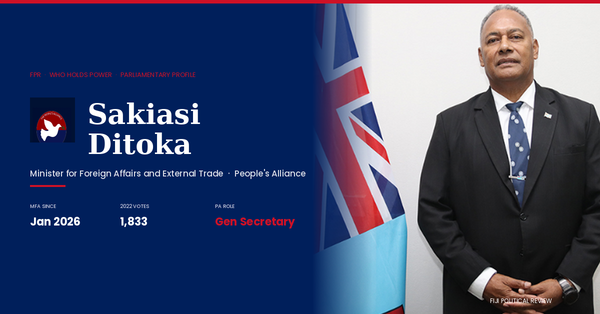
These positions built on Fiji's national statement two days earlier. Foreign Minister Sakiasi Ditoka told the conference that "1.5°C is not a negotiating position", and that COP31's outcomes should align with the ICJ opinion, which Fiji regards as establishing climate action as both a legal and a moral obligation.
The Alliance of Small Island States took the same line as a bloc. Its 20 November statement noted the absence of any reference to fossil fuels despite their centrality to emissions reduction, and warned that COP31 would fail if it did not respond to accelerating warming, as reported by the Guardian.
The context gives Fiji's position added weight. Fiji co-convened the Pacific Pre-COP31 in Nadi in October, alongside Tuvalu and Australia, where leaders adopted the Taku Pakasoa Declaration on safeguarding the 1.5°C goal. Six weeks later, the summit's draft text no longer contained the language the region had sought.
No consensus on the cover text
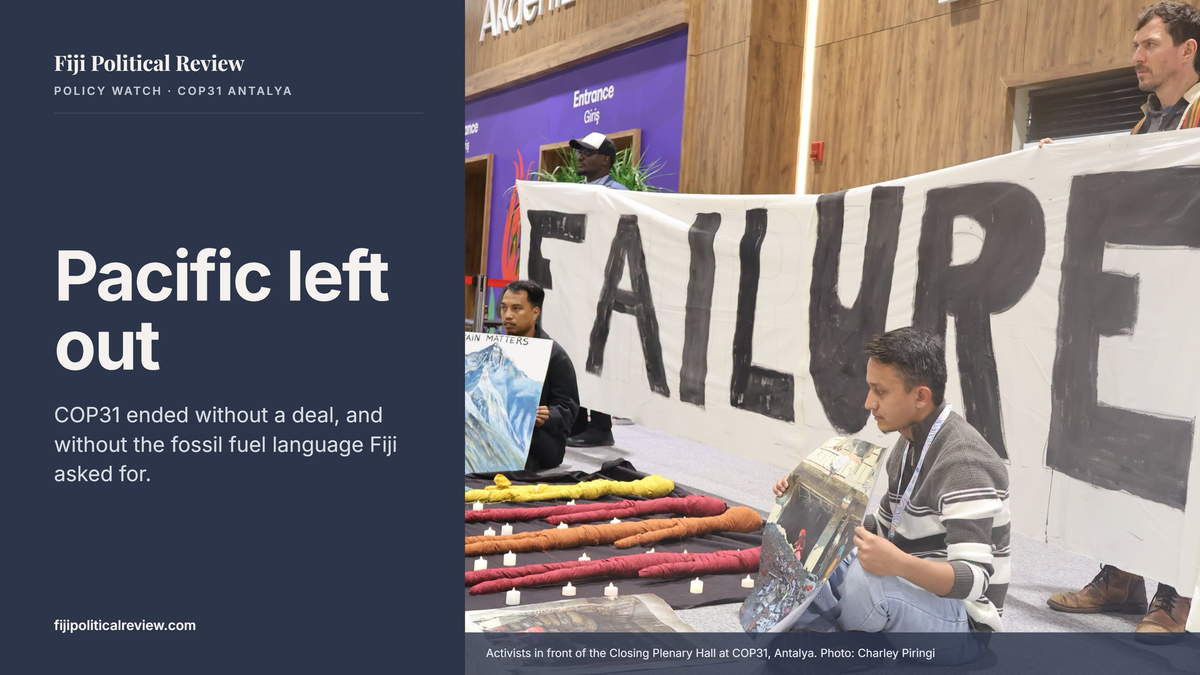
COP31 ended on Sunday 22 November without adopting its cover decision, after the longest climate summit on record. In the closing plenary, President Murat Kurum acknowledged that parties in the hall opposed the text and that, without consensus, the decisions had not been adopted, Reuters reported. Reuters described it as the most significant breakdown in UN climate talks since Copenhagen in 2009.
The final draft, styled the Antalya Pact, did not name fossil fuels. Its only link to the Dubai commitment was a preambular line "Recalling the United Arab Emirates Consensus in its entirety", according to the presidency's 22 November text. It retained the 35 per cent electrification target and a gigatonne-scale aim for carbon capture, and would have been the first COP decision to express "deep concern" that peak warming will exceed 1.5°C.
The final draft also dropped any reference to the International Court of Justice advisory opinion. The 19 November text had placed it in a paragraph on sea-level rise and Pacific leadership, which Fiji and PSIDS objected to as framing a universal ruling as a regional matter. Rather than moving it into universal language, the 22 November draft removed it entirely. The word "Pacific" does not appear in the final draft.
The European Union formally objected, with Ireland's Darragh O'Brien saying on its behalf that the pact failed to meet the moment. Panama and the Marshall Islands also formally objected, Germany said it would reject the text as written, and Tuvalu was among the small island states that refused to accept a text omitting fossil fuels, the Guardian reported. Saudi Arabia defended the draft's carbon capture references, according to BBC News reporting carried by Inquisitr.
Fiji stayed in Antalya through the overtime, pressing for the final text to acknowledge the transition away from fossil fuels and to drop carbon capture, Tabuya told the Fiji Sun. At the closing plenary, Fiji called for a standalone decision on the ocean, the Earth Negotiations Bulletin reported, and tabled alternative text to preserve ocean provisions that Tabuya said were uncontested (Fijivillage). The ocean language, the first in a COP cover decision, fell with the rest of the text. Whether Fiji formally objected to adoption has not been reported.
Fiji's two senior voices drew different lessons. Tabuya told Reuters the process was "exhausting and frustrating and disappointing" after years without movement. Chief negotiator Sivendra Michael defended consensus, asking how else the parties that have committed legally could be brought together (Reuters). Fiji has begun preparing for COP32 in Addis Ababa.
Kurum said there would be no further drafting: "We will not be carrying out work on a new text in an environment where there is no consensus." Under rule 16 of the UNFCCC's draft rules of procedure, unfinished items pass automatically to the next session, COP32 in Addis Ababa in 2027. The Dubai commitments, including the transition away from fossil fuels, are unaffected.
Draft by draft
The reference point for assessing the COP31 texts is paragraph 28(d) of the COP28 global stocktake decision, agreed in Dubai in 2023. It called on parties to contribute to "transitioning away from fossil fuels in energy systems, in a just, orderly and equitable manner", the first time a COP decision had named fossil fuels. Over six days in Antalya, the treatment of that commitment narrowed considerably. The wording below is taken from the UNFCCC texts unless otherwise marked.
| Draft | Length | Fossil fuels | Carbon capture | Dubai link |
|---|---|---|---|---|
| 16 November | 144 paragraphs, 18 pages | Para 65: reaffirms "transitioning away from fossil fuels in energy systems in a just, orderly and equitable manner". Para 66: "Calls for accelerated action to phase out fossil fuels, including through the immediate transition" away from them | Para 60: CCUS "to at least 500 MtCO2 reflecting current policies by 2035" | Reaffirms paragraph 28 of the first global stocktake (decision 1/CMA.5) |
| 19 November | 80 paragraphs, 9 pages | None. Para 36 calls for an "irreversible global transition towards low greenhouse gas emissions and climate resilience" | Para 36(h): 500 MtCO2 by 2035 and a 1.3 to 2.5 Gt goal, both in square brackets | Para 39: implementation of NDCs and NAPs "informed by the outcome of the first global stocktake" |
| 22 November, "Antalya Pact" (no consensus) | 94 paragraphs, 10 pages | None. Para 3 calls the transition "towards low greenhouse gas emissions and climate-resilient development" irreversible | Para 40(h): CCUS deployment "with an aim to achieve gigatonne scale globally by 2035" | Preamble recalls "the United Arab Emirates Consensus in its entirety"; para 38 cites decision 1/CMA.5 |
The 16 November text was a compilation of party proposals rather than a negotiated outcome, and its paragraph 66 would have been without precedent: no adopted COP decision has called for a phase-out of fossil fuels.
The 19 November draft retained a link to Dubai, but only by citation. Paragraph 39 refers to decision 1/CMA.5 without restating its content, so that a reader of the Antalya text alone would find no reference to coal, oil or gas. The draft also removed language welcoming Brazil's COP30 roadmap on transitioning away from fossil fuels, Climate Home News reported.
The Presidency's position was that the Dubai language had already been agreed and did not need to be repeated. Its emphasis instead fell on paragraph 36(d), the flagship target of raising electricity's share of global final energy consumption to 35 per cent by 2035. As drafted, that target did not specify the sources of the additional electricity, a gap several delegations sought to close.
Australia's dual role
The texts Pacific ministers objected to emerged from a presidency that Australia shares. Under the Türkiye-Australia arrangement, Murat Kurum is COP President and holds the gavel, while Chris Bowen, as President of Negotiations, has exclusive authority over the negotiations, according to the joint statement.
Australia framed its role in Pacific terms from the outset. The Department of Foreign Affairs and Trade described the Fiji and Tuvalu Pre-COP as placing Pacific priorities front and centre, and Australia provided logistical support for it. After COP30 concluded without fossil fuel language in Belém, Bowen said Australia would continue to argue for a transition away from coal, oil and gas at COP31.
Bowen's own account of the drafts reflects the constraints of the chair. Presenting the first draft on 16 November, he described it as a starting point and acknowledged that the fossil fuel language would meet strong opposition (PINA). Asked why the 19 November draft omitted fossil fuels, he said it had been written in the strongest terms capable of securing approval (RenewEconomy). The same draft removed a reference to the Pacific Resilience Facility, which Australia had championed and Fiji's national statement had highlighted.
Australia's broader record in the region is mixed in a way that sharpens the question. It is a substantial provider of Pacific climate finance and a major exporter of the fuels Pacific governments want phased down. Both sides of that record are documented below.
| On Pacific climate finance | On fossil fuels |
|---|---|
| $1.3 billion in climate finance to Pacific island countries over 2020 to 2025, 96% as grants, according to DFAT | Coal and gas exports add more than double the emissions of Australia's whole domestic economy, Wesley Morgan writes |
| AUD100 million foundational contribution activated the Pacific Resilience Facility in May 2026 (Fiji Sun) | Pre-COP pledges to the facility reached about half its US$500 million goal (AAP via NIT) |
| The Falepili Union recognises Tuvalu's continuing statehood despite sea-level rise, in a legally binding treaty | Tuvalu's Climate Minister Maina Talia has said Australia can't claim friendship while expanding fossil fuels (Fossil Fuel Treaty Initiative) |
| Albanese used COP31 to call for global investment in the facility (PM's office) | Albanese's COP31 leaders' address didn't mention fossil fuels; he said he wanted the focus on Pacific needs (AAP via NIT) |
The ICJ advisory opinion adds a legal dimension to the second column. By confirming that states carry obligations in relation to climate harm, including harm associated with fossil fuel exports, it gives Pacific governments an authoritative reference point for arguments they have long advanced politically. This helps explain why Fiji and PSIDS pressed for the opinion to be recognised as universal in the COP31 text.
Fiji's asks against the text
Measured against the final draft, Fiji's asks on fossil fuels, carbon capture, finance and the ICJ opinion were unmet, while its positions on electrification, 1.5°C, the ocean and least developed countries were partly reflected. The draft was not adopted, so none of it binds; the assessment shows where the negotiation ended.
| Fiji's ask | Who asked | Final draft (22 November, 2am; not adopted) | Status |
|---|---|---|---|
| Restore the transition away from fossil fuels | Tabuya, as PSIDS chair | Not named. Preamble recalls "the United Arab Emirates Consensus in its entirety"; para 38 cites decision 1/CMA.5 | Not met |
| No CCUS target | Tabuya, as PSIDS chair | Para 40(h): CCUS deployment "with an aim to achieve gigatonne scale globally by 2035" | Not met |
| Electrification tied to clean energy | Tabuya | Paras 29 to 30 tie electrification to emission reductions; para 40(d) sets 35 per cent by 2035, sources unspecified | Partly met |
| Keep 1.5°C alive | Ditoka, national statement | Para 11: "deep concern" that peak warming will exceed 1.5°C; para 40 aims "to keep 1.5 degrees within reach" | Partly met |
| Align outcomes with the ICJ advisory opinion, as a universal ruling | Ditoka; Tabuya | No reference at all; removed since the 19 November draft | Not met |
| Close the finance gap; Pacific Resilience Facility | Ditoka | No adaptation finance figure; launches an Antalya to Addis Ababa road map on adaptation and resilience finance; Pacific Resilience Facility not named | Not met |
| Framework for ocean-based climate action | Ditoka | Para 40(f) and paras 70 to 72 ("Antalya Ocean Current"), the first ocean language in a cover decision; lost when the text failed. Fiji tabled a standalone ocean decision at the plenary | Partly met |
| Recognise LDCs' special circumstances | Tabuya | LDCs named alongside small island states in paras 40(a), 50 and 59 | Partly met |
The final-draft column quotes the presidency's 22 November 2am text. A formal version, FCCC/PA/CMA/2026/L.25, went to the plenary later that day and may differ; it could not be retrieved for this piece.
Implications
Three tests indicate how far COP31 held the position reached in Dubai and reflected Pacific priorities. On the final draft, each was answered against the Pacific.
The first is the fossil fuel language itself. The final draft referred to the Dubai outcome only through a general recall of the UAE Consensus, keeping the 2023 commitment formally in view while declining to restate it. The second is carbon capture, which PSIDS treated as a red line: the numerical targets fell away, but a gigatonne-scale aim remained. The third is the ICJ advisory opinion. Fiji and PSIDS sought its recognition as a statement of universal obligation; the final draft removed it altogether.
Because the text did not secure consensus, none of these provisions binds, and the Dubai commitments stand unchanged. But the negotiating record will shape how Pacific governments assess the value of an Australian-led negotiation, at a time when the region's expectations of its largest partner on climate are increasingly explicit.
Sources
- UNFCCC, Draft cover decision, unedited version 16 November 2026
- UNFCCC, Draft cover decision, unedited version 19 November 2026
- UNFCCC, Draft cover decision, version 22 November 2026, 2:00
- Fiji Ministry of Foreign Affairs, Fiji Demands Stronger Global Action at COP 31 to Keep 1.5°C Alive, 18 November 2026
- PINA, 'We cannot accept it': Fiji Climate Change Minister Tabuya rejects COP31 draft text, 20 November 2026
- PINA, Pacific climate demands face resistance at COP31, 18 November 2026
- Fiji Sun, Fiji, Pacific hold their ground on fossil fuels as COP31 talks run into overtime
- Fijivillage, Fiji seeks standalone ocean decision after COP31 cover text rejected, 23 November 2026
- Earth Negotiations Bulletin, Highlights for 22 November 2026
- The Guardian via Yahoo News, Cop31 heading for overtime thanks to bitter dispute over fossil fuels
- The Guardian via Yahoo News, Cop31 ends with no deal as longest climate summit ever collapses into disarray, 22 November 2026
- Reuters via Cyprus Mail, COP31 climate talks break down as EU, others reject deal, 22 November 2026
- Reuters via Yahoo News, Can climate diplomacy build on the collapse of COP31?, 23 November 2026
- Inquisitr, citing BBC News, EU rejects 4th COP31 draft for omitting fossil fuels, 22 November 2026
- Climate Home News, COP31 Bulletin Day 10, 19 November 2026
- Climate Home News, COP31 Bulletin Day 13, 22 November 2026
- Climate Home News, COP31 Co-President says fossil fuel transition fight will continue, 24 November 2025
- RenewEconomy, Fossil fuel phase-out plan, Pacific fund dropped from COP31 draft
- DFAT, Australia welcomes decision to host pre-COP in Fiji and Tuvalu
- Anadolu Agency, Head of COP31 says gap narrowing on final text, 22 November 2026