Vuvale Development and the Caution of a Dependency Culture: Why Hard Work and Strategic Planning Matter More in the Pacific
Is Fiji building genuine self-reliance — or deepening dependency? Associate Professor Andrew Levula calls for strategic investment in human capital and a return to Pacific values of discipline and preparation.

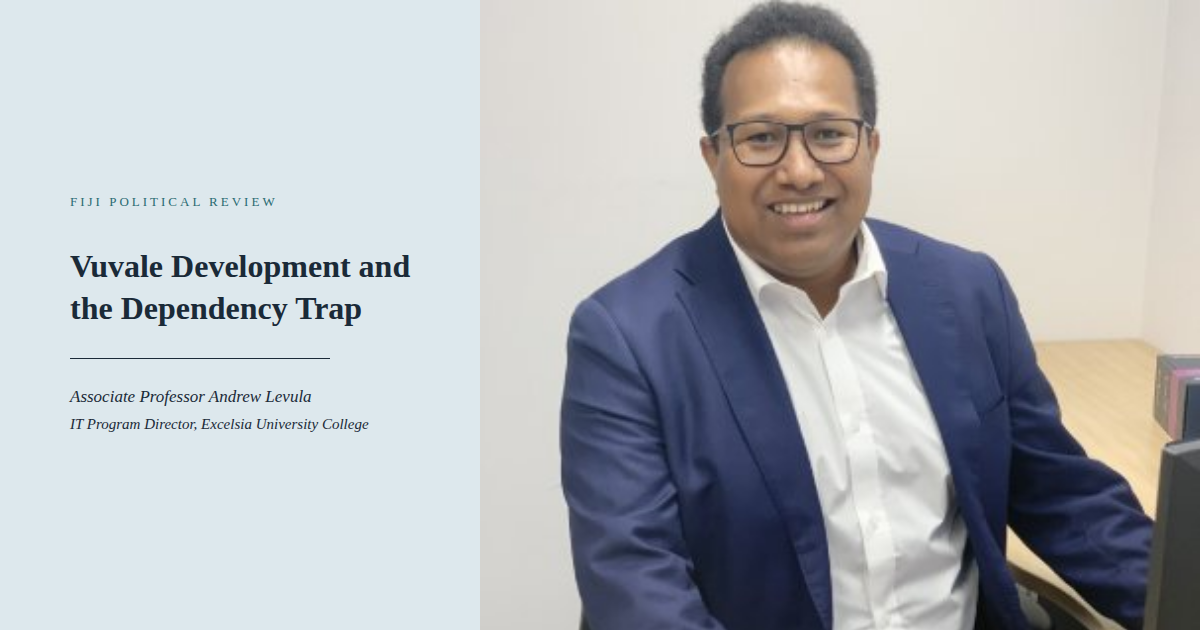
Associate Professor Andrew Levula is IT Program Director at Excelsia University College, Sydney. His research spans digital transformation, human capital development, and technology-enabled innovation in Pacific Island contexts. He writes in a personal capacity.
When the Australian Government pledged an additional A$30 million to ensure a stable fuel supply for Fiji, the announcement coincided with the unveiling of the Fiji–Australia Vuvale Union — a strategic agreement expected to strengthen cooperation across security, economics, and people-to-people ties between the two nations.
The word vuvale is Fijian for 'family,' but it carries far more than a generic meaning. It encompasses belonging, reciprocity, shared responsibility, and mutual obligation — the spirit of 'my home is your home.' The Fiji–Australia Vuvale Partnership was intentionally built on these principles of respect, trust, and long-term friendship. Bilateral partnerships among neighbouring nations are valuable — but a growing recognition across the Pacific holds that indigenous communities must be empowered to develop independently and reach genuine self-sufficiency. Too often, the leaders of Pacific developing nations remain overly reliant on their larger neighbours, particularly Australia and New Zealand. This piece is not an argument against partnerships or aid. Rather, it is a call for clearer thinking about what lies beneath. Fiji, like other Pacific Island nations, faces genuine and compounding pressures: rising global fuel costs driving up the cost of living; regional insecurity from drug trafficking and geopolitical tensions linked to conflicts in the Middle East and Europe; serious healthcare challenges, including HIV outbreaks straining an already fragile health system laid bare during the pandemic; and devastating climate-related disasters, including Category 5 cyclones Winston, Harold, and Yasa.
The polycrisis facing Fiji and the wider Pacific demands better planning and a multilayered, structured response. Fiji cannot indefinitely rely on its neighbours — its leaders must pursue long-term solutions grounded in human capital development and genuine empowerment. That requires a transformed mindset and the kind of strict discipline that should define the government’s vision.
A Transformed Mindset
One of the most dangerous threats to long-term Pacific development may not come from outside powers, economic shocks, or even climate change. It is the growing dependency on overseas nations — alongside the failure to properly utilise the resources Fiji has been endowed with: agricultural land and marine life for food security, natural resources and minerals, and the largely untapped potential of its human capital, innovation, and indigenous knowledge systems. These are the foundations of long-term sustainable development and self-reliance.
Political commentators have noted a growing overreliance on what is known as a vakavanua or kerekere culture — communal practices that historically helped indigenous Fijians cope in difficult times. Yet prolonged kerekere carries risks: it can create a false sense of obligation in recipients, breed entitlement, and ultimately disempower those who depend on it. The ancient proverb remains as relevant as ever — the borrower is slave to the lender. Strategic planning and targeted investment are therefore essential for Pacific Island nations to build the capacity and mindset needed to create an economically and environmentally sustainable future. This is precisely the path taken by today’s developed nations — Singapore, South Korea, Japan, Australia, and New Zealand alike — each having passed through periods of sacrifice, discipline, institution-building, and relentless investment in their labour force.
The Need for Strategic Thinking
The greatest development gap in the Pacific today is not financial — it is strategic. Across the region, governments remain trapped in short political cycles rather than planning for generational transformation. Critical investments in education, technology, cybersecurity, healthcare, and innovation ecosystems are chronically underfunded or inconsistently implemented. Meanwhile, global competition is accelerating rapidly. Artificial intelligence is reshaping industries. Cyber warfare is emerging as a serious national security threat. Financial technology is disrupting traditional economies. At the same time, nations across the globe are investing heavily in STEM education, innovation hubs, and research capacity to ensure they are not left behind in the scientific and technological advancements essential for national development and resilience.
The Pacific cannot afford to remain a spectator. Fiji has the potential to become a regional leader in fintech innovation, climate resilience technology, and Pacific-centred research and education — but only with a deliberate national strategy built around human resource development and a cultural shift back toward valuing discipline, hard work, and long-term preparation.
The Ancient Path: The Forgotten Culture of Preparation and Hard Work
Older generations of Pacific Islanders understood something modern societies increasingly forget: that survival and genuine success demand preparation. Though our forefathers were not wealthy by Western standards, they possessed extraordinary discipline and were largely self-sufficient — building their own homes, farming the land, and fishing the sea. They carried multiple responsibilities simultaneously without complaint. A woman mastered weaving, caregiving, and household logistics; she was the pillar of her family. When a major community event approached, preparation began months in advance — men farming, hunting, and fishing; women weaving mats and trading with women from other communities to ensure nothing was left to chance. There was no expectation that resources would appear overnight. There was dignity in labour and honour in every contribution. Preparation itself was an expression of unity, resilience, and commitment.
Today, however, many Pacific societies have drifted toward over-reliance on donations, borrowing, and kerekere. Social media and modern consumer culture have deepened the appetite for instant gratification, eroding the ancient wisdom of elders who understood that discipline and preparation were non-negotiable. When that wisdom is forgotten, communities drift into uncertainty — with lasting consequences for national development.
A Drop In The Ocean
Mother Teresa once consoled a frustrated friend who felt her efforts among the poor made no measurable difference. Her response is often quoted:
“We ourselves feel that what we are doing is just a drop in the ocean. But if the drop was not in the ocean, I think the ocean would be less because of the missing drop.”
That spirit of purposeful, incremental contribution remains as relevant as ever to the challenge of Pacific development. The true foundation of national development is investing in and empowering human capital. A nation’s future is determined by whether it can cultivate thinkers, engineers, entrepreneurs, scientists, healthcare professionals, and innovators capable of solving today's and tomorrow's problems. For Fiji, the future will be won or lost based on the strategies and laws implemented to protect and elevate its indigenous population. The playing field remains uneven for iTaukei men and women — a reality that must be acknowledged and addressed through targeted support structures to build genuine hope for future generations. While private sector efforts to close this gap remain limited, one recent story offered an encouraging sign.
Fiji’s fintech sector quietly delivered one of the year’s most significant development stories. Sole Fintech awarded its prestigious NXG scholarship to Chief Technology Officer Penioni Narube, enabling him to pursue a Master of Science in Management of Technology at the Massachusetts Institute of Technology in Boston — a scholarship valued at FJD $562,000. Rather than directing resources toward short-term political gain, this investment channels expertise directly into Fiji’s economy and accelerates its fintech ambitions, aligned with broader Pacific development goals. This is what genuine nation-building looks like: strategic, structured, and invested in long-term outcomes. It reflects confidence that Pacific people can and do compete at the highest levels globally.
The Way Forward
Fiji does not need handouts from Australia for long-term sustainability. What it needs is a reckoning with its own ancient wisdom — and the discipline to develop the expertise required to address its growing skills shortage. That responsibility lies squarely with Fiji’s leaders. Too often, politics has been defined by elitism and personal attacks, offering little incentive for educated, qualified individuals to enter a space too frequently described as “dirty” — a problem shared across much of the Pacific. Fiji must instead enable and empower its iTaukei population by restoring the ancient values of hard work, sacrifice, communal responsibility, resilience, and long-term preparation that once defined our forefathers. These values must be woven back into education, leadership, governance, and community development — so that future generations inherit not a culture of dependency, but a nation confident in its own capacity to innovate, plan, and compete.
There is an urgent need to invest strategically in technology, innovation, and advanced human capital development. Investments like the Narube scholarship should not remain isolated examples of private sector initiative — they must be integrated into Fiji’s broader national development agenda. Highly skilled ICT professionals, engineers, cybersecurity experts, data analysts, and innovators must be positioned to contribute to long-term national planning, digital transformation, and regional competitiveness. ICT is not merely a sector; it is a catalyst and key enabler of economic, social, and governance transformation. Nations that invest in digital capabilities, research ecosystems, and technological leadership will define the Pacific’s future. Fiji must create the conditions for its talented people to contribute not only to private enterprise but to national resilience, economic diversification, and sustainable development. The government should also consider reintroducing targeted affirmative action measures to level the playing field for iTaukei communities. While such policies invite debate, virtually every developed nation implements legislation to advance its indigenous population in education and business. Doing so will accelerate indigenous participation in economic development, improve literacy, and elevate the quality of life for future generations.
Finally, rising energy prices demand an urgent review of Fiji’s energy policy. The government must invest in renewable energy alternatives — solar, hydro, wind, and wave technologies — to reduce fuel dependence and improve long-term energy self-sufficiency. Fiji must also assess its energy capacity in light of the demands of emerging technologies: artificial intelligence, blockchain, and fintech infrastructure all rely on high-consumption data centres. Diversifying energy supply and reviewing the legislative framework to attract new providers is not optional — it is foundational to Fiji's national development strategy.