Parliamentary Watch: The Vuvale Union and the Parliament That Has not Seen It
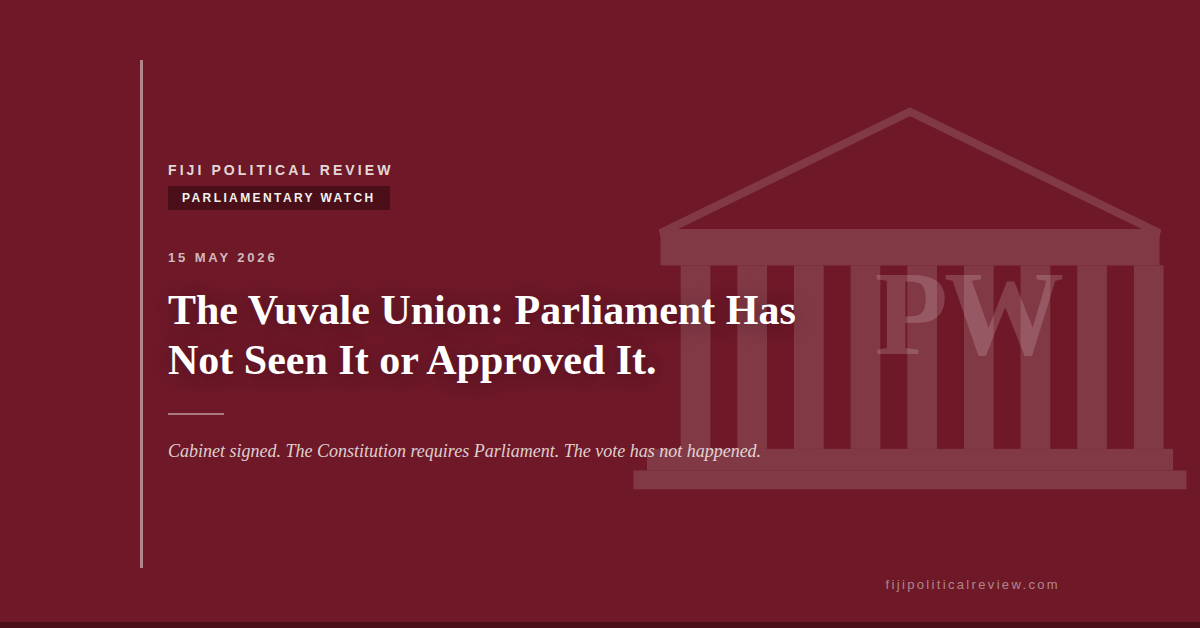
Cabinet has approved the Vuvale Union. Parliament has not. Under section 51 of the 2013 Constitution, that is a constitutional problem.

This is a Fiji Political Review Parliamentary Watch Briefing — a short analytical note on a significant parliamentary development. Parliamentary Watch is published when Parliament does something worth examining closely — or, as in this case, when something happens that Parliament should have examined and has not.
On 8 May 2026, Fiji’s Cabinet approved the Vuvale Union — a treaty-level framework with Australia covering security, economic cooperation and people-to-people ties. Australian Foreign Minister Penny Wong and Pacific and Defence Minister Pat Conroy had spent three days in Suva finalising the framework. The full text has not been released, and the treaty has not yet been formally signed.
The Vuvale Union is not the beginning of the Australia–Fiji relationship. It builds on the Fiji–Australia Vuvale Partnership, first signed in 2019 and renewed by Prime Ministers Albanese and Rabuka in October 2023, a non-binding framework running through to 2028. The Vuvale Union is a new instrument sitting on top of that existing partnership — elevating it from an informal cooperation framework into a treaty-level commitment with binding legal force. That elevation is precisely what makes parliamentary scrutiny under section 51 essential.
The Vuvale Union has not been approved by Parliament.
Under s.51 of the 2013 Constitution, the position is unambiguous: 'An international treaty or convention binds the State only after it has been approved by Parliament.' Cabinet approval is not parliamentary approval. The two are constitutionally distinct. A Cabinet decision to enter a treaty is an executive act. Parliamentary approval is a separate, constitutionally required step; the mechanism by which the elected representatives of the Fijian people exercise oversight over the government’s international commitments. Cabinet has approved the framework. The treaty has not yet been formally signed. When it is, s.51 applies — Parliament must approve it before it can bind the State. The time to establish that principle is now, before the treaty is signed, not after.
The PRF Comparison
Less than two weeks ago, Fiji’s Parliament provided a clear example of how s.51 is supposed to work. On 30 April 2026, the Pacific Resilience Facility Establishment Agreement was tabled in Parliament, debated across two sittings, and approved unanimously, with the full house present. Members of both the government and the opposition spoke in favour of the agreement. The vote was a matter of public record. The text of the PRF agreement was available to members before the vote.
The Vuvale Union has received no equivalent treatment. The full treaty text has not been released publicly. Parliament has not been given an opportunity to debate or vote on it. And Parliament last sat on 1 May 2026 — seven days before Cabinet approved the agreement. The contrast is direct and requires an explanation. One week after Cabinet approval, the full treaty text remains unreleased. The composition of Fiji’s negotiating team gives some indication of why. Confirmed attendees at the negotiating session included the Commissioner of Police, Acting Attorney-General Siromi Turaga, RFMF Commander Major-General Ro Jone Kalouniwai, and permanent secretaries for Immigration, Foreign Affairs, the Prime Minister’s Office, Defence and Justice. This was a security-heavy team. The absence of any parliamentary representative at the negotiating table, and the continued withholding of the treaty text, is consistent with a treaty whose security provisions its authors prefer to finalise before public and parliamentary scrutiny begins.
Why the Text Has Not Been Released
No official reason has been given for withholding the full treaty text, which remains unreleased one week after Cabinet approval. Two explanations are legitimate and common: treaty texts sometimes undergo further legal drafting after political agreement is reached, and security agreements are sometimes withheld pending formal signature. A third explanation is one only the text can resolve: whether the Vuvale Union contains provisions limiting Fiji’s ability to enter security arrangements with third parties, as comparable Australian agreements with Tuvalu, Nauru and Papua New Guinea have done. Vanuatu’s equivalent agreement has been stalled since 2025 because its government raised precisely that concern. Parliament cannot assess that question without the text. Neither can the Fijian public.
Three Questions the Government Must Answer
One. When will the Vuvale Union be tabled in Parliament for approval under s.51? The Constitution does not specify a timeframe, but the treaty is described as establishing a framework that will operate 'for generations to come.' The longer it operates without parliamentary approval, the more acute the constitutional question becomes.
Two. Will the full treaty text be released before the parliamentary debate? The PRF agreement was available to MPs before the ratification vote. The same standard of transparency should apply to the Vuvale Union — particularly given that the treaty’s security provisions, which cover policing, interdiction and transnational crime, are precisely the kind of commitments that require robust parliamentary scrutiny.
Three. Does the Vuvale Union contain provisions limiting Fiji’s ability to enter security arrangements with third parties, as comparable Australian agreements with Tuvalu, Nauru and Papua New Guinea have done? Parliament cannot answer that question without the text.
Why This Matters
The government has described the Vuvale Union in terms that suggest its constitutional significance is understood. Prime Minister Rabuka said the treaty 'sets the direction and tone of Fiji-Australia relations for centuries to come.' Australian Foreign Minister Wong said the Vuvale Union would be a 'bedrock for further Pacific cooperation.' If those descriptions are accurate, the Vuvale Union is a consequential international commitment that Fiji has entered into. Commitments of that magnitude are precisely what s.51 was designed to bring before Parliament.
The PRF ratification on 30 April demonstrated that this Parliament is capable of unanimous, cross-party endorsement of significant regional instruments. There is no reason the Vuvale Union should receive less scrutiny. Parliament is scheduled to sit at the end of May 2026. The FPR will be watching for whether the Vuvale Union is listed on the Order Paper, and whether the full treaty text is released before members are asked to vote on it.
The Procedure Parliament Must Follow
The 2013 Constitution provides no exception to the s.51 requirement. The draft Constitution circulated in 2013 contained a provision that would have allowed the Cabinet to bind the State on 'technical and administrative' agreements without parliamentary approval, merely requiring tabling. That provision was removed from the final Constitution. The requirement in s.51 as enacted is unqualified: all international treaties require parliamentary approval, regardless of their character or subject matter.
The Standing Orders contain no special procedure for treaty approval. The established practice, confirmed by Parliament’s own Treaties register, which records approvals dating to 2017, is straightforward: the Minister for Foreign Affairs tables the treaty text, moves a motion of approval, Parliament debates and votes. A simple majority is sufficient. The PRF followed exactly this process on 30 April 2026. The Vuvale Union must follow the same process before it can lawfully bind the State.
The Fiji Political Review sought comment from the Department of Foreign Affairs and Trade and the Office of the Prime Minister prior to publication. Neither responded. The FPR will update this briefing when the Vuvale Union is tabled in Parliament and when the full treaty text is released.