Australia's Budget Is Kind Words and Contingency Reserves
Fiji's bilateral aid allocation is frozen at $64 million while Australia announces a new era in the relationship. The numbers tell a different story to the rhetoric.

What the 2026–27 federal budget actually delivers for Fiji — and what it quietly withholds
Fiji Political Review | Opinion
Published alongside Associate Professor Andrew Levula's essay Vuvale, Development and the Caution of a Dependency Culture. Professor Levula argues that Fiji's greatest development threat is not external — it is dependency. Yesterday's Australian budget provides the numbers that make his case. Read together, these two pieces ask the same question from different directions: what does Fiji want from this relationship, and is Australia delivering on it?
Four days before Australia handed down its 2026–27 federal budget, Foreign Minister Penny Wong stood in Suva and announced A$30 million in emergency fuel support for Fiji. She spoke of partnership, of family, of the Vuvale Union — a new three-pillar agreement to deepen ties between our two countries on security, economics and people.
It was a compelling moment. The budget, delivered Tuesday night, tells a more complicated story.
The dominant reality shaping this budget is the Middle East conflict and its disruption of global oil supplies. Australia's own Budget Paper No. 1 describes the consequences with unusual candour: higher global inflation, lower growth, and particular hardship for 'low-income, energy-importing countries facing higher fuel costs and weaker external demand.' They did not name Fiji. They did not need to. Fiji imports virtually all of its fuel. Its economy runs on tourism — an industry the same budget papers warn will be suppressed by higher travel prices, tighter airline capacity and weakened traveller sentiment. Its farmers face fertiliser prices that have risen by more than 70 per cent since the conflict began, with food price inflation expected to follow within months. The storm that Australia's budget describes in global terms is already making landfall here.
So what did the budget actually deliver for Fiji?
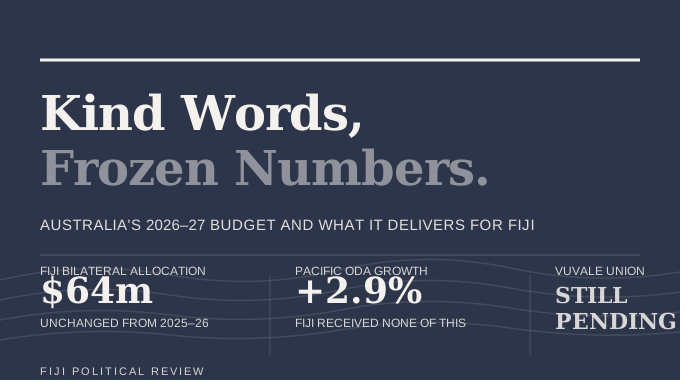
The Development Budget Summary 2026–27, released alongside the budget papers, provides the definitive answer. Fiji's bilateral allocation for 2026–27 is $64 million — identical to 2025–26. Zero increase. At the bilateral level, Fiji received none of the 2.2 per cent growth applied to Australia's total ODA program, nor of the 2.9 per cent growth flowing to the Pacific as a whole. Fiji's total ODA flows, including regional programs, rise by just $1.1 million, from $123.1 million to $124.2 million, an increase of less than one per cent. The $550 million infrastructure facility for the Pacific over the next ten years is real and potentially significant; Fiji has benefited from it before. But ten years is a long horizon when fuel prices are rising now.
Most telling is what the budget says about the Vuvale Union itself: the ODA Summary confirms Australia is still 'negotiating elevated partnerships with Fiji.' Not finalised. Still in progress. The political announcement in Suva ran well ahead of any budget commitment, and this document makes that explicit. None of this is cause for hostility toward Australia. Canberra is navigating a genuine domestic crisis — inflation at 5 per cent, growth slowing, households under pressure. It has maintained its Pacific ODA commitments when others are cutting. That matters and should be acknowledged.
But Fiji's policymakers need to read this budget clearly. The Vuvale Partnership, as it currently stands, formalises a relationship more than it funds one. The $30 million fuel support, while welcome, sits outside the bilateral allocation — the Budget Paper No. 2 confirms Fiji's bilateral envelope is frozen at $64 million, unchanged from last year. And the economic headwinds described in these budget papers will compress Australian household spending, weaken tourism demand, and slow the very growth that underwrites future Australian generosity.
There is one genuinely significant opportunity in this budget for Fiji: the confirmation that the Pacific Pre-COP will be held in Fiji in 2026, ahead of COP31. The moment calls not for gratitude but for clarity. Fiji should define what the Vuvale Union means in dollar terms before Australia does.