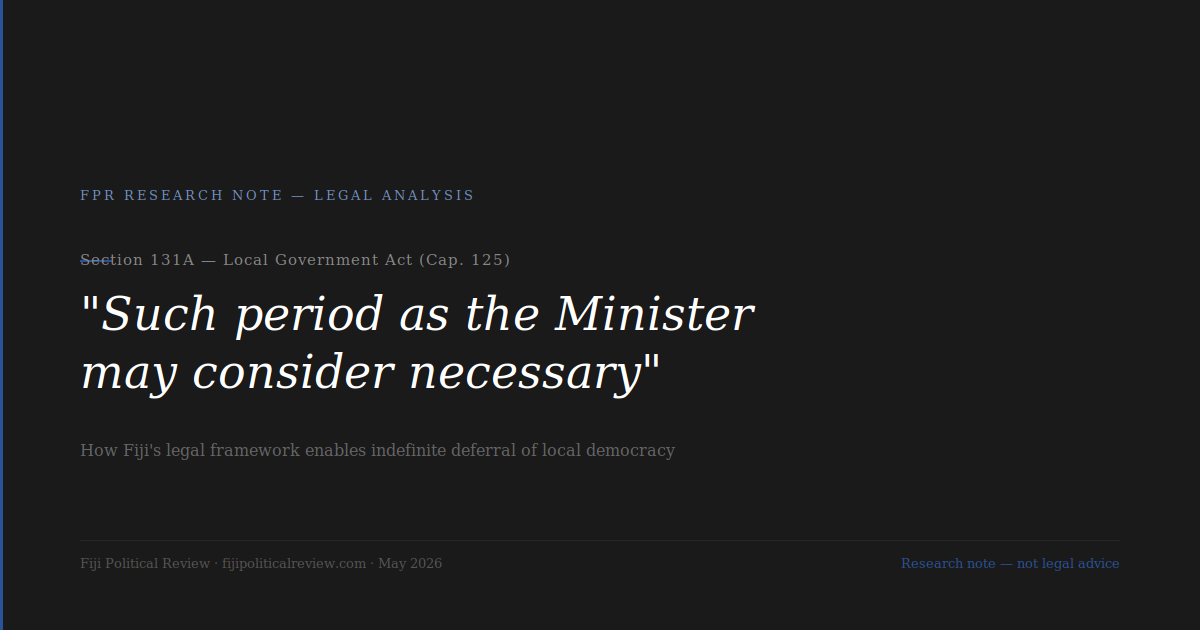
Such period as the Minister may consider necessary
FPR's legal analysis of the instruments governing Fiji's local government election timeline. Finding: no instrument gives Parliament, the FEO, or civil society any formal role. The Minister decides alone.
Executive summary
No instrument gives Parliament, the Fijian Elections Office, or civil society any formal role in setting or contesting the timeline for local government elections. Not the Local Government Act (Cap. 125), not the Electoral Act 2014, not the 2013 Constitution. The Minister of Local Government decides alone. This is not an oversight. It is the legal architecture that has made 21 years of suspended local democracy procedurally unremarkable.
Document structure
1
Primary legislation in force
Local Government Act (Cap. 125), Electoral Act 2014, 2013 Constitution
2
Statutory timeline mechanism
Who holds the power to set, defer, or extend election dates
3
Parliament's formal role
Primary legislation, subsidiary instruments, appropriations control
4
The FEO's formal role
Jurisdictional vs operational independence
5
Civil society's formal role
Consultation requirements, judicial review, Information Act 2018
6
The constitutional dimension
The Ghai Draft, the deliberate removal, and what remains
7
Gazette record and past practice
Executive action since 2005 — instrument by instrument
8
Structured findings
What the law says, what it is silent on, what is genuinely uncertain
Step 1 — Primary legislation in force
Section 131A — Local Government Act (Cap. 125)
"(1) If after consideration of the findings of a committee of inquiry, the Minister is satisfied that a council is in default… he may — (c) dissolve the council and by order appoint two or more persons to the administration of the municipality for such period as the Minister may consider necessary."
Section 154 — Electoral Act 2014 1
The FEO manages all aspects of municipal voting once elections are called by the responsible authority. The FEO cannot initiate, compel, or set a timeline independently.
Step 2 — Statutory timeline mechanism
What the Act contains no provision for
- Mandatory election interval (e.g. "every 3 years")
- Automatic restoration mechanism when a council is dissolved
- Independent FEO power to call elections
- Parliamentary role in setting, approving, or reviewing timelines
- Maximum duration on ministerial administrator appointments
- Periodic review requirement
- Public consultation requirement
Step 3 — Parliament's formal role
FPR assessment
Parliament has no formal role in setting or contesting the local government election timeline. The Local Government Act does not require Parliament to approve council dissolutions, ratify administrator appointments, be informed of deferral decisions, or vote on election restoration. The Electoral (Local Government Elections) Regulations 2025 were approved by Cabinet, not Parliament. Parliament's only indirect leverage is budgetary, and even that is a blunt instrument that cannot compel the Minister for Local Government to call elections.
Step 4 — The FEO's formal role
FPR assessment
The FEO has no formal role in setting or contesting the timeline. Its independence is operational (how elections are conducted), not jurisdictional (whether and when elections are called). This was confirmed by the FEO's own joint statement on the May 2026 deferral: the Electoral Commission and FEO advised they "await Cabinet's final decision." An institution with power to call elections does not issue a statement awaiting another authority's decision to do so. 2
Step 5 — Civil society's formal role
Fiji's Information Act 2018, enacted under Section 150 of the 2013 Constitution, provides a limited statutory basis for accessing government information. Its constraints are significant: citizens and permanent residents only (not NGOs or legal persons); a "directly affects" threshold requiring personal impact; post-2018 temporal scope only; broad exemptions with no public interest override; and an ATC with no enforcement authority. Global RTI rating: 64 out of 150. The Fiji Law Reform Commission's January 2025 Discussion Paper proposes significant amendments — these remain proposals only. The Act is a transparency mechanism, not an accountability mechanism.
FPR assessment
Civil society has no formal role in setting or contesting the timeline. The Act contains no consultation requirements before dissolution or deferral. No council, ratepayer association, or civil society organisation has challenged a deferral in court. A constitutional challenge faces the immediate obstacle that the suspension is expressly authorised by the Act itself. 3
Step 6 — The constitutional dimension
The Constitution Commission chaired by Professor Yash Ghai produced a draft in December 2012 that included a full chapter on local government proposing regular elections, devolved responsibilities, a reasonable degree of autonomy, and accountable representatives. The Commission warned explicitly: "provisions in a constitution are hard to change" and that entrenching local government principles would protect them from executive whim. The Bainimarama regime rejected the draft in its entirety. The Citizens' Constitutional Forum's analysis of the Government Draft Constitution (March 2013) explicitly listed "Local government" under its catalogue of omissions.
FPR assessment
The 2013 Constitution's silence on local government elections is not an oversight — it is a deliberate removal. The constitutional dimension reinforces, rather than constrains, the Minister's discretionary power. There is no constitutional floor below which the statutory delegation cannot sink.
Step 7 — Gazette record and past practice
| Date | Action | Instrument | Authority |
|---|---|---|---|
| 2005 | Last municipal elections held | Local Government Act | Electoral process |
| Dec 2006 | Coup; military oversight begins | Military decree | Commander Bainimarama |
| Early 2009 | All 13 councils dissolved | Decree [number unconfirmed] | Interim government |
| 2009 | Special administrators appointed | Local Government Act, s 131A | Minister of Local Government |
| 2014 | National elections restored | 2013 Constitution | FEO |
| 2014–2022 | No local elections; repeated deferrals | Ministerial decision | Minister of Local Government |
| Aug 2025 | Local Government Elections Regulations approved | Cabinet decision | Cabinet |
| May 2026 | Elections deferred until after general election | PM national address | Prime Minister / Cabinet |
Step 8 — Structured findings
Key findings at a glance
Parliament's role
None identified in primary legislation
FEO's role
Reactive only — executes, cannot initiate
Civil society's role
No formal standing to set or contest
Constitutional protection
None — deliberately removed in 2013
What the law is silent on
- No mandatory election interval for local government
- No automatic restoration mechanism for dissolved councils
- No sunset clause on ministerial administrator appointments
- No parliamentary approval requirement for dissolution or deferral
- No gazette requirement for dissolution orders
- No public consultation requirement
- No judicial review pathway (untested)
- No constitutional protection for local government elections
What is genuinely uncertain
- Whether judicial review of a 21-year deferral would succeed (untested)
- Whether courts would imply a "reasonable time" limitation on Section 131A
- Whether Section 26 of the Constitution could create a right to local elections
- Whether the 2009 dissolution by decree created any legal irregularity
FPR conclusion
No instrument gives Parliament, the FEO, or civil society any formal role in setting or contesting the timeline for the local government election. The Minister of Local Government decides alone. The legal architecture that makes this possible is not a gap or an oversight. It is deliberate design: a Minister with unlimited discretionary power, a Constitution that is silent on local democracy, an FEO with operational but not jurisdictional independence, and a civil society with no formal standing to challenge the timeline. 4
Footnotes
1
The instrument was originally promulgated as the Electoral Decree 2014 (No. 11 of 2014) and consolidated as the Electoral Act 2014 after the first sitting of Parliament following the 2014 general elections. Both designations refer to the same instrument. This document uses "Electoral Act 2014" for consistency with current parliamentary usage.
2
The original citation attributed this testimony to "FEO Deputy Supervisor Mohammed Dawai" — a name that does not correspond to any confirmed FEO officer of that title. FPR has established that the FEO's Manager Legal is Mesake Dawai, and the Supervisor of Elections in 2022 was Mohammed Saneem. The citation has been corrected pending verification of the actual witness against the Standing Committee on Justice, Law and Human Rights transcript for the relevant 2022 session.
3
The FICAC raid in August 2014 also extended to University of the South Pacific offices, as confirmed by the US State Department 2015 Human Rights Report on Fiji. The specific claim that Section 115 was used to formally reject accreditation applications from NDI, IRI, and IFES has not been independently confirmed by FPR against primary sources and is under review.
4
The $50–60 million figure referenced in some FPR editorial coverage is Professor Biman Prasad's combined estimate for three concurrent electoral events: local government elections, a constitutional referendum, and a general election. Prime Minister Rabuka cited a separate figure of $FJD18 million as the cost of local government elections to the 2026–27 budget specifically.