Budget 2026–2027: What the Numbers Say
Fiji's 2026–2027 Budget has been delivered. Here's what the numbers actually say.

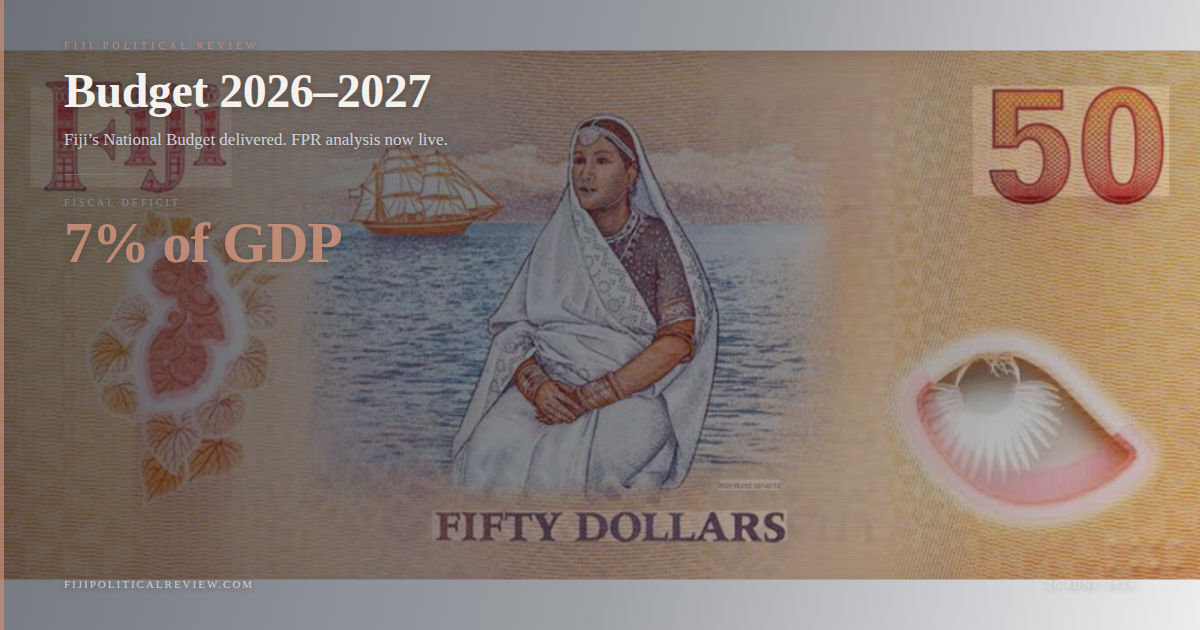
Total revenue: FJD 3.82 billion. Total expenditure: FJD 4.87 billion. Fiscal deficit: FJD 1.05 billion, or 7 per cent of GDP. The government’s medium-term target was 4.8 per cent.
The deficit target has been missed by more than two percentage points. The government’s explanation is a global fuel crisis that cut GDP growth from a 5 per cent target to 1.5 per cent and reduced revenue by FJD 200 million. The structural spending base underneath it is the harder problem.
The Fiscal Snapshot
| Measure | Figure |
|---|---|
| Total revenue | FJD 3.82 billion |
| Total expenditure | FJD 4.87 billion |
| Fiscal deficit | FJD 1.05 billion / 7% of GDP |
| Prior deficit target (MTFS) | 4.8% of GDP |
| New forward deficit target | 3% of GDP |
| GDP growth (revised) | 1.5% (target was 5%) |
| Forward growth projection | Average 3% per year |
| Revenue shortfall vs prior year | FJD 200 million |
| Projected debt (end July 2027) | FJD 12.6 billion / 84.8% of GDP |
| Capital budget this year | FJD 876 million |
| Operating expenditure | FJD 3.99 billion |
1. The Deficit
The 2026–2027 deficit is FJD 1.05 billion, or 7 per cent of GDP. The medium-term target was 4.8 per cent. The new forward target is 3 per cent.
Immanuel acknowledged the gap directly: if revenues had not declined due to the fuel crisis and economic slowdown, the deficit would have been below 5 per cent and debt around 83 per cent of GDP. The 7 per cent is framed as a countercyclical response, not a structural choice.
The 3 per cent forward target is more ambitious than the 4.8 per cent target just abandoned. Reaching it requires operating expenditure to hold at FJD 3.99 billion or fall, revenue to recover as the fuel crisis eases, and growth to average 3 per cent. All three are plausible. None is guaranteed.
2. Spending and Its Composition
Total expenditure is FJD 4.87 billion, a marginal increase of less than one per cent from last year. In real terms adjusted for inflation, expenditure is on a declining path. Operational expenditure has been cut by 10 per cent. Ministers and MPs have taken a 20 per cent salary reduction.
The budget accommodates more than FJD 200 million in new expenditures (elections, census, referendum, bridge replacements, Kinoya wastewater, cancer centre, CWM upgrades, increased debt servicing) while holding the overall total flat.
The fixed spending floor
- Total wages and support services: FJD 2.3 billion (almost 50% of total budget)
- Wages alone (42,000 personnel): FJD 1.5 billion (FJD 6 million per day)
- Operating support services: FJD 800 million (FJD 3 million per day)
- Total operating cost: FJD 9 million per day
- Debt interest servicing: approximately FJD 600 million per year
- Principal debt refinancing: FJD 400–600 million per year
- Operating expenditure total: FJD 3.99 billion (over 80% of total spending)
Inherited liabilities
- Outstanding film tax rebates: approximately FJD 200 million
- Outstanding dues to USP; incomplete projects (Lautoka Swimming Pool, Ba Govind Park Stadium, FNU Labasa Campus, Ratu Sukuna Park)
- Ongoing commitments including Walesi (FJD 6.8 million grant this year)
- FSC EXIM Bank loan repayment (this year): FJD 18 million
- Overall guaranteed debt exposure: approximately FJD 1.1 billion
3. Debt
Public debt has grown from approximately FJD 4 billion in 2016 to almost FJD 12 billion by end of 2026, a threefold increase in 10 years. The debt-to-GDP ratio has doubled from around 43 per cent to almost 85 per cent over the same period.
Debt is projected to reach FJD 12.6 billion or 84.8 per cent of GDP by end of July 2027. The average fiscal deficit has increased from around 2 per cent in the previous decade to around 6 per cent over the last 10 years.
Contingent liabilities
- FSC debt guarantee: FJD 320 million
- FSC debt write-off (recent): FJD 200 million
- Fiji Airways government guarantee: FJD 200 million (to be brought to Parliament)
- Overall guaranteed debt: approximately FJD 1.1 billion
4. State-Owned Enterprise Support
| SOE Commitment | Amount |
|---|---|
| FSC debt guarantee | FJD 320 million |
| FSC cane support (sugar sector total) | FJD 96.3 million |
| Fiji Airways government guarantee | FJD 200 million (to Parliament) |
| Fiji Airways: loss carry-forward extended | 8 years to 15 years |
| Fiji Airways: fees and charges waived | Approximately FJD 10 million (12 months) |
5. The Capital Programme
A total capital budget of FJD 876 million has been allocated in 2026–2027. The government targets a 70:30 OPEX:CAPEX mix. Current mix is approximately 82:18. Four major multi-year projects with a combined value of over FJD 2 billion have commenced, with FJD 1.5 billion of financing already secured with development partners. A further FJD 5 billion in infrastructure will be funded through SOEs.
Transport (Ministry of Public Works: FJD 821 million)
- Fiji Roads Authority total: approximately FJD 370 million
- Road maintenance: FJD 118 million; renewals and resealing: FJD 77 million; bridge renewals: FJD 35 million; community/rural road sealing: FJD 26 million
- Urban congestion relief: FJD 20 million (Ratu Dovi Road, Extension Street bypass, Ratu Sukuna Road)
- Bridge replacements (Lami, Medraukutu, Sabeto, Viseisei): FJD 41.5 million this year / FJD 400 million total (ADB and World Bank)
- Six additional bridge designs in progress (Sawani, Namotomoto, Lomolomo, Labasa)
- Bus shelters, footpaths and frontage: FJD 14.9 million
- Rural roads with China: 82km, 22 new bridges (commencing later this year)
- AIIB feasibility: FJD 6.4 million / US$100 million package under discussion
- Jetty maintenance (Ellington, Savusavu, Taveuni, Rabi): FJD 3.2 million
- Rural service delivery: FJD 17 million
Water and Wastewater (WAF: FJD 291 million)
- WAF water infrastructure: FJD 81.4 million
- Tamavua Water Treatment Plant: FJD 7 million (benefits 150,000 people)
- Sawani/Colo-i-Suva water mains and reservoirs: FJD 11 million (benefits 14,000 people)
- Viria Water Treatment Plant expansion (preparatory): FJD 2 million (benefits 244,000 in Suva-Nausori Corridor)
- WAF wastewater: FJD 16 million
- HOWSIP (ADB, FJD 300 million / US$135 million, 4 years): FJD 28 million this year; doubles Kinoya wastewater capacity; reduces non-revenue water from 50% to 20%
- Water Academy (ADB grant): FJD 10 million; rural water supply: FJD 10.5 million
Flood Alleviation
- Nadi River Flood Alleviation Project: FJD 400 million total (AIFFP and JICA); FJD 3 million this year for preparatory works
Health Infrastructure
- PHIT (Pacific Healthy Islands Transformation): FJD 500 million / US$242 million (World Bank, ADB, OPEC Fund); FJD 41 million this year; 4 years
- Fiji’s first radiotherapy and cancer treatment centre at CWM Hospital (construction commencing)
- 56 additional acute care beds at CWM; 17 health facility upgrades; 70 PHC facilities to be digitally connected (UNICEF)
- Lautoka and Ba Hospitals PPP: FJD 120 million
- India-funded 100-bed Super Specialty Hospital in Nasinu (construction early next year)
- Australia: AUD 10 million for CWM upgrades; master planning for new national tertiary hospital at Valelevu
Energy, Ports and Airports
- EFL investment programme: approximately FJD 2 billion (hydropower, 165MW solar with battery storage, grid upgrades); implementation from 2027
- Suva Port redevelopment: FJD 1.5 billion over 5 years (MCC US grant, Australia AIFFP, FNPF participation)
- Fiji Airports: FJD 700 million over 5 years
- Na Vualiku Project (Vanua Levu): FJD 440 million / US$200 million (World Bank); 10 years; FJD 20 million this year
6. What Households Will Feel
The government states its cost-of-living package now exceeds FJD 1 billion in direct support.
| Measure | Detail |
|---|---|
| VAT rate | 12.5% maintained (reduced from 15% in August 2025) |
| VAT rate relief | Approximately FJD 250 million per year |
| Zero-rated VAT (22 items) | FJD 250 million per year. Items: flour, rice, sugar, canned fish, cooking oil, potatoes, onions, garlic, baby milk, powdered milk, liquid milk, dhal, tea, salt, soap, washing powder, toilet paper, sanitary pads, toothpaste, kerosene, cooking gas, prescribed medicines |
| Combined VAT relief | Approximately FJD 500 million per year |
| Income tax | No increase |
| Corporate tax | No increase |
| Bus fares | 22.5% increase fully absorbed by government; FJD 20 million; 350,000 daily users unaffected |
| Electricity fuel surcharge | 5.91 cents per kilowatt hour; reviewed monthly by FCCC; fully absorbed for households earning below FJD 30,000 (FJD 13.5 million) |
| Free water | Continues for households earning below FJD 30,000 |
| FNPF member interest rate | 9.5% for 2026 (on FJD 1.2 billion total investment income; actuarially cleared) |
| FNPF employer contribution | Reduced from 10% to 8% from 1 August 2026 for 12 months |
| FNPF employee contribution | Unchanged at 8% |
| Back-to-School Assistance | FJD 200 per student; FJD 40 million; payment January 2027; 210,000+ students benefited since 2022 |
| Social welfare, pension, aftercare | FJD 200 million+; 130,000 recipients; temporary 50% fuel crisis top-up (May–July 2026) ending July |
| Civil service salaries | No reduction; increases of 10–23% over last 3 years (FJD 115 million additional annually) |
| First home buyer grants | Up to FJD 40,000 (construction) / FJD 30,000 (purchase) for households earning FJD 30,000 or less |
| Tourism Services Tax (new) | 5% on businesses with FJD 2 million+ annual turnover; effective 1 September 2026; hypothecated to Fiji Airways; expected yield FJD 70 million |
| Vehicle excise increase | 5% on new vehicles, 10% on used vehicles |
| Domestic fuel prices | FCCC to announce major reductions July 2026 as global oil falls below US$80 per barrel |
7. Key Sector Allocations
| Sector | Allocation |
|---|---|
| Education | FJD 883 million (18% of total budget) |
| Public Works and Transport | FJD 821 million |
| Health | FJD 647 million |
| Fiji Police Force | FJD 226.5 million |
| RFMF | FJD 152.6 million |
| Fiji Corrections Service | FJD 64.7 million |
| Fiji Roads Authority | Approximately FJD 370 million |
| Land Transport Authority | FJD 38.8 million |
| Parliament | FJD 18 million |
| Legal Aid Commission | FJD 13.5 million |
| FICAC | FJD 8.6 million |
| Office of the President | FJD 4.1 million |
| Office of the Prime Minister | FJD 9.7 million |
| Office of the Attorney-General | FJD 9.8 million |
| Water Authority of Fiji | FJD 291 million |
| Agriculture, waterways and sugar | FJD 221 million |
| Women and social protection | FJD 211 million |
| Tourism and Civil Aviation | FJD 75.8 million |
| Ministry of Finance | FJD 70.4 million |
| Foreign Affairs | FJD 56.6 million |
| Judiciary | FJD 51 million |
| FRCS | FJD 51 million |
| Rural and Maritime | FJD 35.4 million |
| Policing and Communications | FJD 34.2 million |
| iTaukei Affairs | FJD 33.1 million |
| Local Government | FJD 29.5 million |
| Fisheries | FJD 28.4 million |
| Commerce and Business Development | FJD 27.3 million |
| Forestry | FJD 25.7 million |
| Immigration | FJD 14.8 million |
| Employment and Workplace Relations | FJD 14.9 million |
| Elections (FEO + election day + Electoral Commission + referendum + census) | Approximately FJD 73.9 million |
| Constitutional Review Commission | FJD 1 million |
8. Major Policy Announcements
Sovereign Wealth Fund study
Government will undertake a study into the establishment of a Sovereign Wealth Fund for Fiji, conducted by the Ministry of Finance with either FNPF or the Fiji Investment Corporation. This is a study, not a confirmed fund. Fiji has no significant resource revenues; the most likely funding sources for any eventual fund would be budget allocations, FNPF co-investment, or concessional financing. FPR will track the enabling work closely.
Student debt write-off
More than FJD 650 million in tertiary student debt written off for over 53,000 students. Replaced with merit-based scholarships with bonding arrangements. FJD 160 million allocated for 23,000 scholars in 2026–2027.
Sugar industry diversification
Government explicitly acknowledging the decline of the sugar industry and signalling medium-term diversification. Guaranteed cane price maintained at FJD 85 per tonne despite a market return of FJD 57 per tonne, with FJD 41.6 million funding the FJD 28 per tonne top-up.
HIV response
HIV described by Immanuel as “a major existential threat.” FJD 12 million allocated. Drug use identified as the primary driver. Multi-pronged strategy with Australia, New Zealand and other development partners.
SOE review
Comprehensive review of SOEs and selected public bodies to identify opportunities for improved efficiency, restructuring, partnerships or divestment.
Fixed Asset Review
Ministry of Finance to undertake a comprehensive review of public assets across Fiji to establish their full value.
Elections and referendum
FJD 23.2 million (Fijian Elections Office) + FJD 18.2 million (election day) + FJD 556,000 (Electoral Commission) + FJD 20 million (national referendum) + FJD 12 million (2027 Census). Total approximately FJD 73.9 million.
New tax incentives
- iTaukei eco-tourism / cultural businesses: 7-year holiday (FJD 5–10 million investment) or 13-year (over FJD 10 million)
- Cement manufacturing: 13-year holiday for FJD 20 million+ investment
- Mahogany processing: 5-year holiday for FJD 5 million+ investment
- Peer-to-peer lending and equity crowdfunding: 5-year holiday
- 200% tax deduction for training and upskilling expenditure (effective 1 January 2027)
- 150% tax deduction for new sporting facilities
9. The Economic Context
GDP growth revised down from a 5 per cent target to 1.5 per cent for 2026. Growth projected to average 3 per cent ahead, though 5 per cent has not been achieved in any year since the pandemic. Tourism contributes approximately 40 per cent of GDP. Foreign reserves remain strong.
The fuel crisis is easing. The US-Iran peace agreement and reopening of the Strait of Hormuz have pushed global oil prices below US$80 per barrel. The FCCC will announce major domestic fuel price reductions for July and following months.
The private sector investment pipeline stands at FJD 8.9 billion across 254 active projects. Hotel capacity additions of approximately 5,500 rooms are in various stages of development.
10. The Verdict
This is a budget defined by constraint and ambition in equal measure. The 7 per cent deficit is real and the missed target is significant. But the context is also real: a fuel crisis that cut growth to 1.5 per cent, a revenue shortfall of FJD 200 million, a debt servicing bill of FJD 600 million per year, and a spending floor built over a decade of expanding government.
The capital programme is the budget’s strongest argument. FJD 821 million for transport, FJD 647 million for health, FJD 883 million for education, FJD 876 million capital budget this year, and a FJD 5 billion SOE infrastructure pipeline. These are multi-year commitments with multilateral co-financing from ADB, World Bank, JICA, AIFFP, OPEC Fund, MCC and AIIB. The government is building, not just spending.
The cost-of-living package is substantial and politically calculated. Bus fares absorbed, electricity surcharges covered for low-income households, VAT held at 12.5 per cent, FNPF returning 9.5 per cent to members, total relief exceeding FJD 1 billion. In an election year, these measures are designed to be felt before the writ is issued.
The harder question remains. Debt at FJD 12.6 billion and 84.8 per cent of GDP by July 2027. Operating expenditure at FJD 3.99 billion and over 80 per cent of total spending. A wage bill of FJD 2.3 billion. Contingent SOE liabilities of approximately FJD 1.1 billion. These don’t respond to fuel price movements. The path to 3 per cent deficit reduction requires a private sector-led growth story that has not yet materialised at the required pace.
The SWF study is the budget’s most significant long-term signal. A Fiji with a genuine, independently governed Sovereign Wealth Fund would be a different fiscal proposition from the one that has borrowed its way through the last decade. Whether that institution progresses from study to legislation is the question FPR will watch most closely.
Primary source: Minister for Finance Esrom Yosef Immanuel, 2026–2027 National Budget Address, Parliament of Fiji, 26 June 2026 (official PDF, 76 pages). All figures verified against tabled document. Additional sources: Republic of Fiji Medium-Term Fiscal Strategy FY2026–2027 to FY2028–2029; Immanuel pre-budget statement, 25 June 2026; The Fiji Times budget reporting, 26 June 2026. Figures in Fijian dollars (FJD).