Electon Watch: Part 3 of 5
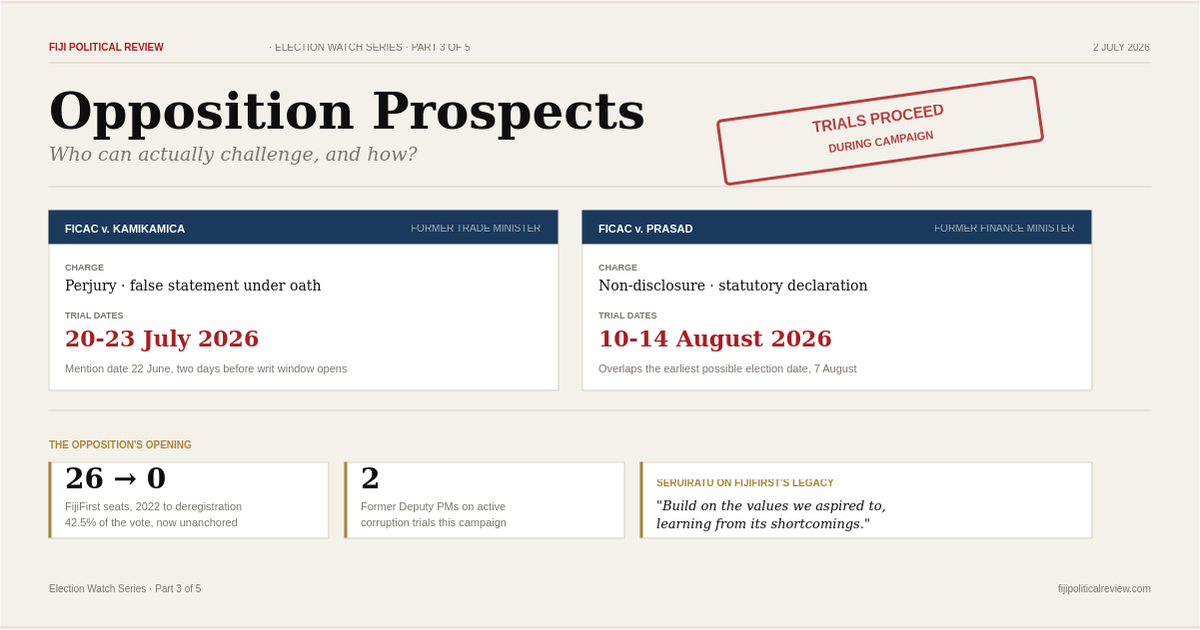
FijiFirst won 42.5% of the vote in 2022, secured 26 seats, and was deregistered. Two former Deputy PMs now face corruption trials during the campaign. The opposition has the opening. Part 3 examines whether it has the organisation to use it.

Opposition Prospects: Who Can Actually Challenge, and How?
FijiFirst won 42.5% of the vote in 2022, secured 26 seats, and formed the largest parliamentary bloc. Then it was deregistered.
That vote didn't disappear. The voters who cast it are still registered and looking for somewhere to go. Where they go in 2026 is the single most consequential variable in this election.
The opposition entering 2026 is fragmented, under-resourced, and running against a coalition that, whatever its internal difficulties, has the machinery of incumbency. What the opposition has is a target: two former deputy prime ministers on corruption charges, a deferred municipal elections promise, a cost-of-living squeeze the government hasn't resolved, and a voter base that once delivered 26 seats that is now politically homeless.
Whether it can convert that opening into a coherent challenge is the question this piece examines.
The People First party
The primary vehicle for the FijiFirst vote is People First, registered in January 2026.
People First was formed by three senior former FijiFirst ministers: Seruiratu, Jone Usamate, and Semi Koroilavesau. According to the FEO's confirmed registration details, the party President is Joanna Koroilavesau, with Raktnesh Kumar and Hazrat Ali as Vice-Presidents, and Lino Racumu as Treasurer. Ema Dimila is the Registered Officer and Secretary. Note: some sources name Semi Koroilavesau as President; FEO documentation names Joanna Koroilavesau. FPR relies on the FEO as the authoritative source. In April 2026, Seruiratu was formally appointed Party Leader of People First, with Parveen Bala Kumar as Deputy Party Leader. He also remains Opposition Leader in Parliament, a position he has held since 29 March 2023 when he replaced Bainimarama after Bainimarama's suspension. He is a former Cabinet minister under the FijiFirst government, serving in defence, foreign affairs, and rural development portfolios.
Seruiratu's pitch is explicit continuity with FijiFirst's record while distancing from its scandals. He said the party would "build on the values we aspired to under FijiFirst, learning from its successes and addressing its shortcomings." He told Pacific Waves he wanted to carry on the FijiFirst legacy but confirmed Bainimarama did not play ball when Seruiratu sought his support. Seruiratu has since cut ties with the former PM entirely and rebranded the formation as People First.
The party is built largely from the "G16+1" bloc of former FijiFirst MPs who regrouped after FijiFirst's deregistration in July 2024. It collected the required 5,000 signatures by August 2025, formally applied on 20 November 2025, and was registered on 19 January 2026 after four objections to its name, symbol, and constitution were assessed and dismissed. Seruiratu declared People First ready to contest in a Mai TV interview two weeks ago. There are now ten registered political parties at the FEO, up from eight at registration.
People First faces three interlocking challenges.
First, the FijiFirst vote was heterogeneous. It included Indo-Fijian voters who supported the party's economic management and multiracial framing, iTaukei voters who backed Bainimarama personally, and institutional supporters including civil servants and state-adjacent interests that benefited from FijiFirst's network in power.
People First needs to hold that coalition together without FijiFirst's incumbency advantages, Bainimarama's personal vote, or the state resources the party previously deployed.
Second, the FijiFirst brand was Bainimarama. Seruiratu is a credible politician with genuine ministerial experience. He is not Bainimarama. The question of whether FijiFirst voters vote for the party's legacy or the leader's name is one the 2022 result cannot answer, because the name was on the ballot in 2022.
Third, the opposition is split. The former FijiFirst parliamentary group divided into two blocs on 5 August 2024: the G16, led by Seruiratu and forming the core of People First, and the G9, led by Ioane Naivalurua. Several G9 members were subsequently sworn into Cabinet by Rabuka in a reshuffle, meaning part of the former opposition is now inside the coalition government itself. The internal dynamics of the former FijiFirst parliamentary group have produced at least two competing formations, not one unified opposition, and one of those formations is no longer fully in opposition at all.
Unity Fiji
Unity Fiji is the opposition's other significant formation. Led by Savenaca Narube, former Reserve Bank of Fiji Governor, the party failed to cross the 5% threshold in 2022 despite Narube's profile. It won zero seats.
The party is active in the 2026 campaign. Unity Fiji began a campaign push in Vanua Levu in June 2026, with Narube conducting community meetings and talanoa sessions across the north. The party has a specific plan for Vanua Levu and Taveuni integrated into what it calls an Economic Transformation Programme. Narube's pitch consistently centres on cost-of-living, economic management, and regional inequality.
Narube is the one opposition figure that the Fiji Sun has identified, alongside Seruiratu, as a leading challenger to Rabuka. His economic credentials are genuine. His 2022 result was not.
Unity Fiji's challenge is arithmetical. Under open-list PR with a 5% threshold, a party needs roughly 37,500 votes on a 750,000 voter roll to enter Parliament. In 2022, Unity Fiji fell below that line despite running a credible candidate at the top of its list. A regional campaign in Vanua Levu may build recognition but does not automatically translate to the national vote share the threshold requires.
The more interesting question is whether Narube and Seruiratu are potential post-election coalition partners, and whether their combined vote could challenge the governing coalition's seat count. That calculation depends on outcomes that neither party can control individually.
The corruption opening
Two former deputy prime ministers are on trial.
Biman Prasad resigned from Cabinet in October 2025 after FICAC charged him with allegedly failing to declare his directorship in hotel ventures as required under the Political Parties Act. Manoa Kamikamica stepped down a week earlier after FICAC charged him with perjury, alleging he made a false statement under oath during the Commission of Inquiry into the appointment of FICAC Commissioner Barbara Malimali.
Both men pleaded not guilty. Both applied to the High Court for a permanent stay of their prosecutions. In May 2026, the High Court refused both applications, ruling the grounds raised lacked merit. Trial dates are now fixed: Kamikamica from 20 to 23 July, Prasad from 10 to 14 August. Both trials proceed as the election campaign opens, and Prasad's overlaps the earliest possible election date.
The opposition's moral argument is direct. Seruiratu has publicly cited "chaos and scandals" in the coalition government. A commentary in Grubsheet described the opposition's pitch as "a moral crusade," centred on the corruption charges, unanswered questions over a Rolex watch Rabuka was photographed wearing amid allegations it was linked to a pardon for a businessman facing criminal charges (the value has been reported as FJ$150,000 but FPR has not independently verified this figure), and what the commentator characterised as "the worst government in 56 years since Independence." That framing is partisan. But the underlying material, two former deputy prime ministers facing active corruption trials in an election year and an unresolved allegation involving the Prime Minister himself, is factual.
The question for the opposition is whether voter concern about corruption is greater than voter concern about cost of living, and whether Seruiratu can credibly prosecute a corruption argument given his own years in the FijiFirst administration. Corruption was not an absent feature of Fijian public life under FijiFirst.
The fragmentation problem
The opposition's biggest weakness is itself.
The parliamentary arithmetic has shifted significantly since the 2022 result. Rabuka lured six of the nine G9 members onto the government benches, with three sworn in as Cabinet ministers and assistant ministers. Nine of the 26 former FijiFirst opposition MPs have effectively aligned with Rabuka, building a 40-member government side in the 55-member parliament. That leaves the remaining opposition, the G16 bloc around Seruiratu, independent MPs, and crossbenchers, with at most 15 seats. Rabuka is no longer dependent on his coalition partners to maintain numbers, even if the formal coalition continues.
In 2022, four parties crossed the 5% threshold, and FijiFirst won 26 seats on 42.5% of the vote. The combined opposition, PA, NFP, and SODELPA, won 29 seats on a fragmented vote that added up to more than FijiFirst's share only because they were aligned post-election.
In 2026, the FijiFirst vote is unanchored. The FEO had reserved names for 30 proposed new parties as of late 2024.
Each party that enters the race is a potential collector of ex-FijiFirst votes. Each party that falls below 5% is a vote that elects no one and returns nothing.
If the former FijiFirst vote distributes across three or four formations, none of which individually clears 5%, the governing coalition wins by default. The voters who delivered 26 seats in 2022 would return zero seats in 2026, not because they didn't vote, but because their votes were spread too thin.
Seruiratu understands this. His January 2025 announcement of People First was an attempt to aggregate the FijiFirst diaspora under one roof before smaller formations proliferated. Whether he has succeeded is not yet clear. Naivalurua's separate formation, the active Unity Fiji campaign, and the general proliferation of new parties all suggest the aggregation is incomplete.
The incumbency gap
Opposition campaigns in Fiji face a built-in disadvantage that isn't often stated plainly.
Under FijiFirst, state resources, including government advertising, civil service networks, and institutional relationships, were deployed in support of the ruling party's electoral interests. The 2022 election was partly a correction against that pattern. The current coalition has not been immune to the temptation to use incumbency advantages, though not at the scale of the Bainimarama era.
The opposition has no state infrastructure. People First is a new party, five months old as of this writing. Unity Fiji has never held a seat. Their candidate pools, fundraising capacity, and ground organisation are all substantially smaller than the three parties they are attempting to displace.
An academic quoted by RNZ in March 2026 noted that if PA is not careful, parties that have been "humiliated," including NFP, SODELPA, and Unity Fiji, could find reason to unify against PA, creating a different dynamic entirely.
That analysis assumes more coordination than the opposition has demonstrated. But it identifies the correct variable. The opposition's best scenario is not that any one party wins. It is that the combined opposition result leaves the governing coalition short of 28 seats and forces a post-election negotiation on terms the opposition can influence.
What to watch
People First's candidate list, when it is released, will be the first real test of whether Seruiratu has consolidated the FijiFirst base or lost chunks of it to competing formations. Watch specifically for former FijiFirst ministers and high-vote candidates. If they are on the People First list, the aggregation is working. If they are scattered across other parties or contesting as independents, it isn't.
Both trial dates are now fixed, and both fall inside the likely campaign window. Kamikamica's trial runs 20 to 23 July, with a mention date on 22 June, two days before the writ window opens. Prasad's trial runs 10 to 14 August, overlapping the earliest possible election date of 7 August if Rabuka calls it early. Four FICAC witnesses are expected in each case. Both proceedings will generate news cycles the opposition wants and the coalition does not, running in parallel with the first weeks of formal campaigning.
Watch Unity Fiji's vote share in any available polling. If Narube is tracking near 5%, he matters post-election as a potential partner. If he is tracking below 3%, his party is a vote-sink that weakens the aggregate opposition result.
And watch whether Seruiratu and Narube are meeting. The two men were identified together as the main challengers to Rabuka. Whether they are coordinating informally, or whether they are competing, shapes the post-election arithmetic significantly.
Part 4 of this series examines the FijiFirst void in depth: where 42.5% of the 2022 vote is going, and which parties are positioned to absorb it.
Sources: Fiji Sun; Fiji Village; FBC News; RNZ Pacific; Asia Pacific Report; Grubsheet; Kaniva Tonga News; East Asia Forum.
All factual claims are sourced. Analysis and scenario assessments are editorial interpretation of verified facts, clearly identified as such.