How Did We Get Here? The Vuda Incinerator and the Governance Questions Nobody Is Asking
A FJD $1.4 billion waste-to-energy facility proposed for sacred iTaukei land at Vuda Point reached formal EIA stage without secured land consent, without addressing its Australian rejection history, and without a Waigani Convention compliance analysis. The Fiji Political Review asks how.

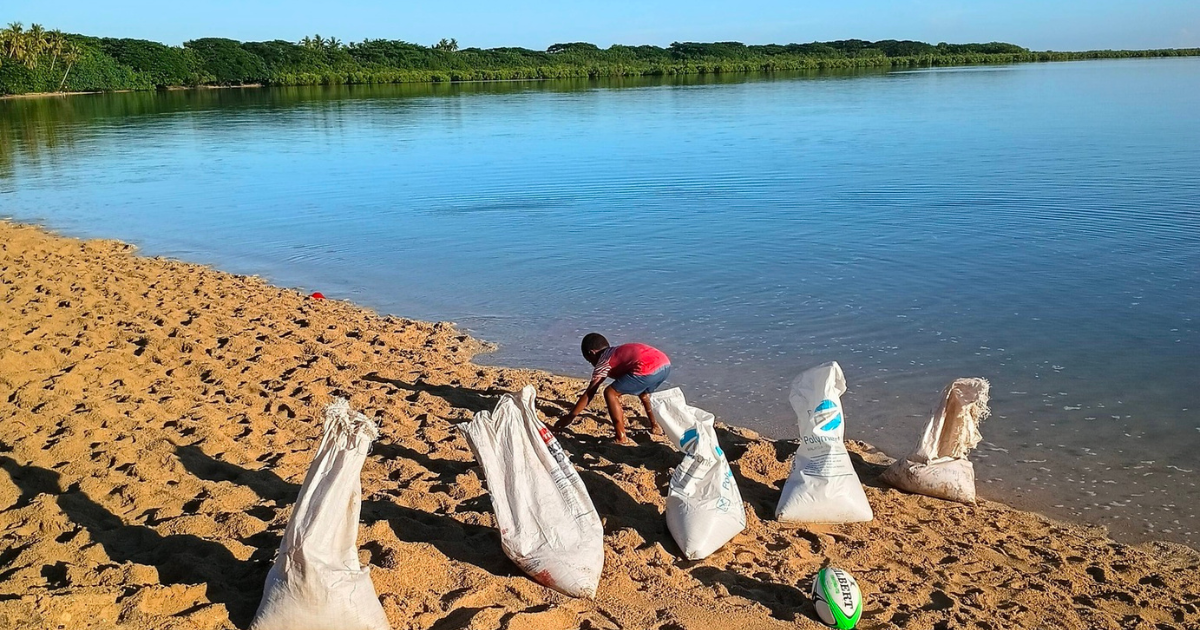
The debate over the proposed TNG waste-to-energy incinerator at Vuda has focused on what it would do to Fiji's coastline, tourism and environment. Those concerns are legitimate and serious. But there is a prior question that has not been answered: how did a $1.4 billion project with no secured iTaukei land consent, rejected in Australia, and designed primarily to import foreign waste, reach the formal Environmental Impact Assessment stage at all? The answer reveals something important about how investment decisions are made in Fiji — and who the regulatory process is designed to serve.
The Proposal in Brief
The Next Generation Fiji (TNG Fiji), a company backed by Australian billionaire Ian Malouf and led by Fiji-born businessman Robert Cromb, has proposed a FJD $1.4 billion (approximately US$900 million) waste-to-energy facility at Vuda Point (Saweni) on Fiji's western coast. The plant would process up to 2,700 tonnes of solid waste per day. A dedicated deep-water port would be built to service it.
On its face, TNG's pitch addresses two real problems. Fiji generates 200,000 tonnes of solid waste annually, and its landfills are near capacity. Fiji also has no domestic fossil fuel reserves. Approximately 37 per cent of its electricity was generated from fossil fuels in 2023, purchased from Singapore-based suppliers. Fiji's National Energy Policy 2023–2030 sets a target to ban heavy fuel oil imports entirely by 2030 — a trajectory that makes waste-to-energy a solution to a problem Fiji is already addressing through renewable energy. A facility that converted waste to electricity could theoretically address both.
The problem is in the numbers. The plant's capacity is 2,700 tonnes per day — approximately 986,000 tonnes annually. Fiji's waste generates only 200,000 tonnes. The remaining 786,000 tonnes, approximately 80 per cent of the plant's total capacity, would need to be imported from Australia, New Zealand, Papua New Guinea and other countries. This is not a solution to Fiji's waste problem. It is a commercial waste-disposal business that requires Fiji's land, coastline and regulatory approval to be profitable.
The Governance Failures
No iTaukei Land Consent — Yet EIA Proceeded
This is the most fundamental governance failure, and it has not received the attention it deserves.
The proposed site sits on land belonging to the Yavusa Koi Vuda of Lauwaki — the iTaukei landowning clan of Viseisei village, one of the oldest continuously inhabited communities in Fiji. Oral tradition holds that Vuda Point is where the great chief Lutunasobasoba made the first iTaukei landfall in Fiji. This is not incidental context; it goes directly to the question of whose consent is required before this land can be leased. The iTaukei landowners of Vuda have not signed any consent for the transfer of their land to TNG. The Ministry of Lands blocked the transfer of the lease. Yet the Department of Environment proceeded with the formal Environmental Impact Assessment process regardless. Under the iTaukei Land Trust Act, any lease of iTaukei land requires the approval of the iTaukei Land Trust Board and the consent of the landowning unit. This is not a procedural formality; it is a legal foundation. As established in Seteo Rasau Cakobau v Sandjunes Management Group Limited [2020] FJHC 540, any purported lease without TLTB approval is null and void.
The question this raises is direct: under what legal basis did the Department of Environment accept and process a 1,529-page EIA for a project that has no secured right to the land on which it proposes to operate? The Fiji Political Review sought an answer from the Ministry of Environment before publication. No response was received.
The EIA Process Structurally Excluded Those Most at Risk
The public review period for a 1,529-page EIA document ran for 21 days, from 23 March to 22 April 2026. A full copy of the document costs FJD 7,645 at five dollars per page. Four physical copies were made available at designated locations. No iTaukei-language version existed for the communities most directly affected.
The government subsequently extended viewing hours in response to public pressure, making the document available until 11 pm at First Landing Beach Resort. This is a partial response to a structural problem. A 1,529-page technical document in English, available at $5 per page for a 21-day window, is not meaningfully accessible to Viseisei villagers, subsistence cane farmers, or Saweni residents, regardless of viewing hours.
Under Regulation 41(2)(e) and 41(4) of the Environment Management (EIA Process) Regulations 2007, the EIA process is intended to facilitate genuine public participation. A process that costs FJD 7,645 to access in full, provides no iTaukei-language materials for indigenous communities, and runs for 21 days against a 1,529-page document, does not meet that standard. It meets the letter of the regulation while defeating its purpose.
Speaking in Parliament on 27 April 2026, just a few days after the public submission window closed, Minister for Information, Environment and Climate Change Lynda Tabuya confirmed no decision had been made and committed to a process free from political interference. Opposition MP Premila Kumar responded by raising the same question that has gone unanswered throughout this process: why is Fiji proceeding with a project that was rejected in Australia on grounds of risk to human health and air quality?
What the Government Has Said
Prime Minister Sitiveni Rabuka has clarified that the Cabinet approved only the due diligence process, including the EIA, not the project itself. "No approval has been made for the business to proceed," he said. Foreign Minister Ditoka has stated the project will face scrutiny across multiple fronts and that "a proposal of this scale must be tested rigorously."
These statements are appropriate and should be taken at face value. The FPR does not suggest the government has approved or will approve this project. The concern is not what the Cabinet has decided, but what the regulatory process has required before reaching this stage.
Tourism Minister Viliame Gavoka has publicly called for the project to be relocated, noting that hoteliers are "not happy" and that the Saweni-to-Denarau corridor could be permanently affected. His position represents a significant signal from within the Cabinet itself.
The Western Sydney Question Has Not Been Answered
Fiji's Permanent Representative to the United Nations, Ambassador Filipo Tarakinikini, publicly raised a question that deserves a direct answer: why was this project rejected in Australia?
In July 2018, the NSW Independent Planning Commission rejected an application by Ian Malouf's Next Generation Pty Ltd for a waste-to-energy incinerator at Eastern Creek in Western Sydney — the largest proposed in the southern hemisphere. The Commission found the project was not in the public interest, citing uncertainty over its impacts on human health, air and water quality and adopting a precautionary approach. NSW Health and the EPA separately opposed the proposal. The community had lodged more than 950 objections. The Commission's precautionary approach was not made in a vacuum — companies linked to Malouf had attracted five clean-up orders from the NSW Office of Environment and Heritage in the preceding years.
The rejection was not the end. In July 2022, the NSW Government gazetted the Thermal Energy from Waste Regulation, explicitly prohibiting waste-to-energy incineration in metropolitan Sydney. TNG challenged the regulation's validity in the NSW Land and Environment Court. Chief Justice Brian Preston dismissed the challenge, found the regulation valid, and ordered TNG to pay costs. Having failed at every level of Australia's regulatory and legal system — planning commission, government regulation, and court challenge — the same company, rebranded as TNG Fiji, is now proposing a facility at Vuda Point.
Chris Bowen, the Federal Labor MP for McMahon in Western Sydney and now Australia's Minister for Climate Change and Energy, opposed the Eastern Creek proposal in the Australian Parliament, describing it as a project that 'must be rejected' and citing its potential to produce 45,000 tonnes of air pollution residues annually — ash — that would affect residents living within one kilometre of the proposed site.
This is not a rhetorical point. If a project was considered unsuitable for a suburban industrial zone in Western Sydney, the standard of justification required for siting it on iTaukei coastal land adjacent to Fiji's premier tourism corridor should be at least as high. The EIA process as conducted, has not established that standard.
The Waigani Convention Question
The Waigani Convention, ratified by both Fiji and Australia, explicitly prohibits Fiji from importing hazardous waste and Australia from exporting it to the Forum Island Countries. The TNG proposal to import up to 786,000 tonnes of waste annually (80 per cent of the plant's total capacity) from Australia, New Zealand and Papua New Guinea raises a direct and unresolved compliance question. Municipal solid waste streams from these countries contain materials that meet the definitions of hazardous waste in Annex I of the Convention. The EIA document does not include a Waigani Convention compliance analysis. That omission is not a procedural technicality; it goes to the legal foundation of the entire proposal.
Foreign Minister Sakiasi Ditoka has noted that the project will need to address international obligations, including the Waigani Convention. But noting the obligation exists and requiring it to be met before the EIA proceeds are different things.
The Prior Question
Fiji needs to solve its waste crisis. That is not in dispute. Fiji also needs to develop its energy capacity and reduce its dependence on imported fossil fuels. These are real problems that deserve real solutions.
But the question the Vuda EIA process raises is not whether Fiji should pursue waste-to-energy technology. It is whether Fiji's regulatory architecture is capable of evaluating a $1.4 billion foreign investment proposal on its merits, subjecting it to the same standard of scrutiny it would apply to a domestic proposal of equivalent scale, and applying that scrutiny before rather than after the formal EIA process has been initiated.
A project that reached formal EIA stage without secured iTaukei land consent, without addressing its Western Sydney rejection history, without a Waigani Convention compliance analysis, and with a 1,529-page document priced at FJD 7,645 for communities with no access to independent legal advice — that project has been given a regulatory runway it has not yet earned.
The EIA public submission window closed on 22 April 2026. The Ministry of Environment is now conducting its technical review. The Cabinet will decide whether the project proceeds only after that review is complete. That process should now be given the time, independence and rigour it requires.
But the communities of Viseisei, Saweni and Vuda, the iTaukei landowners whose consent has not been secured, the tourism operators whose livelihoods depend on the coastline the plant would adjoin, and the Fijian public who have submitted over 875 written submissions, 5,600+ online petition signatures and 3,100+ paper-based signatures, deserve answers to the governance questions that the EIA process itself has not asked.
The Fiji Political Review contacted the Ministry of Environment, the iTaukei Land Trust Board, and TNG Fiji on 28 April 2026 to seek comment on the iTaukei land consent question, the Western Sydney rejection history, and Waigani Convention compliance. None of the three parties responded by the time of publication.