Election Watch: Seven Weeks to the Earliest Possible Writ Day
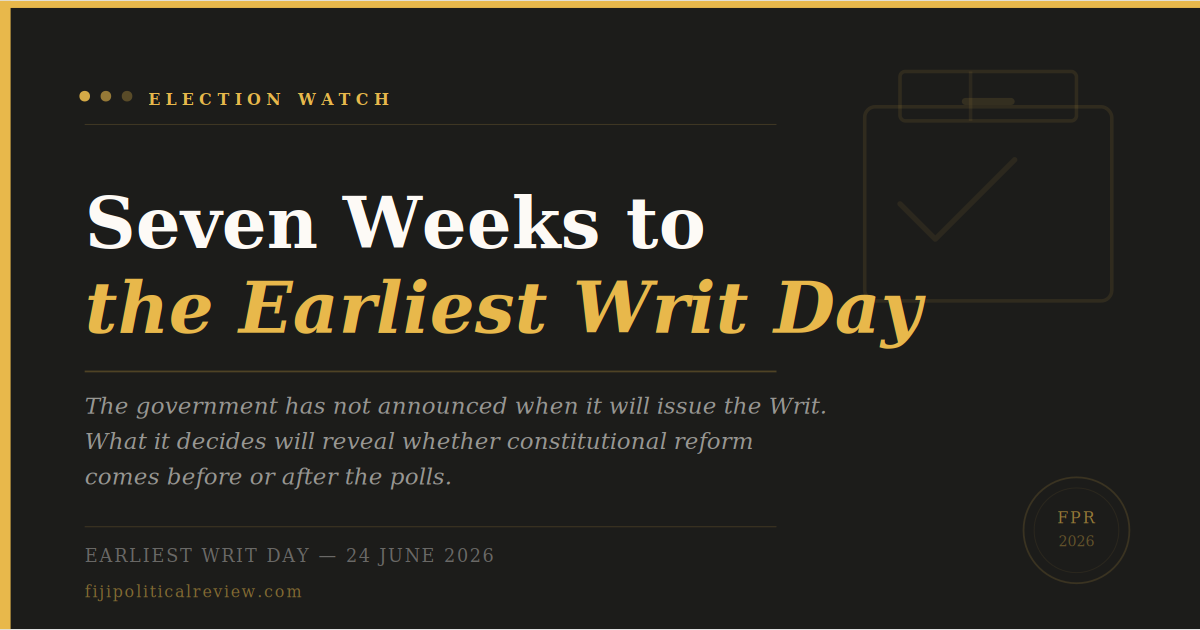
Fiji's 2026 election could be called as early as August — or as late as February 2027. The government has not announced when. What it decides will reveal whether constitutional reform comes before or after the polls.

This is a Fiji Political Review Election Watch Briefing — a short analytical note on a significant electoral development. Election Watch is published when Fiji's path to the 2026 election takes a turn worth examining closely.
The 2026 Election: What Happens and When
Fiji is entering the most compressed political period in its post-2013 history. A constitutional review, a possible referendum, municipal elections, and a general election are all scheduled to occur within the same twelve-month window. This briefing sets out what is coming, when, and what the FPR will be watching.
The Constitutional Election Window
The earliest possible Writ Day — the formal commencement of the election process is 24 June 2026, with the earliest possible polling day set for 7 August 2026. If the Writ is issued at the latest possible date, Christmas Eve 2026, then the last possible election day would be 6 February 2027.
The Writ triggers everything: candidate nominations open, the campaign period begins, and the FEO moves from preparation to execution. The FEO has confirmed it must be election-ready by May 2026 — which is now.
What the Writ Does Not Determine
The government has not announced when it will issue the Writ. That decision rests with the Prime Minister and Cabinet — and the timing will signal whether the government intends to pursue constitutional change before or after going to the polls. Issuing the Writ in June means an August election — before the CRC has reported, before Parliament has debated the recommendations, and before any referendum can be held. Issuing it in December means a February 2027 election — giving more time for constitutional change, but less time for an election campaign.
The government has publicly committed to delivering constitutional change before going to the polls. That commitment and the election timeline are in direct tension.
The CRC Intersection
The Constitutional Review Commission must report by 31 August 2026. If the government issues the Writ in June, the election could be held before the CRC even reports. That outcome, an election fought without a constitutional settlement, would represent a significant failure of the government's stated reform agenda.
The more likely scenario is a Writ issued in the second half of 2026, after the CRC reports and Parliament has at least debated the recommendations. Whether a referendum can also be completed before polling day depends on how quickly Parliament acts on the CRC's report — and whether the National Referendum Bill, currently before Parliament, is passed in time to provide the legal framework.
Municipal Elections
Municipal elections are scheduled for September 2026 — the first local elections in Fiji since 2005. The FEO is managing preparations simultaneously across both the municipal and general election processes. September municipal elections and a general election in the same calendar year place significant logistical demands on the FEO.
The Party Landscape
30 new party names have been reserved with the FEO ahead of the election, and party name reservations remain open until the Writ is issued. If even a fraction of these parties proceed to formal registration, Fiji could face the largest field of parties since the adoption of the 2013 Constitution. The five per cent threshold means most will win no seats — but they will absorb votes that might otherwise go to established parties, and their presence complicates coalition arithmetic.
What the FPR Will Watch
The Election Watch series will track: the Writ Day and what it signals about the government's constitutional intentions; the National Referendum Bill's passage or failure; candidate nominations and party registrations; the FEO's operational readiness; and the conduct of the campaign period once it begins.
The 2026 election will determine who governs Fiji through the most significant constitutional moment since the 2013 Constitution was imposed. It deserves serious, sustained scrutiny.