Ten Months to Five Weeks: The Compressed Public in Fiji's Constitutional Review
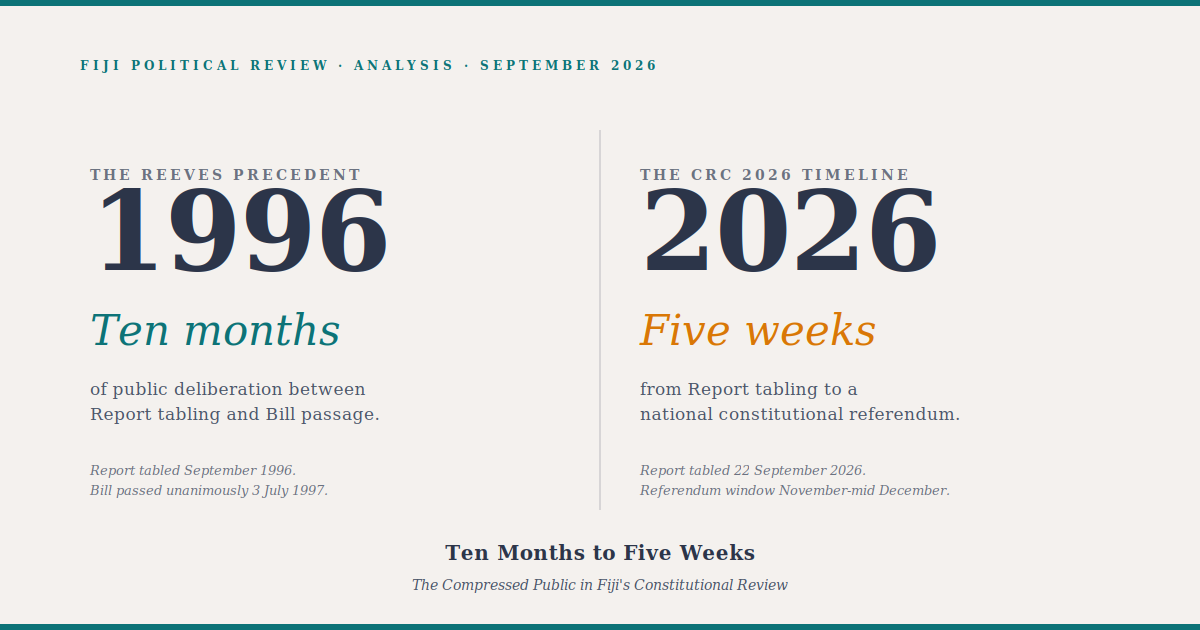
Ten months in 1996. Five weeks in 2026. The CRC Report will be tabled on 22 September. The referendum could be held by mid-December. FPR examines what Fiji's own constitutional practice used to require.

Speaker Filimone Jitoko has confirmed that Parliament will hold a special sitting on Tuesday 22 September 2026 at 11:30am to receive the Constitutional Review Commission's Report and Draft Constitution Bill. The Report has been held confidentially since it was delivered to President Ratu Naiqama Lalabalavu on 31 August. The special sitting will make it public.
That is the confidentiality question resolved, in twenty-three days. The public will have the Report from 23 September, and Parliament's regular sitting begins five days later on 28 September, when debate on the Report is expected to commence.
Five days for parliamentary debate. Five to eleven weeks for referendum consideration. Both are the substantive questions this piece examines.
Under the proposed timeline reported by the Fiji Coalition Government, a national referendum on the Draft Constitution could be held between November and mid-December 2026. If approved, the new Constitution is expected to come into force on 24 December 2026, which is also the opening of the general election window.
That is approximately five weeks from public release of the Draft Constitution to a national referendum on it. Compared to Fiji's own recent constitutional practice, that is a departure that requires justification the Government has not yet provided.
The Reeves comparison
In September 1996, the Constitution Review Commission chaired by Sir Paul Reeves produced The Fiji Islands: Towards a United Future. The Report was tabled in Parliament as Parliamentary Paper No 34 the same month, and became publicly available on tabling. Over the following six months, no less than five Parliamentary sub-committees deliberated on the Report. The Joint Parliamentary Select Committee published its own conclusions in May 1997 as Parliamentary Paper No 17. The Constitution Reform Bill was debated in June. It passed unanimously in the House of Representatives on 3 July 1997.
From tabling to passage: ten months.
The 1996-97 process is Fiji's own most recent constitutional practice. It is not a foreign standard. It is the model Fiji itself set the last time a comprehensive constitutional review was completed and translated into law. Ten months of transparent parliamentary process. Five parliamentary sub-committees. Public submissions to a Joint Select Committee. Unanimous passage.
The 2026 timeline is different in shape and duration.
31 August: Report delivered to the President
22 September: Report tabled in Parliament and made public
28 September: Parliamentary debate begins
November–mid-December: National referendum window
24 December: New Constitution expected to come into force
Between the Report being made public and the referendum being held, the timeline allows approximately five to eleven weeks. Between the Report being made public and parliamentary debate commencing, the timeline allows five days.
Whether Parliament will refer the Report to Select Committees, invite public submissions, hold hearings across Fiji, or replicate the deliberative structure of 1996-97 is not yet known. What is known is that the Government's proposed timeline compresses the entire post-tabling process into less than three months, culminating in a referendum. Reeves took ten months from tabling to a single vote in the House of Representatives. The 2026 process proposes to complete parliamentary debate, referendum, and commencement in a shorter window than Reeves took to complete parliamentary debate alone.
Five weeks is not enough time for civil society organisations to prepare submissions on a Draft Constitution.
It is not enough time for legal practitioners to analyse the Draft Constitution's implications for constitutional rights, chiefly institutions, land governance, electoral administration, or the structure of Parliament.
It is not enough time for iTaukei institutions to consider whether the Draft Constitution addresses the recognition questions the Great Council of Chiefs and provincial councils raised in submissions.
It is not enough time for the diaspora to engage.
It is barely enough time for the media to report on the content, let alone provide serious analysis before a national referendum vote.
Two possibilities
Two possibilities stand open.
The first is that Parliament follows the Reeves model despite the compressed timeline. The Report is tabled on 22 September, referred to Select Committees, opened to public submissions, and deliberated across the November–December window. Public engagement is real, even if compressed compared to 1996-97. Under this reading, the Government's timeline is ambitious but the deliberative substance is preserved.
The second possibility is that the Bill is fast-tracked. Parliamentary debate begins on 28 September, five days after the public first sees the Draft Constitution. The referendum is held between November and mid-December on the basis of that debate. The Commission took five weeks to draft the Draft Constitution, working with three overseas legal experts. The public is given comparable time, without those experts, to decide whether to adopt it.
Which of the two the Government intends is not yet known. The Business Committee's confirmation of the special sitting settles the tabling date. It does not settle the parliamentary process that follows.
The Referendum Bill question
The National Referendum Bill 2025, which would provide the legal framework for any referendum on constitutional change, remains before the Standing Committee on Justice, Law and Human Rights as of the time of writing. Without that Bill in force, the referendum threshold in the 2013 Constitution is procedurally unreachable. A referendum window that opens in November requires the Referendum Bill to be passed with sufficient lead time for the Fijian Elections Office to prepare the vote.
The Government's timeline therefore depends on Parliament passing the Referendum Bill in September or October. That process has not yet been publicly scheduled.
What FPR is watching
- The public release of the Report and Draft Constitution at the special sitting on 22 September
- Whether Parliament refers the Report and Draft Constitution to Select Committees for public hearings, following the 1996-97 Reeves model, or moves directly to debate
- Whether public submissions will be invited on the Draft Constitution, and over what timeline
- When the National Referendum Bill 2025 is passed and brought into force
- The exact date and mechanics of any referendum in the November–mid-December window
- Whether the substantive content of the Draft Constitution addresses the transparency, accountability, and institutional recognition questions raised in the CRC's consultation process
The FPR position
The Government's decision to table the CRC Report on 22 September resolves the confidentiality concern that has hung over the process since delivery. That is a welcome step. The public will have the Report before Parliament debates it, which is the minimum consistent with any serious understanding of democratic process.
What the public will not have is time. The compressed post-tabling timeline reverses the sequence that produced Fiji's 1997 Constitution. That process gave the Report and the public priority; the parliamentary debate followed sustained public engagement. The 2026 process proposes to give the Government's preferred timeline priority; public engagement will fit into whatever window the parliamentary and referendum schedule permits.
The Constitution belongs to the people. President Ratu Naiqama Lalabalavu said as much at State House on 31 August. If it does, the people should have more than five weeks to read it before they are asked to vote on it in a referendum whose legal framework is not yet in force.
References
Documents and instruments
Constitution of the Republic of Fiji 2013 (ss 160, 161 amendment procedure; s 173 immunity).
National Referendum Bill 2025 (Fiji), before Standing Committee on Justice, Law and Human Rights.
Constitutional Review Commission of Fiji, Review Report and Draft Constitution of the Republic of Fiji 2026, delivered to the President 31 August 2026, to be tabled 22 September 2026.
Fiji Electoral Law Reform Commission (Fatiaki Commission), An Electoral System for the People from the People, delivered to Acting Attorney-General 8 July 2025 (not publicly released).
Historical precedent
Constitution Review Commission (Reeves Commission), The Fiji Islands: Towards a United Future, Parliamentary Paper No 34, tabled September 1996.
Joint Parliamentary Select Committee on the Report of the Fiji Constitution Review Commission, Parliamentary Paper No 17, published May 1997.
Constitution Amendment Act 1997 (Fiji).
Comparative practice
Waitangi Tribunal, New Zealand: pre-publication reports released to public on delivery to Ministers (see waitangitribunal.govt.nz).
Public statements
Speaker Filimone Jitoko, statement confirming special parliamentary sitting for September 2026, September 2026.
Fiji Coalition Government, proposed timeline for constitutional referendum and commencement, September 2026.
President Ratu Naiqama Lalabalavu, remarks at State House, 31 August 2026.
Related FPR analysis
Ceremony as Constitution: The Tui Nayau and the Limits of Written Sovereignty, Fiji Political Review, September 2026.
iTaukei Land Legislation and Vanua Consent: The Framework the Constitution Delegates, Fiji Political Review, September 2026.
Fiji Political Review is an independent digital publication covering politics, policy, and governance in Fiji and the Pacific. Read more at fijipoliticalreview.com