Fiji is about to let foreign money into its elections
Fiji's foreign-donor ban is one of the strictest in the Pacific. A bill quietly before Parliament would remove it before the writ.
Fiji's next general election must be held by 6 February 2027. As the campaign approaches, a bill quietly moving through Parliament would lift one of the strictest foreign-donation bans in the Pacific and open the door to unlimited offshore political money, just as Canberra and Wellington have moved to shut theirs. The mechanics are worth walking through, because the government's framing understates what the bill does.
The Political Parties (Registration, Conduct, Funding and Disclosures) (Amendment) Bill 2026, introduced by Acting Attorney-General Siromi Turaga and now before the Standing Committee on Justice, Law and Human Rights (chaired by Ratu Rakuita Vakalalabure), is presented as a tidy-up. Its explanatory note says the bill implements recommendations from Multinational Observer Group reports and aligns with "international best practice". The substance is more consequential than that framing suggests.
Two reforms pulling in opposite directions
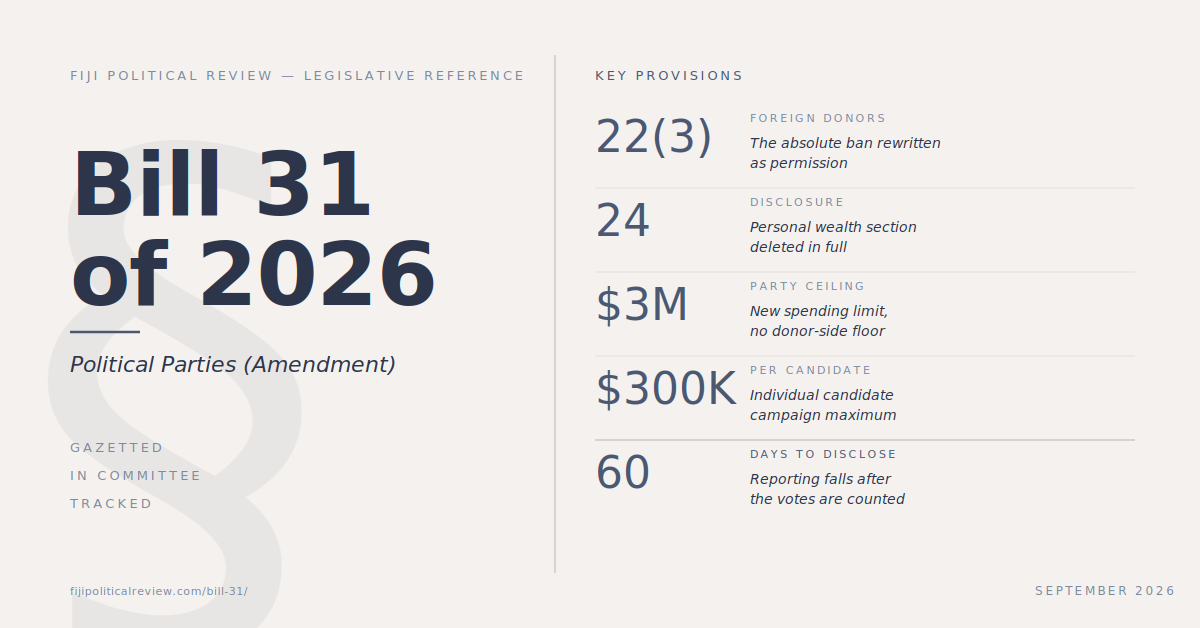
The bill does two things at once. First, it introduces campaign expenditure ceilings for the first time: $3 million per political party and $300,000 per candidate, running from the start of the campaign period until 60 days after polling day. On its face, this is a levelling measure, and the government's explanatory note says as much.
Second, in the same clause set, it deletes the existing $10,000 annual cap on individual political donations and rewrites section 22(3) of the 2013 Act so that the absolute prohibition on donations from non-citizens and former Fijian citizens becomes a permission. Overseas Fijians and non-citizens alike, barred by law from donating a single dollar, would under the amended act be free to donate any amount.
The only backstop is disclosure 60 days after polling day, which is to say, after the votes are counted.
Read together, the two changes undo each other. The expenditure ceiling a party can spend is $3 million. With the donor-side cap gone, a single offshore donor could bankroll that entire permitted spend in one transaction. The ceiling becomes, in effect, the price of a campaign.
The Centre for Democracy and Dialogue made exactly this point to the committee on 7 September. CDD's submission put the example bluntly: "Tomorrow you could have Elon Musk come in and donate $3 million to a political party." With 55 candidates each able to spend $300,000, CDD calculated the total national campaign spend could reach $19.5 million.
The diaspora dimension is not incidental. Fiji has significant overseas populations in Australia, New Zealand, the United States, and Canada, including citizens who took foreign nationality and are currently barred from any political donation at home. The amended act would bring them back into the funding pool. Depending on your reading, that is either a democratising move (Fijians overseas gaining a voice) or a widening of the potential donor base beyond the electorate itself (people with no vote gaining financial influence over those who do).
The bill leaves no donor-side cap in the act at all. Any ceiling on individual contributions, if the bill passes as drafted, exists only as the mirror image of the party's own spending limit. There is no independent floor.
A quieter third change
Clause 9 also deletes the old section 24 in full. That section imposed detailed personal asset, income and liability disclosure on every party applicant, office holder and candidate (plus their spouses and children) annually and at nomination. Replacing it with expenditure ceilings removes comprehensive personal-wealth disclosure from the act at the same moment the donor-side cap disappears. Less restriction on who can give; less disclosure from those who receive.
The bill leaves several restrictions in place. Section 22(1)'s ban on donations from foreign governments, inter-governmental organisations, NGOs and multilateral agencies stays. So do sections 22(7) to (11), which prohibit corporate and body-corporate donations outright. The channel that opens is specifically for non-citizen individual donors.
Against the regional grain
The direction of travel runs opposite to Fiji's closest partners. Australia banned donations of $1,000 or more from foreign sources under the Electoral Legislation Amendment (Electoral Funding and Disclosure Reform) Act 2018, in response to foreign-interference concerns. New Zealand's Electoral Amendment Act 2019 made it an offence under section 207L of the Electoral Act 1993 for an overseas person to donate more than NZ$50 to a party or candidate, explicitly to guard against foreign interference.
CDD told the committee, citing that roughly 70 per cent of countries ban foreign political donations and around 49 per cent cap domestic ones. International IDEA's own published research puts the share of countries imposing a complete ban on foreign donations at 27 per cent, with broader restrictions applying more widely. Either way, Fiji would move from an absolute ban to no donor-side ceiling at all, a wider swing than either Canberra or Wellington has made in the opposite direction.
A legitimacy gap
The government's case rests on two claims: that the bill implements MOG recommendations, and that it reflects international best practice. The 2022 MOG Final Report contains 20 recommendations. Only one addresses campaign finance. Recommendation 11 (Aspirational) urges Fiji to require political parties to report campaign expenditure and to consider setting campaign expenditure limits.
That covers the $3 million and $300,000 ceilings. It covers nothing else in Bill 31.
No MOG recommendation proposes lifting the foreign-donor ban. None proposes removing the $10,000 individual cap. None proposes deleting section 24 disclosure. The report goes further in the other direction: on page 36, it calls Fiji's existing fundraising reporting requirements "robust" and finds they "impart a high degree of transparency" when compared to international practice. The disclosure regime Bill 31 would strip out is the part of Fiji's political-finance framework the MOG endorsed.
Liberalising foreign donations is also difficult to reconcile with international best practice, given the direction of travel in Australia and New Zealand set out above.
That leaves the claim that the bill implements MOG recommendations resting on a single aspirational line about expenditure caps, bolted to a set of changes the MOG did not recommend and, in the case of the disclosure regime, actively praised. The gap between the stated rationale and the substance is the part of this bill most in need of explanation.
Why it matters
In Fiji, money in politics has weight. A small electorate, a competitive coalition, and a constitutional reform process already straining public trust make campaign finance load-bearing.
The bill lands in the same September legislative window as the still-secret Constitutional Review Commission report and the Constitution Amendment and Referendum Bills, both slated for the 28 September to 3 October sitting. It shares its committee with the Fiji Police Bill 2026, which civil-society groups warn would hand police broad surveillance and biometric powers. Relaxing constraints on political money while tightening state surveillance capacity, in the same weeks before an election, is a combination that warrants attention on its own terms.
What to watch
The bill's fate turns on what the Standing Committee reports back to Parliament, and whether the government accepts amendments. Three questions are worth pressing.
First, which specific MOG recommendation, if any, calls for removing the foreign-donor ban? And if none does, what is the actual policy rationale?
Second, what penalties attach to "corrupt electoral practice," the offence category the bill creates by cross-reference to the companion Electoral (Amendment) Bill 2026 (currently before the same committee, and separately subject to civil-society concern over its Clause 26 permitting free voter transport, food and refreshments on polling day)? The answer determines whether the new expenditure ceilings have any enforcement teeth at all.
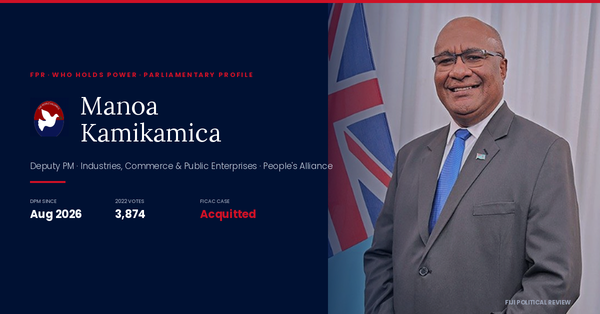
Third, enforcement of the new ceilings falls to whichever body has jurisdiction over corrupt electoral practice offences. If that is FICAC, currently working through the fallout of the Malimali Commission of Inquiry and a Deputy Prime Minister recently acquitted of related charges, the ceilings are only as robust as the commission's capacity and independence at the time they need to bite.
Fiji is about to test a proposition the region has spent a decade moving away from: that foreign money and democratic elections can be safely mixed, provided the disclosure arrives after the fact.
Sources
Primary legislation and official documents
- Political Parties (Registration, Conduct, Funding and Disclosures) (Amendment) Bill 2026 (Bill No. 31 of 2026), full text and Explanatory Note, Parliament of Fiji
- Government of Fiji Gazette Extraordinary, Vol. 27, No. 77, Thursday 20 August 2026 (Gazette Notice listing Bills Nos. 29–31), Parliament of Fiji
- Political Parties (Registration, Conduct, Funding and Disclosures) Act 2013 (Act No. 4 of 2013), Fijian Elections Office
- Fijian Elections Office, Declaration of Assets Form (section 24 of the 2013 Act), definition of "children"
- Multinational Observer Group, 2022 Fiji Election Final Report, March 2023, 92 pp: Summary of Recommendations (pp 6–8), Recommendation 11 (Aspirational) on Campaign Funding and Spending (p 37), fundraising reporting assessment (p 36)
News reporting
- "Foreign money could influence political parties: CDD warns," Fiji Sun, 9 September 2026
- "Fiji Labour Party opposes removal of $10,000 political donation limit," fijivillage, 8 September 2026
- "Fiji election 2026: Candidates may face $300k campaign spending limit," Fiji Sun, 21 August 2026
- Anish Chand, "Bill proposes $3m campaign spending cap for political parties," Fiji Times, 21 August 2026
- "Three constitutional milestones set for September," Fiji Sun, 10 September 2026
- "FCOSS warns proposed police surveillance powers could be misused," Fiji Sun, 9 September 2026
- Inoke Rabonu, "PM denies lobbying GCC to delay General Election," Fiji Sun, 11 September 2026
- "Fiji PM says next election due between 24 December and early February 2027," PINA, 26 June 2026
Comparative and international sources
- Parliament of Australia, Parliamentary Library Briefing Book (46th Parliament): "In late 2018 the Parliament passed legislation to ban political donations of $1,000 or more from foreign sources"
- Electoral Legislation Amendment (Electoral Funding and Disclosure Reform) Act 2018 (Cth), Commonwealth Electoral Act 1918 (Cth) as amended
- Electoral Legislation Amendment (Electoral Reform) Act 2024 (Cth), further spending caps and disclosure changes
- New Zealand Department of Internal Affairs, "AML-CFT Election financing laws" (section 207L of the Electoral Act 1993, as amended by the Electoral Amendment Act 2019, $50 threshold)
- International IDEA, Political Finance Database, Fiji country profile
- International IDEA, Political Finance Database, Australia country profile
- USP academic analysis: "Fiji's Political Parties Law: Analysis of the 2013-2014 Decrees" (confirming section 24 disclosure scope covers spouse and dependent children)