Sashi Kiran
From founding FRIEND Fiji in 2001 to running the Ministry of Women, Children and Social Protection. A profile of Sashi Kiran, one of five women in Parliament.


National Federation Party · Parliament of Fiji
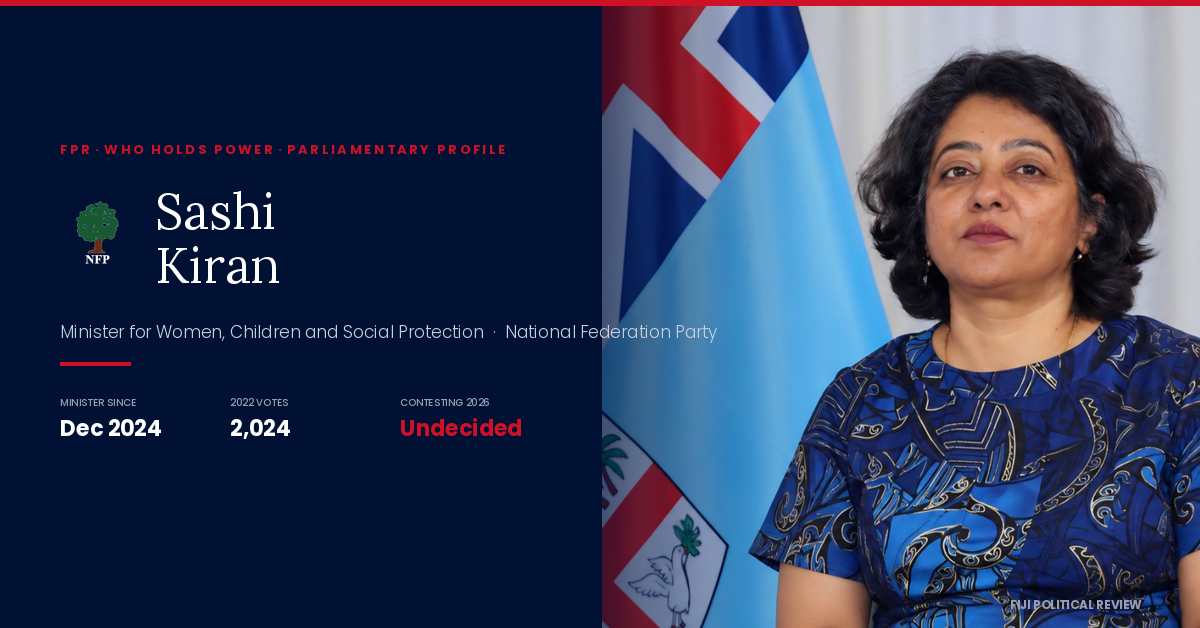
Sashi Kiran is a Fijian politician, social entrepreneur and community-development leader currently serving as Minister for Women, Children and Social Protection. She is a first-term MP representing the National Federation Party and one of only five women in the current 55-seat Parliament.
She founded the Foundation for Rural Integrated Enterprises and Development (FRIEND Fiji) in December 2001 at the age of 28, in the aftermath of the 2000 political crisis, and led it as CEO for 21 years before resigning to contest the 2022 general election. She was appointed to Fiji's Human Rights and Anti-Discrimination Commission in 2015 and has served on the Commonwealth Elections Observer Team for the 2017 Papua New Guinea general election.
Kiran spent more than two decades in grassroots development before entering politics. FRIEND Fiji, the organisation she founded and led, works across Fiji's Western, Northern and Central divisions supporting rural and underserved communities through programmes focused on sustainable livelihoods, community development and health. It is best known publicly for its long-selling line of supermarket chutneys, made by women in rural communities from raw ingredients bought from smallholder farmers.
Before FRIEND, Kiran worked as a journalist for Fiji Communications. She was recognised in October 2017 as one of the Secretariat of the Pacific Community's 70 Inspiring Pacific Women. She chaired the Pacific Organic Ethical Trade Community and has served as a consultant to regional and international development organisations.
In November 2022, Kiran resigned from FRIEND to contest the 2022 general election as an NFP candidate. Writing in the Fiji Times at the time of her decision, she said: "I believe that NFP and its leaders – Biman Prasad, Pio Tikoduadua and Lenora Qereqeretabua and others in its leadership – are people I can work with to achieve my ambitions for Fiji and its people."
She was elected to Parliament on 14 December 2022, polling 2,024 votes (FEO Official Results). On 24 December 2022 she was sworn in as Assistant Minister for Women, Children and Poverty Alleviation in the coalition government, serving under Minister Lynda Tabuya.
On 26 December 2024, Prime Minister Rabuka dismissed Tabuya from Cabinet. Kiran was sworn in as Minister for Women, Children and Social Protection the following day, 27 December 2024, by President Ratu Naiqama Lalabalavu at State House.
| Party | National Federation Party |
| Electoral basis | NFP list MP. 2,024 personal votes in 2022. |
| In Parliament since | 14 December 2022 |
| Current role | Minister for Women, Children and Social Protection (27 December 2024 to present) |
| Previous role | Assistant Minister for Women, Children and Poverty Alleviation (24 December 2022 to 26 December 2024) |
| Career background | Founder and CEO, Foundation for Rural Integrated Enterprises and Development (FRIEND Fiji), 2001 to 2022; Chair, Pacific Organic Ethical Trade Community; Fiji Human Rights and Anti-Discrimination Commission (2015); Commonwealth Elections Observer, PNG 2017; journalist, Fiji Communications |
| Portfolio focus | Gender equality, women's political representation, prevention of technology-facilitated gender-based violence, child protection, social welfare, rural livelihoods |
The Ministry of Women, Children and Social Protection is responsible for policy and service delivery across gender equality, social welfare payments, child protection, family services, and prevention of and response to violence against women and children. Kiran's portfolio also involves coordination with the Commonwealth Women Parliamentarians Fiji Group, which she chairs, and with international partners including UN Women, UNFPA and the Commonwealth Foundation.
Since taking up the ministerial role, Kiran has focused public advocacy on three connected priorities: increasing women's representation in Parliament, addressing online abuse and technology-facilitated gender-based violence against women in public life, and health issues facing women that she says are under-discussed, including postpartum depression, menopause, endometriosis and sexually transmitted infections.
At the Parliament Speaker's Debate in July 2026, she noted that Fiji ranks 165th out of 181 countries for women's representation in Parliament, below both the global average of 27 per cent and the Pacific average of 11.6 per cent. Only 49 women have been elected to the Fijian Parliament in 60 years of democratic elections, and only 31 completed a full four-year term.
In September 2026, her ministry supported a Women's Political Participation workshop in Suva focused on Confronting Technology-Facilitated Gender-Based Violence, and is supporting a technology initiative to help women candidates deal with online abuse, filter toxic content, block bots, and record evidence of coordinated attacks and threats.
Kiran has been publicly weighing whether to contest the 2026 general election, and if so, under which party. On 27 September 2026, NFP leader Biman Prasad told journalists at the NFP National Convention that Kiran had "indicated she will seek re-election" while fellow NFP MPs Pio Tikoduadua and Lenora Qereqeretabua remained undecided or, in Qereqeretabua's case, unlikely to contest.
Three days earlier, in a 24 September 2026 interview with the Fiji Sun, Kiran gave a more qualified account. She said she was reconsidering an earlier decision to step away from frontline politics after being encouraged by numerous organisations and individuals to contest again. "I have not decided what I am going to do right now," she said. Asked which political party she intended to contest under, Ms Kiran remained non-committal.
The two statements are not incompatible — Prasad's characterisation is stronger than her own — but the party-affiliation ambiguity is notable. Kiran has been one of the most publicly visible ministers in Government and one of NFP's most prominent portfolio holders.
Kiran's own most recent public statement (24 September 2026) is that no final decision has been made and that she has not committed to a party for the 2026 election. FPR will update this profile as her position is confirmed.
Kiran's own confirmation is the immediate item. Whether she stands, and under which party, is a question with weight both for NFP's 2026 line-up and for the balance of women candidates across the field. Fiji is entering the campaign with five women in a 55-seat Parliament; the loss or repositioning of any of the sitting five is a material change to the composition of the next Parliament, even before votes are counted.
Her portfolio priorities give her a natural set of campaign themes independent of party affiliation. Gender-based violence, women's political participation, and the visibility of women's health issues have all been part of her ministerial record and would translate straightforwardly into a re-election platform. Her long history at FRIEND gives her policy authority in rural livelihoods and community development that few sitting MPs match.
The party question is the more consequential one. If Kiran stands under NFP, she strengthens the party's bench at a moment when Qereqeretabua is stepping back and Tikoduadua is undecided. If she stands under a different banner, or as an independent, the political signal about NFP's ability to hold its high-profile women is significant.
⚠ FPR welcomes corrections: editor@fijipoliticalreview.com