Election Watch: Part 4 of 5
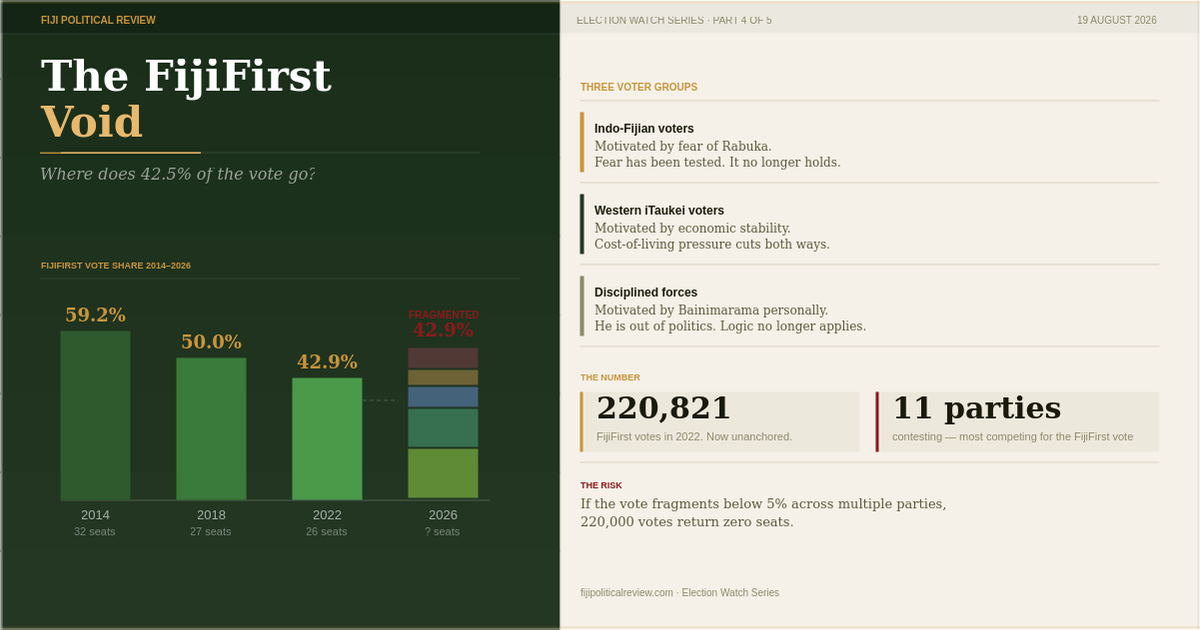
FijiFirst won 59.2% in 2014, 50% in 2018, 42.9% in 2022. Then it was deregistered. The 220,821 votes it carried into 2022 are now unanchored, and at least seven parties are competing to absorb them across three distinct voter groups. Where that vote lands shapes the next Parliament.

The FijiFirst Void: Where Does 42.5% of the Vote Go?
In the 2014 general election, FijiFirst won 59.2% of the vote; by 2018 that had fallen to 50.02%, and in 2022 it won 42.9%, translating to 220,821 votes and 26 seats. Then it was deregistered, its leader was convicted and imprisoned, and its general secretary withdrew from public life.
That trajectory, from 59% to 50% to 43% and then to nothing, is the defining electoral fact of the 2026 campaign. FijiFirst didn't collapse suddenly. It eroded across three elections as its coalition of Indo-Fijian voters, western iTaukei voters, and disciplined forces personnel slowly frayed. By the time the party was formally dissolved, the question wasn't whether it had already lost a portion of its base. It was how much was left, and who picks it up.
The answer to that question determines whether the Rabuka coalition wins a second term, whether People First becomes a credible government-in-waiting, and whether the 2026 election produces the hung parliament that 2022 did, or something cleaner. The FEO reports that more than 16,000 Fijians accessed voter registration and awareness services since the YES Outreach exercise began on 4 May 2026, suggesting the operational infrastructure for a higher-turnout election is being built.
What FijiFirst actually was
FijiFirst's electoral coalition was built on three distinct voter groups, and understanding the 2026 realignment requires understanding each separately.
The first and largest was Indo-Fijian voters. FijiFirst captured the dominant share of the Indo-Fijian vote across all three elections under the 2013 Constitution. The mechanism was fear, deployed systematically. FijiFirst told Indo-Fijian voters that Rabuka's past coups, SODELPA's emphasis on iTaukei paramountcy, and the opposition's general character represented an existential threat to Indo-Fijian security and livelihoods. In a community with direct historical memory of the 1987 coups and the ethnic violence that accompanied them, that argument had purchase. FijiFirst also delivered tangible goods: free bus fares, free school fees, the TELS tertiary loan scheme, and a guaranteed sugar cane price. Transactional politics worked because the transactions were real.
The second group was iTaukei voters in the western division, particularly those connected to the tourism sector. These voters were less motivated by identity politics than by economic stability. Bainimarama had governed through Fiji's post-GFC recovery and the COVID-19 period. Western iTaukei voters who depended on resort employment, hospitality supply chains, and tourism-adjacent businesses had a material interest in the government that had managed that economy staying in office.
The third group was personnel from Fiji's disciplined forces. Voting booth records from the 2022 election from military camps and prison facilities showed FijiFirst support despite those institutions being overwhelmingly iTaukei in composition. The military connection to Bainimarama was personal, institutional, and in some cases hierarchical.
None of these three groups voted as a monolith. But each had a distinct reason to support FijiFirst that was separable from the others. That matters in 2026 because each group is now weighing a different set of choices.
The Indo-Fijian calculation
The Indo-Fijian vote is the largest single block of the FijiFirst inheritance, and the hardest for any single party to capture.
FijiFirst's primary tool for holding Indo-Fijian voters was fear of Rabuka. That tool is now blunted. Rabuka has been Prime Minister for three and a half years. He has not conducted a coup. The sky has not fallen on Indo-Fijian communities. FijiFirst's warnings about what a Rabuka government would mean have not been validated by events. The fear argument is available to People First and Seruiratu as a historical reference, but it no longer has the immediacy it carried when Rabuka was an opposition figure rather than a sitting PM with a governance record.
What replaces fear as the organising principle for the Indo-Fijian vote is less clear. One analysis suggested the community has in the past "shifted en masse" around single issues or leaders, citing the FLP sweep of 1999 and the FijiFirst consolidation of 2014. In 2026, no single leader commands that kind of gravitational pull among Indo-Fijian voters.
NFP is the natural home for a portion of this vote. It has governed with reasonable ministerial competence, held the Finance portfolio under Prasad until his resignation, and presents as a multiracial rather than ethnically specific party. Prasad's FICAC charge complicates his personal position but has not yet demonstrably damaged the party's standing. As of mid-August 2026, that assessment remains intact. NFP is contesting alone in 2026, which means it is actively soliciting this vote without the Rabuka association that constrained it in 2022.
People First is also competing for Indo-Fijian voters directly. Seruiratu told RNZ his party is pro-multiculturalism and pro-secularism, and has committed to fielding at least 50% women candidates. The party is explicitly targeting the western division, where FijiFirst's Indo-Fijian and western iTaukei support was concentrated. As of the party's official launch at Korovuto College, Nadi in late June 2026, the manifesto is still being developed through nationwide consultations. Seruiratu says the party is built on five core values: respect, service before self, integrity, national unity, and sustainable progress. On 4 August 2026, People First began telegraphing its economic narrative, issuing a warning on national debt as it outlined its consultation-driven manifesto plan. That framing, debt sustainability as a central pitch, is calibrated to appeal to the western iTaukei and Indo-Fijian business voters who worried about fiscal management under FijiFirst. The manifesto's full content, when finalised, will determine whether the pitch holds up under scrutiny.
The Indo-Fijian vote is likely to distribute across NFP, People First, and potentially the governing coalition in 2026, rather than consolidating under any single party. That distribution is the dominant uncertainty in the 2026 count.
The western iTaukei question
The western division iTaukei vote is the most moveable of the three FijiFirst constituencies, and the most contested.
These voters supported FijiFirst not primarily out of ideology but out of economic interest. The Rabuka coalition came to power promising cost-of-living relief, curbing government wastage, and greater media freedom. It has delivered media freedom relatively cleanly, through the repeal of the Media Industry Development Act. On cost of living, the record is more mixed. The pressures that Rabuka cited as justification for deferring the municipal elections, global economic headwinds, fuel costs, EFL power rationing warnings, are the same pressures that western tourism-sector workers are living with.
People's Alliance will argue it has managed a difficult global economic environment competently. People First will argue the coalition promised relief it hasn't delivered. Unity Fiji, which is campaigning actively in Vanua Levu, is pitching directly on economic transformation and regional equity.
The western division iTaukei voter who supported FijiFirst in 2022 has multiple options in 2026 and no obvious default. That ambiguity favours a fragmented outcome in this cohort rather than a consolidated switch.
The disciplined forces bloc
The military and prison vote for FijiFirst in 2022 was counterintuitive. These institutions are majority iTaukei, but they backed a party whose 2013 Constitution critics argued diminished iTaukei rights. The explanation is institutional: Bainimarama commanded the RFMF before he led the government, and his personal networks within the military sustained that loyalty into his electoral career.
Bainimarama is out of politics. The institutional logic no longer applies. Seruiratu, a former military man himself, may have some capacity to appeal to this cohort, but he is not Bainimarama and the connection is not the same. The police, which voted differently from the military in 2022, remains a separate calculation.
This is probably the least predictable of the three FijiFirst voter groups in 2026, and also one of the least discussed. It is worth watching.
The absorption competition
At least seven parties are competing to absorb the FijiFirst inheritance, and they are not doing so cooperatively. People First, NFP, People's Alliance, and Unity Fiji are the four with the clearest pitch to specific FijiFirst voter groups. But One Nation, led by Ravindran Kumaran and built partly from former FijiFirst figures, is also targeting that base directly. NGAP (NeXTGEN Alliance Party), registered 26 June 2026, is pitching to younger voters who crossed to FijiFirst in 2018 and 2022. The Fiji Labour Party, historically the Indo-Fijian party before FijiFirst consolidated that vote in 2014, is also contesting. Each additional party in the field is another potential vote-sink below the 5% threshold.
People First is the primary vehicle. Seruiratu holds the Opposition Leader position and carries the formal institutional continuity of the FijiFirst parliamentary group, minus the nine G9 MPs who crossed to join the coalition, six of whom now sit on the government benches with three sworn into Cabinet. Rabuka has built a 40-member government side in the 55-member parliament. That leaves the formal opposition with at most 15 seats, a materially weaker position than the 2022 result suggests. His explicit pitch is FijiFirst's record without FijiFirst's scandals. The problem is that the record and the scandals are not easily separated. Bainimarama's governance was personal and centralised. The record belongs to him as much as to the party, and he is unavailable.
NFP is competing for the Indo-Fijian portion of the inheritance without claiming the FijiFirst brand. Its pitch to former FijiFirst voters is: you supported FijiFirst partly because you feared Rabuka. That fear has been tested and found to be overstated. NFP is now a party of government with a credible track record and no coup history. Consider us.
People's Alliance is competing for the western iTaukei portion. Its argument is incumbency: it is the government, it has governed stably, and a vote for a fragmented opposition is a vote for instability.
Unity Fiji is competing for economically motivated voters across communities. In February 2026, the party severed its MOU with the Fiji Labour Party and announced it will contest the 2026 election independently. Narube explicitly accused the coalition of reneging on its promise to restore municipal elections, giving Unity Fiji a specific grievance to campaign on. Unity Fiji is not part of any broader opposition front. It is pitching purely on its own economic-management brand. Narube's pitch on economic management is substantive, but his 2022 result demonstrated that substance does not automatically translate to the 5% threshold.
The risk, as noted in Part 3, is that this competition splits the FijiFirst inheritance into fragments that fall below the threshold individually, returning zero seats collectively. A 2022 result where FijiFirst's 220,000 votes become 80,000 for People First, 70,000 for NFP gains, 40,000 for Unity Fiji, and 30,000 scattered across sub-threshold parties would dramatically reshape the parliamentary arithmetic without necessarily producing an opposition that can challenge the coalition.
What the coalition needs from this
The governing coalition's optimal 2026 scenario is precisely the fragmentation described above.
PA needs People First to fall short of its potential. If Seruiratu consolidates the FijiFirst vote efficiently, People First could win 20 or more seats and become a credible alternative government. If the vote disperses, it wins 12 or 14 seats and remains a minority opposition even in combination with NFP and Unity Fiji.
The coalition also needs the fear argument to stay dead. Three and a half years of Rabuka governance have not produced the security crisis FijiFirst warned about. The election is now formally underway. The FEO issued the writ on 9 August 2026. Candidate nominations commenced on 11 August. The legal window remains 7 August 2026 to 6 February 2027. The coalition is now campaigning on its record rather than anticipating the election. Every day that passes without that crisis is a day the fear argument loses more of its residual force among Indo-Fijian voters. A Rabuka government seeking a second term is a qualitatively different electoral proposition from a Rabuka opposition seeking a first term. The coalition is betting that its record is good enough to hold, and that the opposition field is fractured enough to make that hold count.
What to watch
People First has released two batches of provisional candidates. The first 15 were announced at the Nadi launch in late June, including former Minister for Lands Ashneel Sudhakar, Drug-Free Fiji founder Kalesi Toga, and Hazrat Ali. A second batch followed on 2 August, adding Sitiveni Weleilakeba, Arisi Tabuasei, Ashley Amrita Singh, Luisa Vusonimasei, and Mohammed Saiyaz Khan. On 18 August, the party confirmed its commitment to field at least 50% women candidates, with women representation being actively implemented. The full 55-candidate slate is still to come. The progression from 15 to a second batch signals consolidation is proceeding, not stalling. Watch the final list: the presence of senior FijiFirst figures and high-vote 2022 candidates will be the definitive test.
Watch the western division voter research. The concentration of FijiFirst's 2022 vote in the west means that what happens in that region's communities will disproportionately shape the national result. Any polling, party event, or reported voter sentiment from Nadi, Lautoka, or the Ba corridor should be read carefully.
Watch People First's manifesto release. A party targeting the FijiFirst voter base needs to offer a credible policy account of what it will deliver that FijiFirst promised and the coalition has not. Without a manifesto, it is asking voters to trust the brand without reading the label.
And watch whether the fear argument is revived. Seruiratu has distanced himself from Bainimarama and rebranded. But the temptation to remind Indo-Fijian voters of Rabuka's 1987 history will exist in the campaign, particularly if People First is struggling to consolidate. If that argument returns, it tells you something about where Seruiratu thinks his numbers are.
Part 5 of this series examines electoral reform and the 2026 ballot: what the CRC and the suppressed ELRC report mean for how this election is fought, and what changes and what can't before polling day.
Sources: RNZ Pacific; Fiji Village; FBC News; Fiji Sun; Devpolicy; Asia Pacific Report; USIP; CIVICUS; Kaniva Tonga News.
All factual claims are sourced. Analysis and scenario assessments are editorial interpretation of verified facts, clearly identified as such.